Halftone graphics
Halftone is the reprographic technique that simulates continuous-tone imagery through the use of dots, varying either in size or in spacing, thus generating a gradient-like effect.[1] "Halftone" can also be used to refer specifically to the image that is produced by this process.[1]
Where continuous-tone imagery contains an infinite range of colors or greys, the halftone process reduces visual reproductions to an image that is printed with only one color of ink, in dots of differing size (pulse-width modulation) or spacing (frequency modulation) or both. This reproduction relies on a basic optical illusion: when the halftone dots are small, the human eye interprets the patterned areas as if they were smooth tones. At a microscopic level, developed black-and-white photographic film also consists of only two colors, and not an infinite range of continuous tones. For details, see film grain.
Just as color photography evolved with the addition of filters and film layers, color printing is made possible by repeating the halftone process for each subtractive color – most commonly using what is called the "CMYK color model".[2] The semi-opaque property of ink allows halftone dots of different colors to create another optical effect: full-color imagery.[1] Since the location of the individual dots cannot be determined exactly, the dots partially overlap leading to a combination of additive and subtractive color mixing called Autotypical Color Mixing.
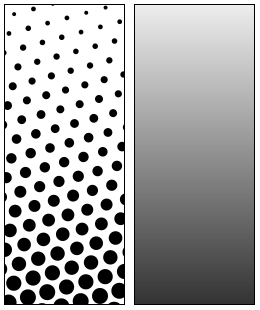
Left: Halftone dots. Right: Example of how the human eye would see the dots from a sufficient distance.
History
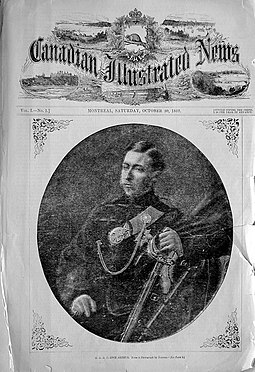
 The first printed photo using a halftone in a Canadian periodical, October 30, 1869. Prince Arthur, who would be the last surviving child of Queen Victoria, reportedly her favorite..
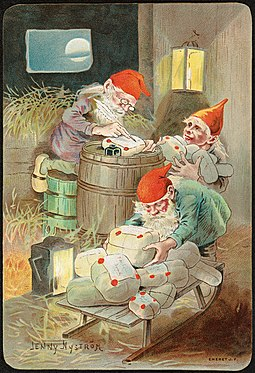
A multicolor postcard (1899) printed from hand-made halftone plates.
While there were earlier mechanical printing processes that could imitate the tone and subtle details of a photograph, most notably the Woodburytype, expense and practicality prohibited their being used in mass commercial printing that used relief printing.
Previously most newspaper pictures were woodcuts or wood-engravings made from hand-carved blocks of wood that, while they were often copied from photographs, resembled hand drawn sketches. Commercial printers wanted a practical way to realistically reproduce photographs onto the printed page, but most common mechanical printing processes can only print areas of ink or leave blank areas on the paper and not a photographic range of tones; only black (or coloured) ink, or nothing. The half-tone process overcame these limitations and became the staple of the book, newspaper and other periodical industry.[3]
William Fox Talbot is credited with the idea of halftone printing. In an 1852 patent he suggested using "photographic screens or veils" in connection with a photographic intaglio process.[4][5]
Several different kinds of screens were proposed during the following decades. One of the first attempts was by William Leggo with his leggotype while working for the Canadian Illustrated News.
The first printed halftone photograph was an image of Prince Arthur published on October 30, 1869.[6] The New York Daily Graphic would later publish "the first reproduction of a photograph with a full tonal range in a newspaper" on March 4, 1880 (entitled "A Scene in Shantytown") with a crude halftone screen.[7]
The first truly successful commercial method was patented by Frederic Ives of Philadelphia in 1881.[5][7] Although he found a way of breaking up the image into dots of varying sizes, he did not make use of a screen. In 1882, the German Georg Meisenbach [de] patented a halftone process in Germany which he named autotype.[8] His invention was based on the previous ideas of Berchtold and Swan. He used single lined screens which were turned during exposure to produce cross-lined effects. He was the first to achieve any commercial success with relief halftones.[5]
Shortly afterwards, Ives, this time in collaboration with Louis and Max Levy, improved the process further with the invention and commercial production of quality cross-lined screens.[5]
The relief halftone process proved almost immediately to be a success. The use of halftone blocks in popular journals became regular during the early 1890s.[5]
The development of halftone printing methods for lithography appears to have followed a largely independent path. In the 1860s, A. Hoen & Co. focused on methods allowing artists to manipulate the tones of hand-worked printing stones.[9] By the 1880s, Hoen was working on halftone methods that could be used in conjunction with either hand-worked or photolithographic stones.[10][11]
Halftone photographic screening
Prior to digitised images, special photographic techniques were developed to break grayscale images down into discrete points. The earliest of these was "screening" where a coarse-woven fabric screen was suspended before the camera plate to be exposed, breaking the incoming light into a pattern of dots via a combination of interruption and diffraction effects. The photographic plate could then be developed using photo-etching techniques to create a printing plate.
Other techniques used a "screen" consisting of parallel bars (a Ronchi ruling), which was then combined with a second exposure with the same screen orientated at another angle. Another method was to expose through a screen-plate with crossing lines etched into the surface. Later, either photographic contact screens were used, or sometimes no screen at all, exposing directly on a lithographic (extremely high contrast) film with a pre-exposed halftone pattern.
...
Extra Connections:
Prince Arthur
Duke of Connaught and Strathearn (Arthur William Patrick Albert; 1 May 1850 – 16 January 1942), was the seventh child and third son of Queen Victoria of the United Kingdom and Prince Albert of Saxe-Coburg and Gotha. He served as Governor General of Canada, the tenth since Canadian Confederation and the only British prince to do so....
In Canada, Arthur, as an officer with the Montreal detachment of the Rifle Brigade,[3] undertook a year's training and engaged in defending the Dominion from the Fenian Raids; there was initially concern that his personal involvement in Canada's defence might put the Prince in danger from Fenians and their supporters in the United States, but it was decided his military duty came first.[3] Following his arrival at Halifax, Arthur toured the country for eight weeks and made a visit in January 1870 to Washington, D.C., where he met with President Ulysses S. Grant....on 25 May 1870 he was engaged in fending off Fenian invaders during the Battle of Eccles Hill, for which he received the Fenian Medal...On their way to India, the couple passed through Egypt where the Duke opened the (lower) Assuan dam on 10 December 1902...As president of the Boy Scouts Association and one of Lord Baden-Powell's friends and admirers, he performed the official opening of the 3rd World Scout Jamboree at Arrowe Park.