Vermeer
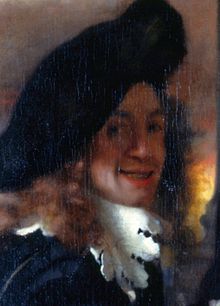
Nickname/Alias: also known as Johannes Vermeer, and Jan van der Meer van Delft
Achievements: Among the greatest painted interiors done by Old Masters.
Born: October 31, 1632; Delft, Netherlands
Died: December 15, 1675; Delft, Netherlands (Aged 43)
Field & Discipline: Art; Painter
Language: English
Education: Unknown
Major Work: “Allegory of Painting” (c. 1665)
Life & Times:
His mother, Digna Baltens (c. 1596–1670)[22][c] was from Antwerp.[20] Digna's father, Balthasar Geerts, or Gerrits, (born in Antwerp in or around 1573) led an enterprising life in metalworking, and was arrested for counterfeiting.[24][20] Vermeer's father, named Reijnier Janszoon, was a middle-class worker of silk or caffa (a mixture of silk and cotton or wool).[d] He was the son of Jan Reyersz and Cornelia (Neeltge) Goris.[e] As an apprentice in Amsterdam, Reijnier lived on fashionable Sint Antoniesbreestraat, a street with many resident painters at the time. In 1615, Reijnier married Digna...In 1625, Reijnier was involved in a fight with a soldier named Willem van Bylandt who died from his wounds five months later.[26] Around this time, Reijnier began dealing in paintings. In 1631, he leased an inn, which he called "The Flying Fox". In 1635, he lived on Voldersgracht 25 or 26. In 1641, he bought a larger inn on the market square, named after the Flemish town "Mechelen". The acquisition of the inn constituted a considerable financial burden.[27] When Reijnier died in October 1652, Vermeer took over the operation of the family's art business.
Relatively little is known of Vermeer's early life, but it is assumed that he began his artistic training sometime in the mid-1640s. On 29 December 1653, Vermeer became a member (like his father before him) of the Guild of Saint Luke, a trade association for painters , which granted him the right to sell his work in Delft, take on pupils, and to work as an art dealer. The guild's records make clear that Vermeer did not pay the usual admission fee. It was a year of plague, war, and economic crisis; Vermeer was not alone in experiencing difficult financial circumstances. In 1654, the city suffered the terrible explosion known as the Delft Thunderclap, which destroyed a large section of the city.[37]
Vermeer's artistic career is divided into three periods. The early period (c.1655-57) was devoted to experimentation in techniques and subject matter, his very earliest works being history paintings, such as 'Christ in the House of Mary and Martha' (c.1655) and 'Diana and her Companions' (c.1655).
Most of the paintings of the middle (c.1657-67) and late period (1667-75) are genre paintings - i.e. scenes of everyday life - reflecting the prosperous, cultured atmosphere of Dutch homes in a period when the Netherlands was at the height of its power. His subjects were chiefly women engaged in tranquil activities: a maid pouring milk ('The Kitchen-maid'), or ladies reading, trying on pearls, doing lacework, playing music or receiving cavaliers, shown against a lavish backdrop of fine carpets, musical instruments, embroidered dresses and robes, ermine and silk, pearls, and silver cutlery.
During the middle period, in his next five paintings:- 'Girl Asleep at a Table', 'Soldier with a Laughing Girl', 'Girl Reading a Letter at an Open Window', 'The Milkmaid' and the 'Glass of Wine' (all probably painted between 1657 and 1661) Vermeer reduced the size of the figures in relation to the overall space, his application of paint became thicker, and he also paid greater attention to realism and the naturalistic effects of light within his interiors.
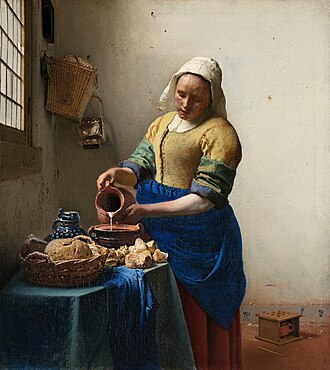
In 'The Milkmaid', for example, Vermeer used an optical device to view his subject, to which he then applied his famous 'pointilles' (small dots of paint used to give the effect of broken contours and dissolved forms in light), which give the objects such as chunks of bread an extraordinary tactile reality.
Vermeer's two surviving townscape paintings followed: 'Little Street' (c. 1658-60) and the famous 'View of Delft' (c.1661), with its collapsed perspective and focal distortions created with the aid of a [used] camera obscura*, suggested to him by [a pal of] Christiaan Huyghens*
By the early 1660s he’d gained artistic recognition, and his colleagues elected him headman of the Guild of St. Luke from 1662 to 1664, the youngest artist to be chosen for the post since the guild had been reorganized in 1611. Vermeer continued to modify and refine his style throughout the 1660s, most notably in 'Woman with Two Men' and the 'pearl pictures,' a group of paintings of women, dated 1662 and 1665, that share a common motif of pearls and a luminous, silvery tonality, and which includes 'Woman with a Water Jug', 'Woman Reading a Letter', Woman with a Pearl Necklace', 'Woman Holding a Balance,' and his famous 'Head of a Girl with a Pearl Earring'.
During this middle period Vermeer also produced two paintings with deep spatial recessions and almost mathematically calculated compositions:- 'the 'Music Lesson' and 'The Concert', both probably 1665-66. His masterpiece from this period is the 'Allegory of Painting' (c.1666-67), in which he harmoniously integrated a variety of exquisitely painted figures and objects within a carefully constructed, light-suffused room.
The paintings of his last years (c.1667-75), such as the 'Love Letter', 'Lady Writing a Letter with her Maid', the 'Allegory of Faith', and the 'Guitar Player', are characterized by geometric purity, the abstraction of forms and linear precision. In 1670 to 1672 Vermeer again served as chairman of the artists' guild, and by 1672 he was clearly recognized as an expert in Italian art: in May of that year he was summoned to The Hague to appraise a collection of 12 Italian paintings for their prospective buyer, Frederick William, the Grand Elector of Brandenburg.
However, it appears that despite this reputation, Vermeer's art sales were hampered by his slow and painstaking method of working, which meant that he produced only a small number of pictures, and that he had to rely principally on his activities as an art dealer to support his family.
During his last years, Vermeer and his family suffered great financial hardship, mainly as a result of the economic crisis that engulfed the Netherlands in the wake of the French invasion of 1672. Vermeer died in Delft in 1675, at the age of 43, leaving a widow and eleven children, eight of which were still minors. In 1677 his widow, Catharina Vermeer, left bankrupt and with large debts, testified that during the war with France Vermeer could sell none of his paintings nor those by other masters, and when he died his baker held two pictures for outstanding bills.
Catharina’s situation was improved by the intervention of the microscopist [a pal of] Leeuwenhoek* (possibly the sitter for one or both of Vermeer's only two exclusively male portraits, 'The Astronomer' and 'The Geographer', c.1668-69), who served as a trustee for the family from 1676 to 1682, and who in May 1677 organized a large sale of Vermeer's paintings a part of the proceeds of which went to his widow.
Assessment: A Dutch master.
Oneliner: Jan Vermeer, one of the greatest Dutch Old masters
Extra Connections:
Vermeer's painting techniques have long been a source of debate, given their almost photorealistic attention to detail, despite Vermeer's having had no formal training, and despite only limited evidence that Vermeer had created any preparatory sketches or traces for his paintings.[62] see Multimedia below.
In 2001, British artist David Hockney published the book Secret Knowledge: Rediscovering the Lost Techniques of the Old Masters, in which he argued that Vermeer (among other Renaissance and Baroque artists including Hans Holbein and Diego Velázquez) used optics to achieve precise positioning in their compositions, and specifically some combination of curved mirrors, camera obscura, and camera lucida. This became known as the Hockney–Falco thesis, named after Hockney and Charles M. Falco, another proponent of the theory.
In the 20th century, Vermeer's admirers included Salvador Dalí, who painted his own version of The Lacemaker (on commission from collector Robert Lehman) and pitted large copies of the original against a rhinoceros in some surrealist experiments. Dali also celebrated the master in The Ghost of Vermeer of Delft Which Can Be Used As a Table, 1934.
Han van Meegeren was a 20th-century Dutch painter who worked in the classical tradition. He became a master forger, motivated by a blend of aesthetic and financial reasons, creating and selling many new "Vermeers" before turning himself in for forgery to avoid being charged with capital treason for collaboration with the Nazis, specifically, in selling what had been believed to be original artwork to the Nazis.[78]
On the evening of 23 September 1971, a 21-year-old hotel waiter, Mario Pierre Roymans, stole Vermeer's Love Letter from the Fine Arts Palace in Brussels where it was on loan from the Rijksmuseum for the exhibition Rembrandt and his Age.[79]
To mark the 26th anniversary of the opening of an exhibition at Washington, DC's National Gallery of Art featuring his work, Google honored Vermeer with a Google Doodle on 12 November 2021.[80]
Bibliography:
- Encyclopedia Britannica.
- Collier's Encyclopedia.
- Grove Dictionary of Art.
- Whitelock, A.K.,Jan Vermeer, London: Thames and Hudson, 1988.
Multimedia:
Tim's Vermeer is a documentary film, directed by Teller, produced by his stage partner Penn Jillette and Farley Ziegler,[2] about inventor Tim Jenison's efforts[3] to duplicate[4] the painting techniques of Johannes Vermeer, in order to test his theory that Vermeer painted with the help of optical devices.
Father: Reynier Jansz. Vermeer
Mother: Digna Baltens
Siblings: One elder sibling
Spouse: Catharina Bolnes (1631-88, married 1653)
Children: 11 children