Talbot Fox
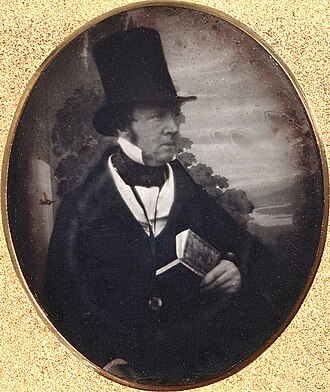
ACHIEVEMENT(S): Founded photography
NICKNAME/ALIAS:
DATE/PLACE OF BIRTH: 11th February, 1800, at Melbury House, Dorset, England.
DATE/PLACE/AGE AT DEATH: 17th September, 1877, at Lacock Abbey, Wiltshire, England. Aged 77.
DISCIPLINE: Mathematics
FIELD: Photography
LANGUAGE: English
EDUCATION: Harrow School; Trinity College, Cambridge.
MAJOR WORK: Calotype photographic process
LIFE AND TIMES:
Throughout the 1820’s Talbot wrote a number of articles on math. He was a frequent contributor to the ‘Annales de Mathématiques Pures at Appliqués’. He joined the Royal Institution, the Astronomical Society and the Zoological Society. He began a correspondence with astronomer JFW Herschel* through whom he met Brewster*, with whom he would have a long scientific association. In Paris in 1825, he spent several weeks working at the Paris Observatory with Arago*, its director.
In 1826, the ‘Edinburgh Journal of Science’ edited by David Brewster, published an article of Talbot’s on ‘Some experiments on coloured Flames’.
For some years, work had been conducted in the area of spectral analysis, a method by which a chemical substance could be identified. This work (identifying a substance by burning it and viewing through a prism the characteristics of the light from the flames) followed on that of Wollaston*, Frauenhofer*, Brewster and Herschel.
In 1833, in Italy on his honeymoon, Talbot became dissatisfied with his attempt to sketch Lake Como. As was popular at the time, he used the camera obscura*to help him, when this failed he turned to the new camera lucida of Wollaston, but his efforts continued to meet with failure. Better than drawing, he decided, would be to fix the images that he saw in the camera obscura by chemical means, and he began to experiment.
By 1835, he had succeeded in making outlines of objects laid on sensitized paper dipped in a weak salt solution and then spread with a solution of silver nitrate. He made pictures of flowers, leaves, lace and engravings.
In 1835, using a camera obscura and paper prepared with repeated washes of silver chloride alternated with salt solution, he took his first photograph. The image was of his family home, Lacock Abbey, and was one inch square.
Until Daguerre’s* announcement of his photographic technique in 1839, Talbot did not pursue his experiments. Daguerre’s publicity stimulated him, and he rushed to make his work known, in case it should be the same as Daguerre’s.
At the Royal Institution and then at the Royal Society*, on 31stJanuary 1839, Talbot showed exhibits of his work, some of which were positives, and presented a paper on his methods three weeks later. This was published in ‘the Literary Gazette’ and ‘the Athenaeum’. The enthusiasm generated by the revelation of his discovery, which Talbot called photogenic drawing, was immense.
Talbot next investigated the light-sensitivity of silver bromide and silver iodide, and found that an image could be developed using gallic acid. The exposure time for this new process was reduced from the twenty minutes required for a daguerreotype, to a minute or two. The negatives were produced on paper, which could be made transparent by waxing, and positive prints taken by contact copying onto silver chloride paper. This is essentially the negative positive process still used in photography today. The new technique was called the calotype- or talbotype-process. Talbot patented his method in 1841, but despite this failed to make much profit out of his photographic discoveries. The collodion process would eventually replace the calotype.
He produced a book, ‘The Pencil of Nature’, which appeared in six parts, beginning on 29thJune 1844. It was the first book ever to be illustrated by photographs and was well received.
In 1843 Talbot patented the photographic enlarger. He also pioneered flash photography, when in 1851 by the use of an electric spark he captured the image of a page of the ‘The Times’ while it was rotating on a rapidly turning wheel.
Talbot continued to search for improvements to his technique. He discovered the light-sensitivity of bichromated gelatin and in 1852 patented what he called photoglyphy, a type of photo-etching onto copper or steel plates.
Talbot was also an archaeologist, publishing papers in this field, and together with Henry Rawlinson and Dr Edward Hincks deciphering the Assyrian cuneiform inscriptions at Nineveh.
The last few years of William Talbot’s life were marred by severe rheumatism, which restricted his travelling about, and a serious heart condition.
ASSESSMENT: He made a major contribution to photography
EXTRA CONNECTIONS: His work inspired neurophysiologist Golgi*
ONELINER: WH Fox Talbot, photography pioneer
BIBLIOGRAPHY:
Arnold, H. J. P.,William Henry Fox Talbot: Pioneer of Photography and Man of Science, Hutchinson Benham; London, 1977.
Artistic jealousy that inspired William Henry Fox Talbot to develop photography
Mark Bridge, Times History Correspondent
PARENTS: William Davenport Talbot and Lady Elisabeth Fox Strangeways.
SIBLINGS: Two half sisters: Caroline Fielding, Horatia Fielding.
SPOUSE: Constance Mundy, 1832.
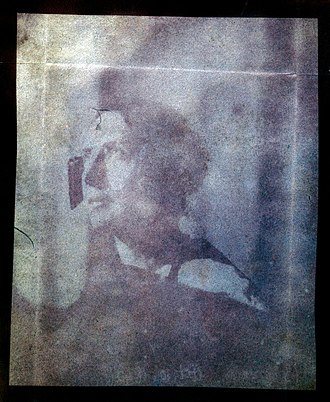
Constance Talbot (née Mundy, 30 January 1811 – 9 September 1880)[1] was an English artist credited as the first woman ever to take a photograph – a hazy image of a short verse by the Irish poet Thomas Moore.[2]
Constance, who came from Markeaton in Derbyshire,[3] was the youngest daughter of Francis Mundy (1771–1837), Member of Parliament for that county from 1822 to 1831.[4]
She married William Henry Fox Talbot, one of the key players in the development of photography in the 1830s and 1840s, in 1832.[3] In 1833, during their honeymoon in Italy, her husband realised that her artistic abilities were superior to his, and began to develop a method to capture a view without draughtsmanship, which led to the negative-positive process of photography.[5]
She briefly experimented with the process herself as early as 1839.[6]
Her watercolours and drawings remained hidden at Lacock Abbey, Fox Talbot's home, until they were digitised by the National Trust and made publicly available.[5][7]
CHILDREN: Ela Theresa, Rosamond Constance, Matilda Caroline, Charles Henry.