Jesuits
The Society of Jesus (Latin: Societas Iesu; abbreviation: SJ), whose members are known as the Jesuits (/ˈdʒɛʒu.ɪts, ˈdʒɛz(j)u, ˈdʒɛs-/;[3] Latin: Iesuitæ),[4] is a religious order of clerics regular of pontifical right for men in the Catholic Church headquartered in Rome. It was founded in 1540 by Ignatius of Loyola and six companions, with the approval of Pope Paul III. The society is engaged in evangelization and apostolic ministry in 112 nations. Jesuits work in education, research, and cultural pursuits. Jesuits also conduct retreats, minister in hospitals and parishes, sponsor direct social and humanitarian ministries, and promote ecumenical dialogue.
The Society of Jesus is consecrated under the patronage of Madonna della Strada, a title of the Blessed Virgin Mary, and it is led by a Superior General.[5][6] The headquarters of the society, its General Curia, is in Rome.[7] The historic curia of Ignatius is now part of the Collegio del Gesù attached to the Church of the Gesù, the Jesuit mother church.
Members of the Society of Jesus are expected to accept orders to go anywhere in the world, where they might be required to live in extreme conditions. This was so because Ignatius, its leading founder, was a nobleman who had a military background. Accordingly, the opening lines of the founding document declared that the society was founded for "whoever desires to serve as a soldier of God,[a] to strive especially for the defense and propagation of the faith, and for the progress of souls in Christian life and doctrine".[9] Jesuits are thus sometimes referred to colloquially as "God's soldiers",[10] "God's marines",[11] or "the Company".[12] The society participated in the Counter-Reformation and, later, in the implementation of the Second Vatican Council.
Jesuit missionaries established missions around the world from the 16th to the 18th century and had both successes and failures in Christianizing the native peoples. Beginning in 1759, the Catholic Church expelled Jesuits from most countries in Europe and from European colonies. In 1814, the Church lifted the suppression.
- History
- Ignatian spirituality
- Formation
- Governance of the society
- Statistics
- Habit and dress
- Controversies
- Nazi persecution
- In science
- Notable members
- Gallery: Jesuit churches
- Institutions
- Publications
- See also
- Notes
- References
- Further reading
- External links
History
Foundation

Ignatius of Loyola, a Basque nobleman from the Pyrenees area of northern Spain, founded the society after discerning his spiritual vocation while recovering from a wound sustained in the Battle of Pamplona. He composed the Spiritual Exercises to help others follow the teachings of Jesus Christ. In 1534, Ignatius and six other young men, including Francis Xavier and Peter Faber, gathered and professed promises of poverty, chastity, and later obedience, including a special vow of obedience to the pope in matters of mission direction and assignment. Ignatius's plan of the order's organization was approved by Pope Paul III in 1540 by a bull containing the "Formula of the Institute".
On 15 August 1534, Ignatius of Loyola (born Íñigo López de Loyola), a Spaniard from the Basque city of Loyola, and six others mostly of Castilian origin, all students at the University of Paris,[13] met in Montmartre outside Paris, in a crypt beneath the church of Saint Denis, now Saint Pierre de Montmartre, to pronounce promises of poverty, chastity, and obedience.[14] Ignatius' six companions were: Francisco Xavier from Navarre (modern Spain), Alfonso Salmeron, Diego Laínez, Nicolás Bobadilla from Castile (modern Spain), Peter Faber from Savoy, and Simão Rodrigues from Portugal.[15]
The meeting has been commemorated in the Martyrium of Saint Denis, Montmartre. They called themselves the Compañía de Jesús, and also Amigos en El Señor or "Friends in the Lord", because they felt "they were placed together by Christ." The name "company" had echoes of the military (reflecting perhaps Ignatius' background as Captain in the Spanish army) as well as of discipleship (the "companions" of Jesus). The Spanish "company" would be translated into Latin as societas like in socius, a partner or comrade. From this came "Society of Jesus" (SJ) by which they would be known more widely.[16]
Religious orders established in the medieval era were named after particular men: Francis of Assisi (Franciscans); Domingo de Guzmán, later canonized as Saint Dominic (Dominicans); and Augustine of Hippo (Augustinians). Ignatius of Loyola and his followers appropriated the name of Jesus for their new order, provoking resentment by other orders who considered it presumptuous. The resentment was recorded by Jesuit José de Acosta of a conversation with the Archbishop of Santo Domingo.[17]
In the words of one historian: "The use of the name Jesus gave great offense. Both on the Continent and in England, it was denounced as blasphemous; petitions were sent to kings and to civil and ecclesiastical tribunals to have it changed; and even Pope Sixtus V had signed a Brief to do away with it." But nothing came of all the opposition; there were already congregations named after the Trinity and as "God's daughters".[18]
In 1537, the seven travelled to Italy to seek papal approval for their order. Pope Paul III gave them a commendation, and permitted them to be ordained priests. These initial steps led to the official founding in 1540.
They were ordained in Venice by the bishop of Arbe (24 June). They devoted themselves to preaching and charitable work in Italy. The Italian War of 1535-1538 renewed between Charles V, Holy Roman Emperor, Venice, the Pope, and the Ottoman Empire, had rendered any journey to Jerusalem impossible.
Again in 1540, they presented the project to Paul III. After months of dispute, a congregation of cardinals reported favourably upon the Constitution presented, and Paul III confirmed the order through the bull Regimini militantis ecclesiae ("To the Government of the Church Militant"), on 27 September 1540. This is the founding document of the Society of Jesus as an official Catholic religious order. Ignatius was chosen as the first Superior General. Paul III's bull had limited the number of its members to sixty. This limitation was removed through the bull Exposcit debitum of Julius III in 1550.[19]
In 1543, Peter Canisius entered the Company. Ignatius sent him to Messina, where he founded the first Jesuit college in Sicily.
Ignatius laid out his original vision for the new order in the "Formula of the Institute of the Society of Jesus",[20] which is "the fundamental charter of the order, of which all subsequent official documents were elaborations and to which they had to conform".[21] He ensured that his formula was contained in two papal bulls signed by Pope Paul III in 1540 and by Pope Julius III in 1550.[20] The formula expressed the nature, spirituality, community life, and apostolate of the new religious order. Its famous opening statement echoed Ignatius' military background:
 A fresco depicting Ignatius receiving the papal bull from Pope Paul III was created after 1743 by Johann Christoph Handke in the Church of Our Lady Of the Snow in Olomouc.
Whoever desires to serve as a soldier of God beneath the banner of the Cross in our Society, which we desire to be designated by the Name of Jesus, and to serve the Lord alone and the Church, his spouse, under the Roman Pontiff, the Vicar of Christ on earth, should, after a solemn vow of perpetual chastity, poverty and obedience, keep what follows in mind. He is a member of a Society founded chiefly for this purpose: to strive especially for the defence and propagation of the faith and for the progress of souls in Christian life and doctrine, by means of public preaching, lectures and any other ministration whatsoever of the Word of God, and further by means of retreats, the education of children and unlettered persons in Christianity, and the spiritual consolation of Christ's faithful through hearing confessions and administering the other sacraments. Moreover, he should show himself ready to reconcile the estranged, compassionately assist and serve those who are in prisons or hospitals, and indeed, to perform any other works of charity, according to what will seem expedient for the glory of God and the common good.[22]
In fulfilling the mission of the "Formula of the Institute of the Society", the first Jesuits concentrated on a few key activities. First, they founded schools throughout Europe. Jesuit teachers were trained in both classical studies and theology, and their schools reflected this. Second, they sent out missionaries across the globe to evangelize those peoples who had not yet heard the Gospel, founding missions in widely diverse regions such as modern-day Paraguay, Japan, Ontario, and Ethiopia. One of the original seven arrived in India already in 1541.[23] Finally, though not initially formed for the purpose, they aimed to stop Protestantism from spreading and to preserve communion with Rome and the pope. The zeal of the Jesuits overcame the movement toward Protestantism in the Polish–Lithuanian Commonwealth and southern Germany.
Ignatius wrote the Jesuit Constitutions, adopted in 1553, which created a centralised organization and stressed acceptance of any mission to which the pope might call them.[24][25][26] His main principle became the unofficial Jesuit motto: Ad Maiorem Dei Gloriam ("For the greater glory of God"). This phrase is designed to reflect the idea that any work that is not evil can be meritorious for the spiritual life if it is performed with this intention, even things normally considered of little importance.[19]
The Society of Jesus is classified among institutes as a mendicant order of clerks regular, that is, a body of priests organized for apostolic work, following a religious rule, and relying on alms, or donations, for support.
The term Jesuit (of 15th-century origin, meaning "one who used too frequently or appropriated the name of Jesus") was first applied to the society in reproach (1544–1552).[27] The term was never used by Ignatius of Loyola, but over time, members and friends of the society adopted the name with a positive meaning.[18]...
Expansion of the order
 Jesuit missionary, painting from 1779
After much training and experience in theology, Jesuits went across the globe in search of converts to Christianity. Despite their dedication, they had little success in Asia, except in the Philippines. For instance, early missions in Japan resulted in the government granting the Jesuits the feudal fiefdom of Nagasaki in 1580. This was removed in 1587 due to fears over their growing influence.[30] Jesuits did, however, have much success in Latin America. Their ascendancy in societies in the Americas accelerated during the seventeenth century, wherein Jesuits created new missions in Peru, Colombia, and Bolivia; as early as 1603, there were 345 Jesuit priests in Mexico alone.[31]

Francis Xavier, one of the original companions of Loyola, arrived in Goa (Portuguese India) in 1541 to carry out evangelical service in the Indies. In a 1545 letter to John III of Portugal, he requested an Inquisition to be installed in Goa to combat heresies like crypto-Judaism and crypto-Islam. Under Portuguese royal patronage, Jesuits thrived in Goa and until 1759 successfully expanded their activities to education and healthcare.
In 1594 they founded the first Roman-style academic institution in the East, St. Paul Jesuit College in Macau, China. Founded by Alessandro Valignano, it had a great influence on the learning of Eastern languages (Chinese and Japanese) and culture by missionary Jesuits, becoming home to the first western sinologists such as Matteo Ricci. Jesuit efforts in Goa were interrupted by the expulsion of the Jesuits from Portuguese territories in 1759 by the powerful Marquis of Pombal, Secretary of State in Portugal.[32]
The Portuguese Jesuit António de Andrade founded a mission in Western Tibet in 1624. Two Jesuit missionaries, Johann Grueber and Albert Dorville, reached Lhasa, in Tibet, in 1661. The Italian Jesuit Ippolito Desideri established a new Jesuit mission in Lhasa and Central Tibet (1716–21) and gained an exceptional mastery of Tibetan language and culture, writing a long and very detailed account of the country and its religion as well as treatises in Tibetan that attempted to refute key Buddhist ideas and establish the truth of Catholic Christianity.
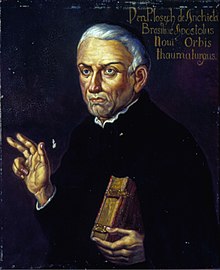 ()The Spanish missionary José de Anchieta was, together with Manuel da Nóbrega, the first Jesuit that Ignacio de Loyola sent to America.
Jesuit missions in America became controversial in Europe, especially in Spain and Portugal where they were seen as interfering with the proper colonial enterprises of the royal governments. The Jesuits were often the only force standing between the Native Americans and slavery. Together throughout South America but especially in present-day Brazil and Paraguay, they formed Christian Native American city-states, called "reductions".
These were societies set up according to an idealized theocratic model. The efforts of Jesuits like Antonio Ruiz de Montoya to protect the natives from enslavement by Spanish and Portuguese colonizers would contribute to the call for the society's suppression. Jesuit priests such as Manuel da Nóbrega and José de Anchieta founded several towns in Brazil in the 16th century, including São Paulo and Rio de Janeiro, and were very influential in the pacification, religious conversion, and education of indigenous nations. They also built schools, organized people into villages, and created a writing system for the local languages of Brazil.[31] José de Anchieta and Manuel da Nóbrega were the first Jesuits that Ignacio de Loyola sent to America.[33]
 Bell made in Portugal for Nanbanji Church run by Jesuits in Japan, 1576–1587
Jesuit scholars working in foreign missions were very dedicated in studying the local languages and strove to produce Latinized grammars and dictionaries. This included: Japanese (see Nippo jisho, also known as Vocabvlario da Lingoa de Iapam, "Vocabulary of the Japanese Language", a Japanese–Portuguese dictionary written 1603); Vietnamese (Portuguese missionaries created the Vietnamese alphabet,[34][35] which was later formalized by Avignon missionary Alexandre de Rhodes with his 1651 trilingual dictionary); Tupi (the main language of Brazil); and the pioneering study of Sanskrit in the West by Jean François Pons in the 1740s.
Jesuit missionaries were active among indigenous peoples in New France in North America, many of them compiling dictionaries or glossaries of the First Nations and Native American languages they had learned. For instance, before his death in 1708, Jacques Gravier, vicar general of the Illinois Mission in the Mississippi River valley, compiled a Kaskaskia Illinois–French dictionary, considered the most extensive among works of the missionaries.[36] Extensive documentation was left in the form of The Jesuit Relations, published annually from 1632 until 1673.
Britain
Whereas Jesuits were active in the 16th century, due to the prosecution of Catholics in the Elizabethan times, an 'English' province was only established in 1623.[37] Whereas the first pressing issue of early Jesuits, in what today is the UK, was to establish places for training priests, the Society's activities today are much broader than that. After an English College was opened in Rome (1579), a Jesuit seminary was opened at Valladolid (1589), then one in Seville (1592), which culminated in a place of study in Louvain (1614).
This was the earliest foundation of what would later be called Heythrop College. Campion Hall founded in 1896, has been a presence within Oxford University since then. In terms of other longer-established manifestations of the Jesuits commitment to working in Britain, four Jesuit churches remain today in London alone, with three further places of workship in England, and two in Scotland.[38] For a recent assessment of the Jesuits in Britain's work, see Melanie McDonagh's article. [39]
China
Main article: Jesuit missions in China
 Matteo Ricci (left) and Xu Guangqi in the 1607 Chinese publication of Euclid's *Elements
 Confucius, Philosopher of the Chinese, or, Chinese Knowledge Explained in Latin* 1687
 A map of the 200-odd Jesuit churches and missions established across China c. 1687
The Jesuits first entered China through the Portuguese settlement on Macau, where they settled on Green Island and founded St. Paul's College.
The Jesuit China missions of the 16th and 17th centuries introduced Western science and astronomy, then undergoing its own revolution, to China. The scientific revolution brought by the Jesuits coincided with a time when scientific innovation had declined in China:
[The Jesuits] made efforts to translate western mathematical and astronomical works into Chinese and aroused the interest of Chinese scholars in these sciences. They made very extensive astronomical observation and carried out the first modern cartographic work in China. They also learned to appreciate the scientific achievements of this ancient culture and made them known in Europe. Through their correspondence, European scientists first learned about the Chinese science and culture.[40]
For over a century, Jesuits like Michele Ruggieri, Matteo Ricci,[41] Diego de Pantoja, Philippe Couplet, Michal Boym, and François Noël refined translations and disseminated Chinese knowledge, culture, history, and philosophy to Europe. Their Latin works popularized the name "Confucius" and had considerable influence on the Deists and other Enlightenment thinkers, some of whom were intrigued by the Jesuits' attempts to reconcile Confucian morality with Catholicism.[42]
Upon the arrival of the Franciscans and other monastic orders, Jesuit accommodation of Chinese culture and rituals led to the long-running Chinese Rites controversy. Despite the personal testimony of the Kangxi Emperor and many Jesuit converts that Chinese veneration of ancestors and Confucius was a nonreligious token of respect, Pope Clement XI's papal decree Cum Deus Optimus ruled that such behavior constituted impermissible forms of idolatry and superstition in 1704;[43] his legate Tournon and Bishop Charles Maigrot of Fujian, tasked with presenting this finding to the Kangxi Emperor, displayed such extreme ignorance that the emperor mandated the expulsion of Christian missionaries unable to abide by the terms of Ricci's Chinese catechism.[44][45][46][47] Tournon's summary and automatic excommunication for any violators of Clement's decree[48]—upheld by the 1715 bull Ex Illa Die—led to the swift collapse of all the missions in China;[45] the last Jesuits were finally expelled after 1721.[49]
Ireland
The first Jesuit school in Ireland was established at Limerick by the Apostolic Visitor of the Holy See, David Wolfe. Wolfe had been sent to Ireland by Pope Pius IV with the concurrence of the third Jesuit General, Diego Laynez.[50] He was charged with setting up grammar schools "as a remedy against the profound ignorance of the people".[51]
Wolfe's mission in Ireland initially concentrated on setting the sclerotic Irish Church on a sound footing, introducing the Tridentine Reforms and finding suitable men to fill vacant Sees. He established a house of religious women in Limerick who were known as the Menabochta (mna bochta, poor women) [52] and in 1565 preparations began for establishing a school at Limerick....
Suppression and restoration
Main article: Suppression of the Society of Jesus
The Suppression of the Jesuits in Portugal, France, the Two Sicilies, Parma, and the Spanish Empire by 1767 was deeply troubling to Pope Clement XIII, the society's defender.[116] On 21 July 1773 his successor, Pope Clement XIV, issued the papal brief Dominus ac Redemptor, decreeing:
Having further considered that the said Company of Jesus can no longer produce those abundant fruits, ... in the present case, we are determining upon the fate of a society classed among the mendicant orders, both by its institute and by its privileges; after a mature deliberation, we do, out of our certain knowledge, and the fulness of our apostolical power, suppress and abolish the said company: we deprive it of all activity whatever. ...And to this end a member of the regular clergy, recommendable for his prudence and sound morals, shall be chosen to preside over and govern the said houses; so that the name of the Company shall be, and is, for ever extinguished and suppressed.
— Dominus ac Redemptor[117]
The suppression was carried out on political grounds in all countries except Prussia for a time, and Russia, where Catherine the Great had forbidden its promulgation. Because millions of Catholics (including many Jesuits) lived in the Polish provinces recently part-annexed by the Kingdom of Prussia, the Society was able to maintain its continuity and carry on its work all through the stormy period of suppression. Subsequently, Pope Pius VI granted formal permission for the continuation of the society in Russia and Poland, with Stanisław Czerniewicz elected superior of the province in 1782.
He was followed by Gabriel Lenkiewicz, Franciszek Kareu and Gabriel Gruber until 1805, all elected locally as Temporary Vicars General. Pope Pius VII had resolved during his captivity in France to restore the Jesuits universally, and on his return to Rome he did so without much delay. On 7 August 1814, with the bull Sollicitudo omnium ecclesiarum, he reversed the suppression of the society, and therewith another Polish Jesuit, Tadeusz Brzozowski, who had been elected as Superior in Russia in 1805, acquired universal jurisdiction. On his death in 1820 the Jesuits were expelled from Russia by tsar Alexander I.
The period following the Restoration of the Jesuits in 1814 was marked by tremendous growth, as evidenced by the large number of Jesuit colleges and universities established during the 19th century. During this time in the United States, 22 of the society's 28 universities were founded or taken over by the Jesuits. It has been suggested that the experience of suppression had served to heighten orthodoxy among the Jesuits. While this claim is debatable, Jesuits were generally supportive of papal authority within the church, and some members became associated with the Ultramontanist movement and the declaration of Papal Infallibility in 1870.[118]
In Switzerland, the constitution was modified and Jesuits were banished in 1848, following the defeat of the Sonderbund Catholic defence alliance. The ban was lifted on 20 May 1973, when 54.9 per cent of voters accepted a referendum modifying the Constitution.[119]
Early 20th century
In the Constitution of Norway from 1814, a relic from the earlier anti-Catholic laws of Denmark–Norway, Paragraph 2, known as the Jesuit clause, originally read: "The Evangelical-Lutheran religion remains the public religion of the State. Those inhabitants, who confess thereto, are bound to raise their children to the same. Jesuits and monastic orders are not permitted. Jews are still prohibited from entry to the Realm." Jews were first allowed into the realm in 1851 after the famous Norwegian poet Henrik Wergeland had campaigned for it. Monastic orders were permitted in 1897, but the ban on Jesuits was only lifted in 1956.[120]
Republican Spain in the 1930s passed laws banning the Jesuits on grounds that they were obedient to a power different from the state. Pope Pius XI wrote about this: "It was an expression of a soul deeply hostile to God and the Catholic religion, to have disbanded the Religious Orders that had taken a vow of obedience to an authority different from the legitimate authority of the State. In this way it was sought to do away with the Society of Jesus – which can well glory in being one of the soundest auxiliaries of the Chair of Saint Peter – with the hope, perhaps, of then being able with less difficulty to overthrow in the near future, the Christian faith and morale in the heart of the Spanish nation, which gave to the Church of God the grand and glorious figure of Ignatius Loyola."[121]
...