James Joyce 2
(see main node)
James Augustine Aloysius Joyce (2 February 1882 – 13 January 1941) was an Irish novelist, poet, and literary critic. He contributed to the modernist avant-garde movement and is regarded as one of the most influential and important writers of the 20th century. Joyce's novel Ulysses (1922) is a landmark in which the episodes of Homer's Odyssey are paralleled in a variety of literary styles, particularly stream of consciousness. Other well-known works are the short-story collection Dubliners (1914), and the novels A Portrait of the Artist as a Young Man (1916) and Finnegans Wake (1939). His other writings include three books of poetry, a play, letters, and occasional journalism.
Joyce was born in Dublin into a middle-class family. He attended the Jesuit Clongowes Wood College in County Kildare, then, briefly, the Christian Brothers-run O'Connell School. Despite the chaotic family life imposed by his father's unpredictable finances, he excelled at the Jesuit Belvedere College and graduated from University College Dublin in 1902. In 1904, he met his future wife, Nora Barnacle, and they moved to mainland Europe.
He briefly worked in Pula and then moved to Trieste in Austria-Hungary, working as an English instructor. Except for an eight-month stay in Rome working as a correspondence clerk and three visits to Dublin, Joyce resided there until 1915. In Trieste, he published his book of poems Chamber Music and his short story collection Dubliners, and he began serially publishing A Portrait of the Artist as a Young Man in the English magazine The Egoist. During most of World War I, Joyce lived in Zürich, Switzerland, and worked on Ulysses. After the war, he briefly returned to Trieste and then moved to Paris in 1920, which became his primary residence until 1940.
Ulysses was first published in Paris in 1922, but its publication in the United Kingdom and the United States was prohibited because of its perceived obscenity. Copies were smuggled into both countries and pirated versions were printed until the mid-1930s, when publication finally became legal. Joyce started his next major work, Finnegans Wake, in 1923, publishing it sixteen years later in 1939. Between these years, Joyce travelled widely. He and Nora were married in a civil ceremony in London in 1930. He made a number of trips to Switzerland, frequently seeking treatment for his increasingly severe eye problems and psychological help for his daughter, Lucia. When France was occupied by Germany during World War II, Joyce moved back to Zürich in 1940. He died there in 1941 after surgery for a perforated ulcer, less than one month before his 59th birthday.
Ulysses frequently ranks high in lists of great books of literature, and the academic literature analysing his work is extensive and ongoing. Many writers, film-makers, and other artists have been influenced by his stylistic innovations, such as his meticulous attention to detail, use of interior monologue, wordplay, and the radical transformation of traditional plot and character development.
Though most of his adult life was spent abroad, his fictional universe centres on Dublin and is largely populated by characters who closely resemble family members, enemies and friends from his time there. Ulysses in particular is set in the streets and alleyways of the city. Joyce is quoted as saying, "For myself, I always write about Dublin, because if I can get to the heart of Dublin I can get to the heart of all the cities of the world. In the particular is contained the universal."[1]
- Early life
- University years
- Post-university years in Dublin
- 1904–1906: Zürich, Pula and Trieste
- 1906–1915: Rome, Trieste, and sojourns to Dublin
- 1915–1920: Zürich and Trieste
- 1920–1941: Paris and Zürich
- Death
- Joyce and politics
- Joyce and religion
- Major works
- Legacy
- Bibliography
- Notes
- References
- Further viewing
- External links
Early life
[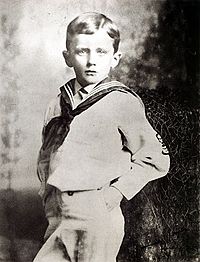
Photograph of Joyce aged six, 1888
Joyce was born on 2 February 1882 at 41 Brighton Square, Rathgar, Dublin, Ireland,[2] to John Stanislaus Joyce and Mary Jane "May" (née Murray). He was the eldest of ten surviving siblings. He was baptised with the name James Augustine Joyce[a] according to the rites of the Roman Catholic Church in the nearby St Joseph's Church in Terenure on 5 February 1882 by Rev. John O'Mulloy.[b]
His godparents were Philip and Ellen McCann.[7] John Stanislaus Joyce's family came from Fermoy in County Cork, where they owned a small salt and lime works. Joyce's paternal grandfather, James Augustine, married Ellen O'Connell, daughter of John O'Connell, a Cork alderman who owned a drapery business and other properties in Cork City. Ellen's family claimed kinship with the political leader Daniel O'Connell, who had helped secure Catholic emancipation for the Irish in 1829.[8] The Joyce family's purported ancestor, Seán Mór Seoighe was a stonemason from Connemara.[9]
Joyce's father was appointed rate collector by Dublin Corporation in 1887. The family moved to the fashionable small town of Bray, 12 miles (19 km) from Dublin. Joyce was attacked by a dog around this time, leading to his lifelong fear of dogs.[10][c] He later developed a fear of thunderstorms,[12] which he acquired through a superstitious aunt who had described them as a sign of God's wrath.[13][d]
In 1891, nine-year-old Joyce wrote the poem "Et Tu, Healy" on the death of Charles Stewart Parnell that his father printed and distributed to friends.[15] The poem expressed the sentiments of the elder Joyce,[16] who was angry at Parnell's apparent betrayal by the Irish Catholic Church, the Irish Parliamentary Party, and the British Liberal Party that resulted in a collaborative failure to secure Irish Home Rule in the British Parliament.[17] This sense of betrayal, particularly by the church, left a lasting impression that Joyce expressed in his life and art.[18]
That year, his family began to slide into poverty, worsened by his father's drinking and financial mismanagement.[19] John Joyce's name was published in Stubbs' Gazette, a blacklist of debtors and bankrupts, in November 1891, and he was temporarily suspended from work.[20] In January 1893, he was dismissed with a reduced pension.[21]
Joyce began his education in 1888 at Clongowes Wood College, a Jesuit boarding school near Clane, County Kildare, but had to leave in 1891 when his father could no longer pay the fees.[22] He studied at home and briefly attended the Christian Brothers O'Connell School on North Richmond Street, Dublin. Joyce's father then had a chance meeting with the Jesuit priest John Conmee, who knew the family. Conmee arranged for Joyce and his brother Stanislaus to attend the Jesuits' Dublin school, Belvedere College, without fees starting in 1893.[23] In 1895, Joyce, now aged 13, was elected by his peers to join the Sodality of Our Lady.[24] Joyce spent five years at Belvedere, his intellectual formation guided by the principles of Jesuit education laid down in the Ratio Studiorum (Plan of Studies).[25] He displayed his writing talent by winning first place for English composition in his final two years[26] before graduating in 1898.[27]
University years
Joyce enrolled at University College[e] in 1898 to study English, French and Italian.[31] While there, he was exposed to the scholasticism of Thomas Aquinas, which had a strong influence on his thought for the rest of his life.[32] He participated in many of Dublin's theatrical and literary circles. His closest colleagues included leading Irish figures of his generation, most notably, George Clancy, Tom Kettle and Francis Sheehy-Skeffington.[33] Many of the acquaintances he made at this time appeared in his work.[34] His first publication— a laudatory review of Henrik Ibsen's When We Dead Awaken—was printed in The Fortnightly Review in 1900. Inspired by Ibsen's works, Joyce sent him a fan letter in Norwegian[35][f] and wrote a play, A Brilliant Career,[38] which he later destroyed.[39][g]
In 1901 the National Census of Ireland listed Joyce as a 19-year-old Irish- and English-speaking unmarried student living with his parents, six sisters and three brothers at Royal Terrace (now Inverness Road) in Clontarf, Dublin.[41] During this year he became friends with Oliver St. John Gogarty,[42] the model for Buck Mulligan in Ulysses.[34]
In November, Joyce wrote an article, The Day of the Rabblement, criticising the Irish Literary Theatre for its unwillingness to produce the works of playwrights like Ibsen, Leo Tolstoy, and Gerhart Hauptmann.[43] He protested against nostalgic Irish populism and argued for an outward-looking, cosmopolitan literature.[44] Because he mentioned Gabriele D'Annunzio's novel, Il fuoco (The Flame),[45] which was on the Roman Catholic list of prohibited books, his college magazine refused to print it. Joyce and Sheehy-Skeffington—who had also had an article rejected—had their essays jointly printed and distributed. Arthur Griffith decried the censorship of Joyce's work in his newspaper United Irishman.[46]
Joyce graduated from the Royal University of Ireland in October 1902. He considered studying medicine[47] and began attending lectures at the Catholic University Medical School in Dublin.[48] When the medical school refused to provide a tutoring position to help finance his education, he left Dublin to study medicine in Paris,[49] where he received permission to attend the course for a certificate in physics, chemistry, and biology at the École de Médecine.[50] By the end of January 1903, he had given up plans to study medicine[51] but he stayed in Paris, often reading late in the Bibliothèque Sainte-Geneviève.[52] He frequently wrote home claiming ill health due to the water, the cold weather, and his change of diet,[53] appealing for money his family could ill-afford.[54]
Post-university years in Dublin
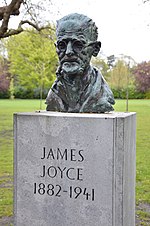 )Bust of Joyce on St Stephen's Green, Dublin, by Marjorie Fitzgibbon
In April 1903, Joyce learned his mother was dying[h] and immediately returned to Ireland.[61] He would tend to her, reading aloud from drafts that would eventually be worked into his unfinished novel Stephen Hero.[62] During her final days, she unsuccessfully tried to get him to make his confession and to take communion.[63][i] She died on 13 August.[65] Afterwards, Joyce and Stanislaus refused to kneel with other members of the family praying at her bedside.[66] John Joyce's drinking and abusiveness increased in the months following her death, and the family began to fall apart.[67] Joyce spent much of his time carousing with Gogarty and his medical school colleagues,[68] and tried to scrape together a living by reviewing books.[69]
Joyce's life began to change when he met Nora Barnacle on 10 June 1904. She was a twenty-year-old woman from Galway city, who was working in Dublin as a chambermaid.[70] They had their first outing together on 16 June 1904,[j] walking through the Dublin suburb of Ringsend, where Nora masturbated him.[73] This event was commemorated as the date for the action of Ulysses, known in popular culture as "Bloomsday" in honour of the novel's main character Leopold Bloom.[74] This began a relationship that continued for thirty-seven years until Joyce died.[75] Soon after this outing, Joyce, who had been carousing with his colleagues,[76] approached a young woman in St Stephen's Green and was beaten up by her companion. He was picked up and dusted off by an acquaintance of his father's, Alfred H. Hunter, who took him into his home to tend to his injuries. Hunter, who was rumoured to be a Jew and to have an unfaithful wife, became one of the models for Leopold Bloom, the protagonist of Ulysses.[77]
Joyce was a talented tenor and explored becoming a musical performer.[78][k] On 8 May 1904, he was a contestant in the Feis Ceoil,[80] an Irish music competition for promising composers, instrumentalists and singers.[81] In the months before the contest, Joyce took singing lessons with two voice instructors, Benedetto Palmieri and Vincent O'Brien.[82] He paid the entry fee by pawning some of his books.[83] For the contest, Joyce had to sing three songs. He did well with the first two, but when he was told he had to sight read the third, he refused.[84] Joyce won the third-place medal anyway.[l]
After the contest, Palmieri wrote Joyce that Luigi Denza, the composer of the popular song Funiculì, Funiculà who was the judge for the contest,[89] spoke highly of his voice and would have given him first place but for the sight-reading and lack of sufficient training.[90] Palmieri even offered to give Joyce free singing lessons afterwards. Joyce refused the lessons, but kept singing in Dublin concerts that year.[91] His performance at a concert given on 27 August may have solidified Nora's devotion to him.[92]
Throughout 1904, Joyce sought to develop his literary reputation. On 7 January he attempted to publish a prose work examining aesthetics called A Portrait of the Artist,[93] but it was rejected by the intellectual journal Dana. He then reworked it into a fictional novel of his youth that he called Stephen Hero that he labored over for years but eventually abandoned.[m]
He wrote a satirical poem called "The Holy Office",[95] which parodied William Butler Yeats's poem "To Ireland in the Coming Times"[96][n] and once more mocked the Irish Literary Revival.[99] It too was rejected for publication; this time for being "unholy".[100] He wrote the collection of poems Chamber Music at this time;[101] which was also rejected.[102][o] He did publish three poems, one in Dana [105] and two in The Speaker,[106] and George William Russell[p] published three of Joyce's short stories in the Irish Homestead. These stories—"The Sisters", "Eveline", and "After the Race"—were the beginnings of Dubliners.[109]
In September 1904, Joyce was having difficulties finding a place to live and moved into a Martello tower near Dublin, which Gogarty was renting.[110] Within a week, Joyce left when Gogarty and another roommate, Dermot Chenevix Trench, fired a pistol in the middle of the night at some pans hanging directly over Joyce's bed.[111] With the help of funds from Lady Gregory and a few other acquaintances, Joyce and Nora left Ireland less than a month later.[112]
1904–1906: Zürich, Pula and Trieste
...
Trieste was Joyce's main residence until 1920.[138] Although he would temporarily leave the city—briefly staying in Rome, travelling to Dublin, and emigrating to Zürich during World War I— it became a second Dublin for him[139] and played an important role in his development as a writer.[140][v] He completed Dubliners, reworked Stephen Hero into A Portrait of the Artist as a Young Man, wrote his only published play Exiles, and decided to make Ulysses a full-length novel as he created his notes and jottings for the work.[142] He worked out the characters of Leopold and Molly Bloom in Trieste.[143] Many of the novel's details were taken from Joyce's observation of the city and its people,[144] and some of its stylistic innovations appear to have been influenced by Futurism.[145][w] There are even words of the Triestine dialect in Finnegans Wake.[147]
1906–1915: Rome, Trieste, and sojourns to Dublin
Rome
Joyce admired Bruno[148] and attended the procession in his honour while in Rome.[149]
In late May 1906, the head of the Berlitz school ran away after embezzling its funds. Artifoni took over the school but let Joyce know that he could only afford to keep one brother on.[150] Tired of Trieste and discouraged that he could not get a publisher for Dubliners, Joyce found an advertisement for a correspondence clerk in a Roman bank that paid twice his current salary.[151] He was hired for the position, and went to Rome at the end of July.[152]
Joyce felt he accomplished very little during his brief stay in Rome,[153] but it had a large impact on his writing.[154] Though his new job took up most of his time, he revised the Dubliners and worked on Stephen Hero.[155] Rome was the birthplace of the idea for "The Dead", which would become the final story of Dubliners,[156] and for Ulysses,[157] which was originally conceived as a short story.[x] His stay in the city was one of his inspirations for Exiles.[159]
While there, he read the socialist historian Guglielmo Ferrero in depth.[160] Ferrero's anti-heroic interpretations of history, arguments against militarism, and conflicted attitudes toward Jews[161] would find their way into Ulysses, particularly in the character of Leopold Bloom.[162] In London, Elkin Mathews published Chamber Music on the recommendation of the British poet Arthur Symons.[163] Nonetheless, Joyce was dissatisfied with his job, had exhausted his finances, and realised he would need additional support when he learned Nora was pregnant again.[164] He left Rome after only seven months.[165]
Second stay in Trieste
[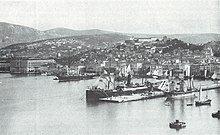
)Trieste circa 1907
Joyce returned to Trieste in March 1907, but was unable to find full-time work. He went back to being an English instructor, working part time for Berlitz and giving private lessons.[166] The author Ettore Schmitz, better known by pen name Italo Svevo, was one of his students. Svevo was a Catholic of Jewish origin who became one of the models for Leopold Bloom.[167] Joyce learned much of what he knew about Judaism from him.[168] The two became lasting friends and mutual critics.[169] Svevo supported Joyce's identity as an author, helping him work through his writer's block with A Portrait of the Artist as a Young Man.[170]
Roberto Prezioso, editor of the Italian newspaper Piccolo della Sera, was another of Joyce's students. He helped Joyce financially by commissioning him to write for the newspaper. Joyce quickly produced three articles aimed toward the Italian irredentists in Trieste. He indirectly paralleled their desire for independence from Austria-Hungary with the struggle of the Irish from British rule.[171] Joyce earned additional money by giving a series of lectures on Ireland and the arts at Trieste's Università Popolare.[172] In May, Joyce was struck by an attack of rheumatic fever,[173] which left him incapacitated for weeks.[y] The illness exacerbated eye problems that plagued him for the rest of his life.[179] While Joyce was still recovering from the attack, Lucia was born on 26 July 1907.[180][z] During his convalescence, he was able to finish "The Dead", the last story of Dubliners.[182]
Although a heavy drinker,[183] Joyce gave up alcohol for a period in 1908.[184] He reworked Stephen Hero as the more concise and interior A Portrait of the Artist as a Young Man. He completed the third chapter by April[185] and translated John Millington Synge's Riders to the Sea into Italian with the help of Nicolò Vidacovich.[186] He even took singing lessons again.[187] Joyce had been looking for an English publisher for Dubliners but was unable to find one, so he submitted it to a Dublin publisher, Maunsel and Company, owned by George Roberts.[188]
Visits to Dublin
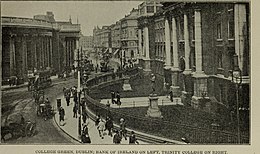 Dublin in 1909
In July 1909, Joyce received a year's advance payment from one of his students and returned to Ireland to introduce Giorgio to both sides of the family (his own in Dublin and Nora's in Galway).[189] He unsuccessfully applied for the position of Chair of Italian at his alma mater, which had become University College Dublin.[190]
He met with Roberts, who seemed positive about publishing the Dubliners.[191] He returned to Trieste in September with his sister Eva, who helped Nora run the home.[192] Joyce only stayed in Trieste for a month, as he almost immediately came upon the idea of starting a cinema in Dublin, which unlike Trieste had none. He quickly got the backing of some Triestine business men and returned to Dublin in October, launching Ireland's first cinema, the Volta Cinematograph.[193] It was initially well-received, but fell apart after Joyce left.[194] He returned to Trieste in January 1910 with another sister, Eileen.[195][aa]
From 1910 to 1912, Joyce still lacked a reliable income. This brought his conflicts with Stanislaus, who was frustrated with lending him money, to their peak.[199] In 1912, Joyce once more lectured at the Università Popolare on various topics in English literature and applied for a teaching diploma in English at the University of Padua.[200] He performed very well on the qualification tests, but was denied because Italy did not recognise his degree from an Irish university. In 1912, Joyce and his family returned to Dublin briefly in the summer.[201] While there, his three-year-long struggle with Roberts over the publication of Dubliners[202] came to an end as Roberts refused to publish the book due to concerns of libel. Roberts had the printed sheets destroyed, though Joyce was able to obtain a copy of the proof sheets.[ab] When Joyce returned to Trieste, he wrote an invective against Roberts, "Gas from a Burner".[204] He never went to Dublin again.[205]
...
Major works
Dubliners
Main article: *Dubliners*
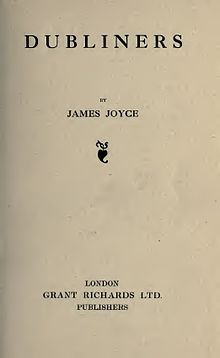 ])First edition of Dubliners, 1914
Dubliners is a collection of 15 short stories first published in 1914,[380] that form a naturalistic depiction of Irish middle-class life in and around the city in the early 20th century. The tales were written when Irish nationalism and the search for national identity was at its peak. Joyce holds up a mirror to that identity as a first step in the spiritual liberation of Ireland.[381][au] The stories centre on Joyce's idea of an epiphany: a moment when a character experiences a life-changing self-understanding or illumination. Many of the characters in Dubliners later appear in minor roles in Joyce's novel Ulysses.[383] The initial stories are narrated by child protagonists. Later stories deal with the lives and concerns of progressively older people. This aligns with Joyce's tripartite division of the collection into childhood, adolescence, and maturity.[384]
A Portrait of the Artist as a Young Man
Main article: *A Portrait of the Artist as a Young Man*
A Portrait of the Artist as a Young Man, published in 1916, is a shortened rewrite of the abandoned novel Stephen Hero. It is a Künstlerroman, a kind of coming-of-age novel depicting the childhood and adolescence of the protagonist Stephen Dedalus and his gradual growth into artistic self-consciousness.[385] It functions both as an autobiographical fiction of the author and a biography of the fictional protagonist.[386] Some hints of the techniques Joyce frequently employed in later works, such as stream of consciousness, interior monologue, and references to a character's psychic reality rather than to his external surroundings are evident throughout this novel.[387]
Exiles and poetry
Main articles: *Chamber Music* (poetry collection) and *Pomes Penyeach*
Despite early interest in the theatre, Joyce published only one play, Exiles, begun shortly after the outbreak of the First World War in 1914 and published in 1918. A study of a husband-and-wife relationship, the play looks back to "The Dead" (the final story in Dubliners) and forward to Ulysses, which Joyce began around the time of the play's composition.[388]
He published three books of poetry.[389] The first full-length collection was Chamber Music (1907), which consisted of 36 short lyrics. It led to his inclusion in the Imagist Anthology, edited by Ezra Pound, a champion of Joyce's work. Other poetry Joyce published in his lifetime includes "Gas from a Burner" (1912), Pomes Penyeach (1927), and "Ecce Puer" (written in 1932 to mark the birth of his grandson and the recent death of his father). These were published by the Black Sun Press in Collected Poems (1936).[390]
Ulysses
Main article: *Ulysses* (novel)
 First edition of Ulysses published by Shakespeare & Company, 1922
The action of Ulysses starts on 16 June 1904 at 8 am and ends sometime after 2 am the following morning. Much of it occurs inside the minds of the characters, who are portrayed through techniques such as interior monologue, dialogue, and soliloquy. The novel consists of 18 episodes, each covering roughly one hour of the day using a unique literary style.[391] Joyce structured each chapter to refer to an individual episode in Homer's Odyssey, as well as a specific colour, a particular art or science, and a bodily organ.[av]
Ulysses sets the characters and incidents of Homer's Odyssey in 1904 Dublin, representing Odysseus (Ulysses), Penelope, and Telemachus in the characters of Leopold Bloom, his wife Molly Bloom, and Stephen Dedalus. It uses humor,[394] including parody, satire and comedy, to contrast the novel's characters with their Homeric models. Joyce played down the mythic correspondences by eliminating the chapter titles[395] so the work could be read independently of its Homeric structure.[396]
Ulysses can be read as a study of Dublin in 1904, exploring various aspects of the city's life, dwelling on its squalor and monotony. Joyce claimed that if Dublin were to be destroyed in some catastrophe, it could be rebuilt using his work as a model.[397] To achieve this sense of detail, he relied on his memory, what he heard other people remember, and his readings to create a sense of fastidious detail.[398] Joyce regularly used the 1904 edition of Thom's Directory—a work that listed the owners and tenants of every residential and commercial property in the city—to ensure his descriptions were accurate.[399] This combination of kaleidoscopic writing, reliance on a formal schema to structure the narrative, and an exquisite attention to detail represents one of the book's major contributions to the development of 20th-century modernist literature.[400]
Finnegans Wake
Main article: *Finnegans Wake*
Finnegans Wake is an experimental novel that pushes stream of consciousness[401] and literary allusions[402] to their extremes. Although the work can be read from beginning to end, Joyce's writing transforms traditional ideas of plot and character development through his wordplay, allowing the book to be read nonlinearly. Much of the word play stems from the work being written in a peculiar and obscure English, based mainly on complex multilevel puns. This approach is similar to, but far more extensive than, that used by Lewis Carroll in Jabberwocky[403] and draws on a wide range of languages.[404] The associative nature of its language has led to it being interpreted as the story of a dream.[405][aw]
The metaphysics of Giordano Bruno of Nola, who Joyce had read in his youth,[406] plays an important role in Finnegans Wake, as it provides the framework for how the identities of the characters interplay and are transformed.[407] Giambattista Vico's cyclical view of history (in which civilisation rises from chaos, passes through theocratic, aristocratic, and democratic phases, and then lapses back into chaos) structures the text's narrative,[408] as evidenced by the opening and closing words of the book: Finnegans Wake opens with the words "riverrun, past Eve and Adam's, from swerve of shore to bend of bay, brings us by a commodius vicus of recirculation back to Howth Castle and Environs"[ax] and ends "A way a lone a last a loved a long the".[409] In other words, the book ends with the beginning of a sentence and begins with the end of the same sentence, turning the narrative into one great cycle.[410]
Legacy
 Statue of James Joyce on North Earl Street, Dublin, by Marjorie Fitzgibbon
Joyce's work still has a profound influence on contemporary culture.[411][ay] Ulysses is a model for fiction writers, particularly its explorations in the power of language.[400] Its emphasis on the details of everyday life have opened up new possibilities of expression for authors, painters and film-makers.[412]
It retains its prestige among readers, often ranking high on 'Great Book' lists.[413] Joyce's innovations extend beyond English literature: his writing has been an inspiration for Latin American writers,[414] and Finnegans Wake has become one of the key texts for French post-structuralism.[415] It also provided the name for the quark, one of the elementary particles proposed by physicist Murray Gell-Mann.[416][az]
The open-ended form of Joyce's novels keep them open to constant reinterpretation.[418] They inspire an increasingly global community of literary critics. Joyce studies—based on a relatively small canon of three novels, a small short story collection, one play, and two small books of poems—have generated over 15,000 articles, monographs, theses, translations, and editions.[419]
In popular culture, the work and life of Joyce is celebrated annually on 16 June, known as Bloomsday, in Dublin and in an increasing number of cities worldwide.[420]...
Bibliography
Knowledge Web Content (see main node)
Name: James Joyce
Achievements: “Stream of consciousness” novels.
Nickname/Alias: None.
Born: 2nd February 1882, in Dublin, Ireland.
Died: 13th January 1941, in Zurich, Switzerland. Aged 59.
Writer.
Field & Discipline: Literature.
Language: English.
Father: John Stanislaus Joyce and Mary Jane Murray.
Siblings: 3 brothers, 6 sisters.
Spouse: Nora Barnacle.
Children: George and Lucia.
Education: Clongowes Wood College; Belvedere College, Dublin; University College, Dublin University.
Major Work:
“Portrait of the Artist as a Young Man” (1916)
“Ulysses” (1922)
“Finnegan’s Wake” (1939)
Life & Times:
Joyce graduated in 1902 and began to mix in Dublin’s literary circles, where he met the poet [encouraged by] Yeats*, who was impressed by his vitality and originality, and the fact that Joyce had an amusing awkwardness and lack of reverence for older writers.
After thinking briefly about a career in medicine, Joyce went to Paris, where he wrote book reviews and practised writing fiction. Back in Ireland in April 1903, he took several different jobs and moved around, at one time living in the Martello Tower at Sandycove, which is now the Joyce Museum.
In 1904, he began to write stories with an Irish background for a farming magazine, “The Irish Homestead.” After three of his stories had been printed, “The Sisters,” “Eveline” and “After the Race,” all written under the pseudonym Stephen Dedalus, the editor decided that Joyce’s work wasn’t suitable for a farming magazine.
At the same time, Joyce was working on a largely autobiographical novel, “Stephen Hero” and he had met and fallen in love with Nora Barnacle. He met her on June 16, 1904, which was the date he later used in his novel “Ulysses” as the day on which the whole action of the book takes place.
Having rejected Catholicism, as a matter of personal principle, Joyce wouldn’t marry, but he and Nora left Ireland, as a couple, for the European continent in October 1904.
After working as a teacher at the Berlitz language school in Pola in the Austro-Hungarian Empire, they moved to Trieste in 1905, where they were joined by Joyce's brother, Stanislaus. In 1906-7 Joyce earned money working in a bank in Rome, while he worked on his novel and wrote some short stories.
At this time, Joyce fell under the influence of new movements in European literature, including the Symbolists and the Realists and he re-wrote “Stephen Hero” in a much shorter form.
In 1909, Joyce took his collected stories to Ireland, in an attempt to get them published, at the same time working on a plan to set up a chain of cinemas. Neither scheme was successful, so he went back to Trieste.
A few years later, in 1913, Joyce received an unexpected letter from [encouraged by] Ezra Pound*, the American poet who was active in London and had heard of Joyce from Yeats. With the backing of Pound, Joyce was able to publish “The Dubliners” in 1914.
Italy joined World War I in 1915 and, although Stanislaus was interned by the Italians, Joyce and his family were allowed to go to Switzerland. They settled in Zurich, where he gave English lessons and worked on “Ulysses,” which he originally planned to write as a short story.
At this time, Joyce was beginning to suffer from glaucoma and he was worried about the mental state of his daughter Lucia, who was later diagnosed as schizophrenic. His living standard was slightly improved when Yeats and Pound persuaded the Royal Literary Fund to make Joyce a small grant.
A contact in Zurich introduced Joyce to an American philanthropist, Edith McCormick, [funded by daughter of] Rockefeller* Snr.’s daughter, who was in Zurich under the care of the analyst Carl Jung and who gave Joyce a monthly allowance.
Around the same time, the re-write of “Stephen Hero” appeared, serialized, in a magazine called “The Egoist,” under the title “A Portrait of the Artist as a Young Man.” Through Pound, Joyce had met Harriet Shaw Weaver, the editor, and, through her efforts, the book was published in the US and England, in 1916.
Reviews were good and in 1918, an American journal, “Little Review” began to publish extracts from “Ulysses,” but they eventually stopped at the end of 1920, when the book was banned for obscenity. Joyce had returned to Trieste in 1918 and, in 1920, he accepted an invitation to from Pound to visit Paris.
Two years later, Sylvia Beach, the English owner of the bookstore, “Shakespeare and Company,” published “Ulysses” in France, although it would not be published in England until 1936. Joyce had written the novel as a modern version of Homer’s “Odyssey” and the three main characters, Leopold Bloom, his wife Molly and Stephen Dedalus, depicted with great humanity, are Joyce's versions of Telemachus, Ulysses and Penelope.
With the whole of the story taking place on June 16th in Dublin, Joyce used the stream-of-consciousness technique, in which the true thoughts and feelings of his characters are written in minute detail, alongside their rational external speech.
“Ulysses,” which was to have a great impact on future writers, was a sensation in literary circles, hated by some, loved by others. Virginia [influenced] Woolf* hated it and argued with [influenced] T S Eliot*, who loved it, but she admired Joyce’s stream-of-consciousness approach and experimented with it herself.
In Paris, [influenced] Ernest Hemingway* loved it but [influenced] Stein* hated it, mainly because she had already started experimental writing and was jealous of Joyce for getting there first.
In 1931, Joyce worked on “Finnegan’s Wake” which, like all his work, he wrote and rewrote. The story, about an Irish bar owner and his family, and a celebration of Dublin and the River Liffey, was another experimental work.
Joyce experimented with language, used foreign words and introduced characters from history and literature, without reference to chronological order. Published in 1939, it was met with puzzled hostility.
The following year, when France was invaded by Germany, Joyce went back to live in Zurich in Switzerland.
Extra Connections: Met film director [met] Eisenstein*.
[published by] Ford Madox Ford* published his work.
Samuel Beckett* ?
He influenced [influenced] William Carlos Williams* and [influenced] Perelman*
He met [met] W Archer*
His portrait was drawn by [portrait drawn by] John*
He met [met] Kokoschka*
Assessment: Joyce's work still generates controversy because of the experimental nature of his writing.
Oneliner: James Joyce, “stream of consciousness” writer
Bibliography:
- Gilbert, S., The Letters of James Joyce, vol 1, 1957.
- Ellmann, R., The Letters of James Joyce, vols 2 and 3, 1966.
- Ellmann, R., James Joyce, Oxford University Press, New York, 1959, (2nd edition, 1982).
- Burgess, A., Joysprick: An Introduction to the Language of James Joyce, 1975.