Della Mirandola

Nickname/Alias: Conte di Concordia
Achievements:
Born: February 24, 1463; Mirandola, duchy of Ferrara (now Italy).
Died: November 17, 1494; Florence, Italy (Aged 31)
Field & Discipline: Education; Philosophy
Language: Italian; Latin
Father: Giovanni Francesco Pico (Gianfrancesco I)
Mother: Giulia Boiardo (d. 1479)
Siblings: At least one older brother
Spouse: None
Children: None
Education: University of Bologna (1477-79); University of Padua (1480-82);
University of Paris; University of Florence
Major Work:
“On the Dignity of Man” (1486)
Life & Times:
In 1482, Pico wrote to the leading Renaissance Platonist philosopher Marsilio Ficino asking for a copy of his recent “Platonic Theology” (1474).
In 1484 he went to Florence and met [collaborated with] Lorenzo de' Medici*, and studied the new Platonic sources that Ficino was then making available to the Latin world. In 1485, Pico went to Paris in order to study medieval scholastic philosophy and theology.
He returned a year later to Florence, where he began to study Hebrew, Aramaic, Arabic and Jewish mystical literature with the Jewish Cabbalist Flavio Mithridates. By 1486 Pico had become one of the first Renaissance scholars determined to master Hebrew, which he considered (alongside Latin and Greek) one of the three historic languages of the West, and he realized would give him access not only to the Old Testament in the original, but also to post-biblical Jewish and rabbinic literature – especially the Spanish Cabbalists (like the13th-century visionary [influenced by] Abulafia* and the 14th-century Spanish-Jewish philosopher [influenced by] Crescas*.)
Pico left Florence in May 1486 for Rome, but his journey was interrupted at Arezzo by a scandalous episode when he attempted to elope with the wife of a Medici. The pair were caught, and Pico was saved from retribution only by the intervention of Lorenzo de' Medici.
Several months of retirement in Rome followed, where Pico made plans to hold a great public debate in which he would reveal a new theological system of his own, based on a study of all philosophies and theologies.
To this end, on 7 December 1486 he published “Nine Hundred Conclusions or Theses,” a list of 900 theses on logic, ethics, theology, mathematics and other subjects, drawn from Christian, Jewish, Muslim, Platonic, Aristotelian, Hermetist, Orphic, Zorastrian, Cabbalist and other sources.
His aim in the “Conclusions” was to show that every major theological tradition contained elements of truth and that these elements could be combined into a grand synthesis, a new theology, that gave a richer understanding of Christian truths.
In December 1486, Pico announced that he would defend these theses publicly early in 1487, inviting the Pope, the College of Cardinals, and all European philosophers and theologians, and offering to pay the travel costs of all challengers.
He also composed, during the same month: “Oration on the Dignity of Man,” intended as the introductory speech with which he would open the discussion, and which became Pico's most famous work. The “Oratio” celebrates man's free will and innate dignity, as humans can either degrade themselves to live like animals, or rise to the level of the angels through their own efforts.
On 20 February 1487, Pope Innocent VIII, on the advice of his court theologians, ordered Pico's discussion suspended, and appointed a commission of enquiry which within a few weeks condemned 13 of Pico's theses as heretical.
Pico replied by publishing in Naples his “Apologia” (1487) in defence of the condemned theses, and in response Innocent VIII issued a bull in which all 900 theses were condemned as a whole, and ordered the arrest of Pico for heresy.
By this time Pico had already fled to France, where he was arrested in January 1488 on the authorization of the French king, at the Pope's request. After much negotiation, he was released a few months later and allowed to settle in Florence under the protection of Lorenzo de' Medici, who had again intervened on his behalf with the Pope.
Apart from brief visits to Ferrara, Pico spent the remaining six years of his life (1488-94) at Lorenzo's court in Florence, where he composed a number of Latin epistles and elegies, a series of Italian sonnets, and his: “On the Sevenfold Narration of the Six Days of Genesis” (1489), a commentary and mystical interpretation of the Genesis creation myth in which he controversially used a non-Christian theology - the Cabbala - as a key to the creation stories.
He also attempted to turn the first chapter of Genesis into a textbook of Greek cosmology through the use of allegory. (This work, along with his “Conclusiones,” would prove highly influential on the Cabbalist studies of the German humanist and scholar [met and influenced] Reuchlin*, whom he would meet in 1490).
In 1492, with the death of Lorenzo de' Medici, Pico came briefly under the influence of the Italian political and religious reformer [influenced by] Savonarola*, and he began to write biblical commentaries and shorter religious and devotional writings. In 1493, Pico was finally absolved from the earlier charge of heresy by Pope [absolved of heresy by] Alexander VI*.
The same year he completed his final work: “Arguments against Astrologers,” the first of a proposed series of works to be written against the enemies of the Church. Though this critique of astrology was religious rather than scientific in its foundation, it influenced the astronomer [influenced] Kepler*.
His works were first collected and published after his death by his nephew, Gian Francesco II, who prefaced the edition with a biography of his uncle, translated into English by [translated by] Sir Thomas More* a few years later.
Extra Connections: Influenced [influenced] Gassendi*.
He influenced the [influenced] Cassini* family
His family hired [employed] Manutius*
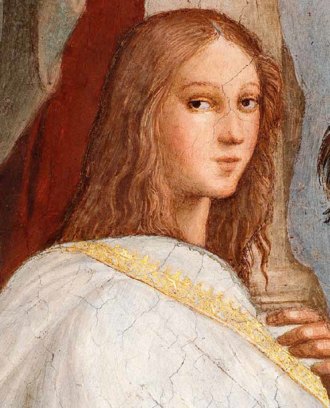
The beardless young man in Raphael's fresco The School of Athens (1509–11) is thought to be Pico della Mirandola.
In James Joyce's Ulysses, the precocious Stephen Dedalus recalls with disdain his boyhood ambitions, and apparently associates them with the career of Mirandola.
There is is a passing reference to Mirandola by H. P. Lovecraft, in the story The Case of Charles Dexter Ward (1927). Mirandola is given as the source of the fearsome incantation used by unknown evil entities as some sort of evocation.
Assessment: His wide learning and originality of thought, in particular his attempts to produce a grand synthesis of religious wisdom which would both deepen the understanding of Christianity and serve as a weapon against non-Christians, have made him the best known of Renaissance philosophers.
Oneliner: Pico della Mirandola, Renaissance mystic philosopher
Bibliography:
- Craven, William G., Giovanni Pico della Mirandola, Geneva: Libraire Droz, 1983.
- Encyclopedia Britannica.
- Routledge Encyclopedia of Philosophy.
"A Renaissance Murder Mystery" By Luke Slattery July 2015 New Yorker Magazine (link)
Father: Giovanni Francesco Pico (Gianfrancesco I)
Mother: Giulia Boiardo (d. 1479)
Siblings: At least one older brother
Spouse: None
Children: None