Cotta JF
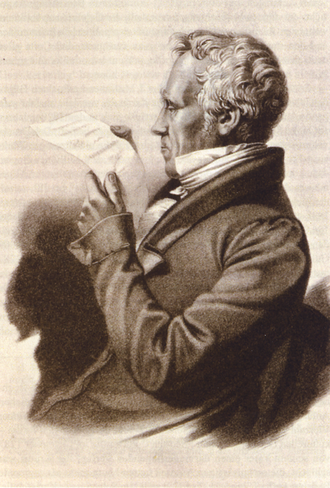
Name: Johann Friedrich Cotta
Nickname/Alias: Baron von Cottendorf
Achievements: Pioneers of the German literary press.
Born: April 27, 1764; Stuttgart, Germany
Died: December 29, 1832; Stuttgart, German (Aged 68)
Field & Discipline: Business; Publishing
Language: German
Father: Christoph Friedrich Cotta
Mother: Rosalie Pirker
Siblings: Friedrich.
Spouse: 1) Wilhelmine Haas; 2) Elisabeth von Gemmingen-Guttenberg
Children: Johann Georg Cotta, Baron von Cottendorf
Education: Stuttgart Gymnasium; Tubingen University
Major Work:
The journal: 'Allgemeine Zeitung' (1798)
Life & Times:
Cotta attended Stuttgart Gymnasium and then went to the University of Tubingen in 1782, where he studied mathematics and law. After graduating in 1785, he visited Paris to study French and natural science, where he mixed with some distinguished literary men. After returning to the university in 1786, he qualified as a barrister the following year and practised law.
He soon rejected this career in order to save the family business, at this time reduced to one printing press and bookshop in Tubingen. His first action was to attend the Leipzig Book Fair where he learned that, as long as he had a decent product to sell, he could be assured of disposing of a number of copies of almost any book.
On 11th January 1791, he married Wilhelmine Haas, the daughter of a local pastor. At this time he was in debt and it was not until 1797 that he was able to finish paying his father for the purchase of the company.
In the summer of 1792, he decided to spend some time in Paris, probably to witness the effects of the French Revolution first-hand. It was during this trip that he began to realise what a powerful tool a well-planned and competently-edited national newspaper could be. The Parisian press was already enjoying a limited period of virtually absolute freedom and a great many political newspapers were being published.
Apart from the Hamburg 'Correspondent' and a few Frankfurt papers, Germany had only provincial gazettes. It was clear to Cotta that Germany needed a national newspaper.
Cotta met the poet and literary theorist, [published] Schiller*, towards the end of 1793, when Schiller was on an extended visit to his native Wurttemberg. On May 4, 1794, he and Schiller agreed two contracts. One was for a newspaper called the 'Allgemeine Europaische Staatenzeitung' and the other was for a literary monthly called the 'Horen'.
Schiller soon broke his contract for the 'Staatenzeitung' due to his doubts that a newspaper could offer any serious contribution to political debate. Cotta kept to his side of the bargain and the 'Horen' appeared, to much critical acclaim, in January 1795.
This journal collapsed only three years later, but the venture was a formative experience for Cotta.
In the first three issues alone, he published most of Schiller's 'Letters on the Aesthetic Education of Man', essays by [published] Goethe*,[published] Fichte*, [published] Hegel*, [published] Herder*, [published] Wilhelm von Humboldt* and [published] Alexander von Humboldt* and the first instalment of a new translation of Dante's 'Inferno' by [published] August Schlegel*.
Within only two issues, he had established a reputation among the most literary authors of the day as a publisher who paid fairly and treated his authors with great care and respect. Despite folding after only three years, 'Horen' lifted the Cotta company from almost complete obscurity into the first rank of European literary houses.
In September 1798, his daily newspaper, the [his daily newspaper was] 'Allgemeine Zeitung'*, edited by Ludwig Huber, was launched and was immediately successful. Cotta worked immensely hard during these early years and by 1803 he had published two million sheets of printed matter with a firm of only a few employees and a small printing press and offices.
In 1799, he began a political career, being sent to Paris as the Wurttemberg representative. Due to censorship issues, he moved his publishing firm to Stuttgart in 1811. State affairs and a commission from the German booksellers took him to the Congress of Vienna in 1814.
The following year he was deputy-elect at the Wurttemberg Diet (government assembly) and in January 1817 was appointed Prussian privy councillor by Frederick William III. This soon led to his ennoblement as Knight of the Order of the Wurttemberg Crown. By 1824 he had become vice-president of the Wurttemberg second chamber.
During this period, Cotta had also started a branch of his publishing empire in Augsburg and another in Munich, where he introduced a steam printing press. This now made his publishing house one of the most modern in Germany.
His health had been declining for years and his trips to Berlin, in the depths of Prussian winters, took a heavy toll. Johann Friedrich Cotta died in Stuttgart in December 1832, a victim of cholera.
Assessment: Cotta enjoyed a variety of interests, including a political career, the establishment of Germany’s national newspaper and the publication of important literary works by prominent authors of his day.
Oneliner: Johann Cotta, major German literary publisher
Bibliography:
- Moran, Daniel, Towards the Century of Words: Johann Cotta and the Politics of the Public Realm in Germany, 1795-1832, Berkeley & Oxford: University of California Press, 1990.