Dante
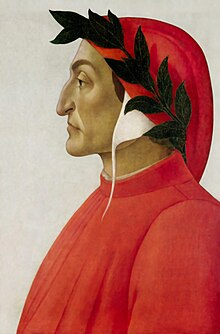
Nickname/Alias: baptized Durante, afterwards abbreviated to Dante
Achievements: Italian national poet
Born: May/June 1265; Florence, Tuscany, Italy
Died: September 14, 1321; Ravenna, Italy (Aged 56)
Field & Discipline: Literature; Poet
Language: Italian
Father: Father unknown
Mother: Bella
Siblings: Half-siblings by father’s second wife, Lapa di Chiarissimo Cialuffi: Francesco; Gaetana
Spouse: Gemma Donati
Children: Six sons and one daughter, Beatrice
Education: Possibly the University of Bologna (c. 1285)
Major Work:
“La Divina Commedia”
Life & Times:
Little is known about Dante’s youth. He claimed that in 1274, at the age of nine, he fell in love with a woman called Beatrice, to whom he paid tribute in his “La Vita Nuova” and “La Divina Commedia.” Scholars have identified her as the Florentine noblewoman Beatrice Portinari, who was related to Medici bank-manager [loved relative of] Portinari* and married to Simone de'Bardi.
Dante’s first important literary work, “La Vita Nuova,” was written not long after Beatrice’s death in 1290. It is made up of passages of prose linking poems he wrote between 1283 and 1293, and it tells of his love for Beatrice and his premonition of her death in a dream.
Although we know nothing about Dante’s education, he was obviously learned because “La Vita Nuova” incorporates a knowledge of astronomy, in particular the work of the early Islamic astronomer, [adapted work of] Al Farghani*. The poetic style shows the influence of the love poetry of Provençal troubadours.
Over the next few years Dante was active in the turbulent political life of Florence. Records from 1295 show that he held several local public offices that year. In October 1301, he was sent to Rome with two other envoys to negotiate with Pope Boniface VIII. In his absence political rivals in Florence ensured that in January 1302 he was banned from the city for a period of two years, fined and his possessions confiscated.
Dante was unaware of this and when he failed to pay the fine was condemned to death. During the early years of his subsequent exile he wrote two important works in Latin. The first, “De Vulgari Eloquentia” in 1304, was a treatise on the proper use of written Italian. Of the second, “Convivio” (c. 1304-07) only the first four books were completed. They contain Dante's most important poetic compositions from 1294 to the time of “The Divine Comedy.”
“The Divine Comedy” was Dante's masterpiece, started around 1307 and finished just before he died. It clearly shows the influence of the Florentine philosopher and rhetorician, Brunetto Latini, who appears as a major figure in the poem.
Written in verse of great precision and dramatic force, the work is an allegorical narrative of the poet's imaginary journey through hell, purgatory, and heaven and is divided into three sections, called Inferno, Purgatorio and Paradiso. In each of the three realms the poet meets mythological, historical, and contemporary characters.
Each character represents a particular fault or virtue, either religious or political, and the punishment or reward given to ach character illustrates the larger meaning of their actions within the universal scheme. Virgil, a symbol of reason, guides him through Hell and Purgatory. Beatrice, whom he regards as manifestation and instrument of divine will, is his guide through Paradise.
The work can be interpreted either as literal, allegorical, moral, or mystical. It can be interpreted as a dramatization of medieval Christian theology, or an allegory of the purification of the soul and the achievement of inner peace through the guidance of reason and love.
In 1316, the city of Florence asked Dante to return home under terms which treated him as a pardoned criminal. Dante rejected the offer, saying that he would only return if they wiped the slate clean and offered him full privileges and honors.
He remained in Ravenna until 1321, when he was sent to Venice as an ambassador. Just after he arrived he caught a fever, died on 14th September 1321 and was later buried in the city.
Extra Connections: He was a friend of [a pal of] Giotto*.
He admired [a fan of] Cimabue*
[a fan was] Bramante* was his passionate admirer
Assessment: Dante Alighieri is Italy's greatest poet and chose to write his poems not in Latin, but Italian, making it the principle literary language of western Europe for several centuries.
Oneliner: Dante Alighieri, the greatest of Italian poets
Bibliography:
- Fergusson, Francis, “Dante,” Weidenfeld & Nicolson, 1966.