Hugo
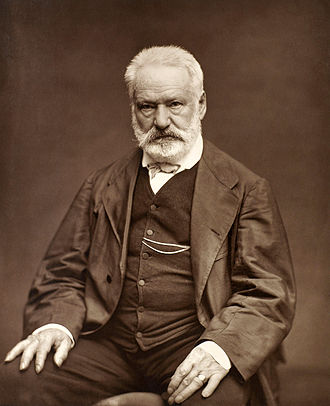
Name: Victor Hugo
Achievements: Leader of French Romantic movement.
Born: February 26, 1802; Besancon, France
Died: May 22, 1885; Paris (Aged 83)
Field & Discipline: Literature; Novelist
Language: French
Father: Joseph-Leopold-Sigisbert Hugo
Mother: Sophie Trebuchet (daughter of a slave trade sea captain from Nantes, France)
Siblings: Abel; Eugene
Spouse: Adele Fouceron (daughter of family friend)
Children: 5 (4 survived)
Education: Private tutoring; Lycee Louis le Grand, Paris (1815-1818)
Major Work:
“Les Miserables”
Life & Times:
In 1815, after the fall of Napoleon, Victor was sent to the Lycee Louis le Grand. Two years later his first literary efforts took the form of an entry for the Academie Francaise poetry competition. His subject: “The Happiness to be derived from Study in all the Circumstances of Life.” This won him an honorable mention, the press took an interest, and the Permanent Secretary of the Academie asked to see him and he was invited to tea with the King.
In 1819 the brothers left school and took up the study of law for two years. At this time both boys met and fell in love with 15-year-old Adele Foucheran, daughter of an old family friend. They also began to publish a magazine: “Le Conservateur Litteraire,” of poetry, literary criticism and fiction. Victor wrote three quarters of the content: odes, articles, stories, under a pen name. The magazine was sponsored by Chateaubriand, the leading literary figure of the day.
By 1821 Victor’s mother had died, they were deeply in debt, the magazine closed down, and the family was on the breadline. By 1822 things had turned round. Poems, published for Victor by his brother Abel, were well-received and even made Victor money. There followed another invitation tea with the King, who gave Victor 1,200 francs, making him financially secure enough to marry Adele. At the wedding, the best man was one of Victor’s close friends, poet [a pal of] de Vigny*
By 1824 Victor was well-known for his literary criticism (he wrote much about, and was influenced by [influenced by] Byron*, even though his English was not good). This year, “Nouvelles Odes” was a big success, sold out in two weeks, and Victor became one of the few young writers able to live off his work.
The new King, Charles X made him a member of the Legion d’Honneur and Victor and Adele set off on a trip to Switzerland accompanied by Charles Nodier, editor of “Muse Francaise,” a magazine to which Victor contributed, as did other aspiring writers: [joined group with] Balzac,* [joined group with] Alexandre Dumas pere* as well as [joined group with] Lamartine* and de Vigny (the group by now known as the “Romantics”).
In 1826 Victor’s career really took off. His approach was disciplined. Every evening at 8 pm he would stop writing even if in the middle of a word. In 1827 “Ode to the Place Vendome Column” made him a national figure. In 1830 his first play, “Hernani,” was pronounced the best since Voltaire. In 1831 came a play: “Le Roi s’amuse,” on which [work adapted by] Verdi* would base “Rigoletto.” Late that year Victor finished his most famous novel of all: “The Hunchback of Notre Dame.”
In 1832 the family moved upmarket, to 6, Palais Royale, into sumptuous surroundings, where Victor played host to such notables as the Polish composer [visited by] Liszt.* In 1833 Victor fell for 26-year-old Juliette Drouet, a beautiful actress who had appeared in one of his plays, and he, Adele and Juliette set up a ménage a trios. Juliette remained a part of his life from then on.
In 1836, with a political career in mind, Victor put himself up for election to the Academie Francaise. To his stupefaction, he was turned down several times. He moved into high society, inviting public figures and politicians to his house. One of them, the Duke of Orleans, got him into the Academie in 1841.
Two years later, after the publication of his play “Ruy Blas,” Victor was to be devastated by the drowning death of his daughter Leopoldine. He would publish nothing for another nine years. In 1845 he began on “Les Miserables.” Two years later King Louis-Phillippe ennobled him.
In 1848 came the revolution and the abdication of the King. Victor was made a Deputy in the new Constituent Assembly, and founded “L’Evenement,” a reformist daily that supported the election of Louis Napoleon to the French Presidency. In 1851 when Louis-Phillippe made himself President for 10 years and dissolved the Assembly, Victor took up the cause against him, tried to provoke an uprising, and was obliged to flee to Belgium, where he was soon expelled and headed for Jersey (via London, where he met a fellow revolutionary, the [met] Mazzini*).
In Jersey Victor set up in grand style at Hautville House, and installed Juliette in a nearby villa. Life became once again very grand, surrounded by thousands of books, baroque furniture, gold and silver plate, an eight foot high brass cannon, porcelain peacocks, and a giant chair only Victor used, inscribed “Ego Victor.”
His sons were busy translating Shakespeare, his daughter wrote symphonies and his wife copied manuscripts. As the visiting writer [a pal of] Sand* was to say: "There are no idle hands begging for the intervention of the devil at the Maison Hugo. Victor is the grand master of a literary factory."
In 1862 “Les Miserables” appeared simultaneously in London, Brussels, Berlin, St Petersburg, Turin and Paris. Writer [admired by] Meredith* proclaimed it the master work of the century.
1870 saw the fall of [exiled by] Napoleon III* and Victor’s triumphant return to Paris, where, at the Gard du Nord, his train was welcomed by thousands. It was at this time, during a revival of “Ruy Blas” that Victor met and had a brief affair with the actress [had affair with] Bernhardt.*
In 1876 Victor was finally made a member of the Senate. Two years later, when Victor was 76, his birthday was declared a national holiday and a Paris avenue was named after him. The public paraded past his house. A young social reformer and writer, [funeral attended by] Zola* said there were more than 1 ½ million people present. It was an unprecedented honor for any French citizen.
In 1885 Victor died, his body lay in state under the Arc de Triomphe, and was buried in the Pantheon.
Extra Connections: He knew [knew] Kingsford,* founder of an anti-vivisection society of which he was President. He also knew [knew] Pathe*
Inspired [inspired] Cormon*
Critiqued by [critiques by] Baudelaire*.
[work adapted by] Delibes* wrote music for “Le roi s’amuse”
[parodied by] Harte* wrote a parody of him
Met [met] Flaubert*, [met] Degas*, [met] Beethoven* and [met] Wilde*
Friend of [a pal of] De Musset*.
[work adapted by] Donizetti* based his “Lucrezia Borgia” on Hugo’s play.
Influenced [influenced] Verlaine* and [influenced] Mallarme*
He was a fan of the tragedian [a fan of]Macready*
Assessment: Victor Hugo is still reckoned to be one of France’s greatest .writers on social conditions
Oneliner: Victor Hugo, author of Les Miserables
Bibliography:
- Richardson, Joanna Victor Hugo, George Weidenfeld & Nicholson Ltd; London, 1976.
- Edwards, Samuel Victor Hugo, A Biography; New English Library; London, 1975.