Dance G
Name: George Dance
Nickname/Alias: George Dance, The Younger (to distinguish him from his father)
Achievements: Redesigned Newgate Prison, London.
Born: April 1, 1741; London, England
Died: January 14, 1825; London, England. Aged 85
Field & Discipline: Architecture; Architect
Language: English
Father: George Dance
Mother: Elizabeth Gould
Siblings: James; Giles; Nathaniel; William; Hester
Spouse: Mary Gurnell
Children: Thomas; George; Charles
Education: St Paul’s, London
Major Work:
Newgate Prison Guildhall
Life & Times:
Dance’s father was a well-known architect who held the post of surveyor to the city of London. When he was seventeen, Dance, who planned to follow his father’s profession was sent to join his brother [brother was] Dance-Holland* (who was studying painting) in Rome, where he studied with an architect and designer.
He learned geometry and draughtsmanship, measured ancient monuments and cast models of classical columns and sculpture.
He returned to England after five years in 1764 and began working in his father’s office. In 1765 he was selected to rebuild the medieval church of All Hallows, London Wall. Dance’s designs for the interior of the church set him among the earliest exponents of neo-classicism in England.
In 1767 Dance drew up plans for a housing development in London and introduced the idea of the crescent. In 1768 Dance’s father died and Dance took over both the firm and his father’s position of surveyor to the city of London. At the age of twenty-six he was responsible for work including development schemes in the City, street widening and improvement, repairs to the dock at Billingsgate, surveys of land owned by the City, renovation of street markets, rebuilding of hospitals, prisons and churches.
The project for which he is best known in London was the 1770-1778 rebuilding of Newgate Prison. He produced a massive and forbidding building, the impression of severity and monumental strength heightened by the rough-hewn masonry, and by making each stone of the first eight courses much larger than those of the upper courses. The novelist [influenced] Dickens* described the huge entrances as “looking as if they were made for the express purpose of letting people in, and never letting them out again.” * Newgate Prison & Sessions House (1769–1777) damaged in the Gordon riots (1780) and restored (1780–1783), demolished (1902–04).

Newgate Prison, c. 1810
The drama of the building may have been influenced by Dance’s admiration for the work of the Italian engraver [met] Piranesi*, whom he met in Rome. The interior of the prison was humanely planned (according to contemporary notions of prison regimes). . There was an adequate supply of lavatories, and a good supply of water and fireplaces. When the prison reformer John Howard later published his reforming work on prisons, he expressed the view that Newgate, was at least, clean.
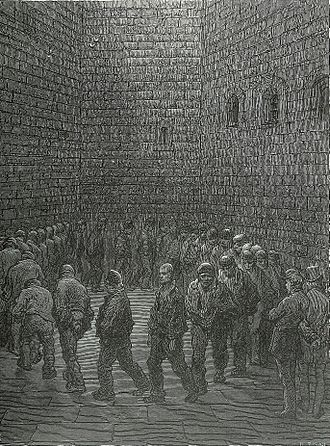
Newgate exercise yard, 1872, by Gustave Doré
Dance was also began on another major project. At the time the Guildhall, which housed the council, administration and law offices of the city of London, was a crowded complex of buildings in urgent need of re-organizing. Dance repaired and renovated various buildings, and rebuilt the south front.
Dance’s friend and neighbor, the artist William Hodges, had visited India and had produced a book of paintings of Indian scenery that [work related to] Sir Joshua Reynolds* suggested might supply themes for architects. London’ financial community may have accepted Dance’s plans because so many of them were involved in the affairs of the [work related to] East India Company*.
In 1780, Pratt commissioned Dance to supply designs for his house in the country, Camden Place, where the Empress [designed retreat of] Eugenie* and Emperor [designed retreat of] Napoleon III* of France would later live in exile.
Unlike [colleague was] Adam*, Dance had to give most of his time to unglamorous and even commonplace projects, and was not asked to undertake work for fashionable or cultured private individuals. In the 1780s and ‘90s, he continued with the demands of his London work, of which the most important projects were the building of the Surgeon’s theatre at St Bartholomew’s Hospital, St Luke’s Hospital for Insane and the Giltspur prison.
In 1791, he was one of the group of architects who founded a dining club called the Architect’s Club, which later became the Royal Institute of British Architects.
Dance also had a gift for portraiture. On a visit to Strawberry Hill in 1793 he drew [sketched portrait of] Horace Walpole*. He also made many pencil portraits of his friends, including profile portraits of the fellow Royal Academicians.
He was also interested in music and was a friend of Dr Charles Burney, the father of [family friend of] Burney*, at whose house he used to play chamber music. When the composer [met and drew] Haydn* visited London in 1794 Dance met him many times and made four pencil portraits.
The successful use of the crescent and the circus in Dance’s street developments influenced John Nash who later designed Oxford Circus and Park Crescent.
In 1798 Dance was made professor of architecture at the Royal Academy, a post he held until 1806. He was now more able to delegate work in the London practice and in 1802 he accepted a commission from his friend Sir George Beaumont to make designs for Cole Orton, his house in Leicestershire.
In 1806 the poet [work admired by] Wordsworth* and his family took the Beaumonts’ farm on the estate. Wordsworth thought the new house looked very good by moonlight.
In 1807 Dance designed and built a new house at Hyde Park Corner in London for his brother Nathaniel, who was now extremely rich.
Assessment: Dance was responsible for introducing innovative measures to London planning schemes and is remembered for his design of Newgate Prison.
Oneliner: George Dance, influential neoclassical architect
Bibliography:
- Stroud, Dorothy, George Dance, Architect, Faber and Faber Ltd., London, 1971.