Solar System
The Solar System^ is the gravitationally bound system of the Sun and the objects that orbit the star. The largest of such objects are the eight planets, in order from the Sun: four terrestrial planets named Mercury, Venus, Earth and Mars, two gas giants named Jupiter and Saturn, and two ice giants named Uranus and Neptune. The terrestrial planets have a definite surface and are mostly made of rock and metal. The gas giants are mostly made of hydrogen and helium, while the ice giants are mostly made of 'volatile' substances such as water, ammonia, and methane. In some texts, these terrestrial and giant planets are called the inner Solar System and outer Solar System planets respectively.
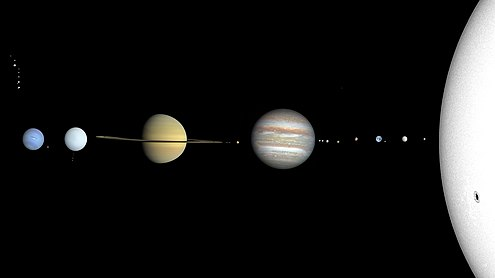
The Solar System was formed 4.6 billion years ago from the gravitational collapse of a giant interstellar molecular cloud. Over time, the cloud formed the Sun and a protoplanetary disk that gradually coalesced to form planets and other objects. That is the reason why all eight planets have an orbit that lies near the same plane. In the present day, 99.86% of the Solar System's mass is in the Sun and most of the remaining mass is contained in the planet Jupiter. Six planets, six largest possible dwarf planets and many other bodies have natural satellites or moons orbiting around them. All giant planets and a few smaller bodies are encircled by planetary rings, composed of ice, dust and sometimes moonlets.
There are an unknown number of smaller dwarf planets and innumerable small bodies orbiting the Sun.[d] These objects are distributed in the asteroid belt that lies between the orbits of Mars and Jupiter, the Kuiper belt, the scattered disc that both lies beyond Neptune's orbit and at even further reaches of the Solar System which they would be classified as an extreme trans-Neptunian object. There is consensus among astronomers to these nine objects as dwarf planets: the asteroid Ceres, the Kuiper-belt objects Pluto, Orcus, Haumea, Quaoar, and Makemake, and the scattered-disc objects Gonggong, Eris, and Sedna.[d] Many small-body populations, including comets, centaurs and interplanetary dust clouds, freely travel between the regions of the Solar System.
The solar wind, a stream of charged particles flowing outwards from the Sun, creates a bubble-like region of the interplanetary medium in the interstellar medium known as the heliosphere. The heliopause is the point at which pressure from the solar wind is equal to the opposing pressure of the interstellar medium; it extends out to the edge of the scattered disc. The Oort cloud, which is thought to be the source for long-period comets, may also exist at a distance roughly a thousand times further than the heliosphere. The nearest stars to the Solar System are within the Local Bubble; the closest star is named Proxima Centauri and is at a distance of 4.2441 light-years away.
Formation and evolution
Main article: Formation and evolution of the Solar System

Artist's impression of the early Solar System's protoplanetary disk, out of which Earth and other Solar System bodies formed
The Solar System formed 4.568 billion years ago from the gravitational collapse of a region within a large molecular cloud.[e] This initial cloud was likely several light-years across and probably birthed several stars.[10] As is typical of molecular clouds, this one consisted mostly of hydrogen, with some helium, and small amounts of heavier elements fused by previous generations of stars. As the region that would become the Solar System, known as the pre-solar nebula,[11] collapsed, conservation of angular momentum caused it to rotate faster.
The center, where most of the mass collected, became increasingly hotter than the surrounding disc.[10] As the contracting nebula rotated faster, it began to flatten into a protoplanetary disc with a diameter of roughly 200 AU (30 billion km; 19 billion mi)[10] and a hot, dense protostar at the center.[12][13] The planets formed by accretion from this disc,[14] in which dust and gas gravitationally attracted each other, coalescing to form ever larger bodies. Hundreds of protoplanets may have existed in the early Solar System, but they either merged or were destroyed or ejected, leaving the planets, dwarf planets, and leftover minor bodies.[15][16]
...
Within 50 million years, the pressure and density of hydrogen in the center of the protostar became great enough for it to begin thermonuclear fusion.[18] The temperature, reaction rate, pressure, and density increased until hydrostatic equilibrium was achieved: the thermal pressure counterbalancing the force of gravity. At this point, the Sun became a main-sequence star.[19] The main-sequence phase, from beginning to end, will last about 10 billion years for the Sun compared to around two billion years for all other phases of the Sun's pre-remnant life combined.[20] Solar wind from the Sun created the heliosphere and swept away the remaining gas and dust from the protoplanetary disc into interstellar space. As helium accumulates at its core the Sun is growing brighter;[21] early in its main-sequence life its brightness was 70% that of what it is today.[22]
The Solar System will remain roughly as it is known today until the hydrogen in the core of the Sun has been entirely converted to helium, which will occur roughly 5 billion years from now. This will mark the end of the Sun's main-sequence life. At that time, the core of the Sun will contract with hydrogen fusion occurring along a shell surrounding the inert helium, and the energy output will be greater than at present. The outer layers of the Sun will expand to roughly 260 times its current diameter, and the Sun will become a red giant. Because of its increased surface area, the surface of the Sun will be cooler (2,600 K (2,330 °C; 4,220 °F) at its coolest) than it is on the main sequence.[20]
The expanding Sun is expected to vaporize Mercury as well as Venus, and render Earth uninhabitable (possibly destroying it as well). Eventually, the core will be hot enough for helium fusion; the Sun will burn helium for a fraction of the time it burned hydrogen in the core. The Sun is not massive enough to commence the fusion of heavier elements, and nuclear reactions in the core will dwindle. Its outer layers will be ejected into space, leaving behind a dense white dwarf, half the original mass of the Sun but only the size of Earth.[23] The ejected outer layers will form what is known as a planetary nebula, returning some of the material that formed the Sun—but now enriched with heavier elements like carbon—to the interstellar medium.[24]
Structure and composition
Further information: List of Solar System objects and Planet § Planetary attributes...