Copernicus
Nickname/Alias: Born: Mikolaj Kopernik
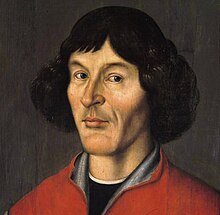
Achievements: Cosmology
Born: February 19, 1473; Torun, eastern Poland
Died: May 24, 1543; Frombork, Poland (Aged 70)
Field & Discipline: Science; Astronomy
Language: German
Father: Father: Niklas Kopernik
Mother: Barbara Watzelrode
Siblings: 1 brother: Andreas; 2 sisters: Katharina, Barbara
Spouse: None
Children: None
Education: Local school, Thorn; University of Cracow
Major Work:
"On the Revolutions of the Celestial Spheres" (1543)
Life & Times:
In 1500 Copernicus visited Rome, where he taught mathematics privately and made observations on a lunar eclipse which he used later for his lunar theory.
His (administrative) canon’s post back at the cathedral of Frombork, Poland gave him financial independence for life and in 1501 he paid a brief visit there to confirm his appointment and secure formal leave of absence to continue his studies.
He then spent over three years studying law and medicine at Padua University and obtained a doctorate in Canon Law from Ferrara in 1503. In 1512 he returned to Frombork and began a systematic study of the movements of planets.
He recorded his observations, and as they were circulated so his fame as an astronomer grew. In 1514 he was consulted on calendar reform by the Lateran Council, but ducked the issue, saying that the positions of the Sun and the Moon were not yet exactly known.
He was doubtful about the validity of the [questioned] Ptolemy’s* complex Earth-centered astronomical system (on which all investigation of the heavens was based), and decided that there must be a simpler way of doing things. He discovered that other ancient Greeks had suggested the idea of a heliocentric universe, and this seemed better seemed even though it still needed complex mathematical calculations to predict planetary movement.
In 1514 he circulated among his scholarly friends a summary of his ideas in a manuscript entitled "A Commentary on the Theories of the Motions of Heavenly Objects from Their Arrangements."
Over the next twenty years Copernicus developed his ideas, backing them up with mathematical calculations and diagrams. In 1533 Pope Clement VII gave his approval and in 1540 Copernicus reluctantly allowed [pupil was] Rheticus*, one of his pupils, to take the manuscript to be printed at Nurnberg in Germany.
When Protestant reformers including [work opposed by] Luther* and [work opposed by] Melanchthon* opposed publication, Rheticus took the manuscript to Leipzig where the Humanist scholar [manuscript altered by] Osiander* oversaw publication.
Osiander added a preface to the work in which he stated that Copernicus's model of the heavens only provided a working model for the simplification of astronomical mathematics and did not claim to represent what was really going on in the sky. This was in order to reduce the dangerous hostility to any ideas that contradicted [contradicted] Aristotle* who had claimed that the Earth was the fixed central point in the universe.
To consider that the Earth was not the centre of a universe was seen by Rome as questioning the god-given order of the universe and threatening man's special relationship with God.
If the earth were just one more planet then it was open to scientific investigation, which conservatives considered an affront to divine authority.
Scientific circles were more receptive to Copernican theory and at the beginning of the seventeenth century the Ptolemaic theory was first formally abandoned by [influenced] Kepler*.
In Copernicus's time, while some astronomers and philosophers even welcomed his theory as a long overdue alternative to the Ptolemaic system, others were outraged at its revolutionary implications.
In the 1543: "On the Revolutions of the Celestial Spheres", Copernicus put forward a view of the universe that provided a new basis for making the mathematical calculations needed to provide accurate information for calendar reform, to predict astronomical events like eclipses, and to investigate the cosmos. He stated that the sun, not the earth, was the fixed point in the centre of the universe. The earth was not fixed: it rotated daily round its own axis and made an annual revolution around the sun.
He also gave a new order of the planets, in which the planets were arranged at a distance from the stationary sun in the following order: Mercury, Venus, Earth with the Moon orbiting around it, Mars, Jupiter and Saturn. The Copernican system offered scientists a less clumsy method than that of Ptolemy for calculating planetary movement but it did mean they had to make two major changes in their mind-set.
The first arose from the concept of the Earth orbiting round the Sun. If this were so, then the stars should move periodically move their positions very slightly. The problem was that they had been seen not to do so at all. Copernicus said this was because they were too far away for any change to be seen. This meant that the universe was much bigger than had been supposed. In England this was interpreted as an infinite universe with stars scattered throughout space.
The second change challenged Aristotle by upsetting his doctrine on gravity. Aristotle had said that objects fell to "their natural place" i.e., to the centre of the universe: Earth. According to Copernican theory, the Earth was not at the centre of the universe, so a new explanation was needed. This eventually led to [triggered gravity work by] Newton's* laws of gravity.
Copernicus died in the same year his theories were published and is believed to have received a copy of "De Revolutionibus orbium coelestium" on the last day of his life.
Extra Connections: He was influenced by the work of [influenced by] Al Battani*
Pope [appointed by] Alexander VI* gave him professorship
His system was opposed by [opposed by] Bellarmine*
An edition of his book was published by [published by] Blaeuw*
His work influenced [influenced] Brahe*, [influenced] Donne*, [influenced] Galileo*, [influenced] Gilbert*, [influenced] Maestlin*, [influenced] Scaliger*, [influenced] Stevin*
His biography was written by [biography written by] Gassendi*
He was anticipated by [anticipated by] Cusa*
He corrected [corrected] Peuerbach’s* work
He was influenced by [influenced by] Regiomontanus’* work.
His tables were reworked by [tables reworked by] Reinhold*
Assessment: Copernicus revolutionized astronomy and his theory had a profound effect on philosophical and religious thought.
Oneliner: Nicolaus Copernicus, who discovered how the solar system works
Bibliography:
- Armitage, Angus, Copernicus, The Founder of Modern Astronomy, George Allen & Unwin Ltd., London, 1938.
- Koyre, Alexandre, The Astronomical Revolution, Methuen, London, 1973.