Bell AM
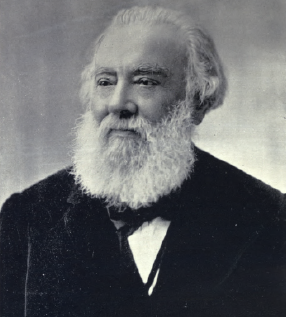
NAME: Bell, Alexander Melville
DATE OF BIRTH: 1 March 1819
PLACE OF BIRTH: Edinburgh, Scotland
DATE OF DEATH: 7 August 1905
PLACE OF DEATH: Washington DC, USA.
DISCIPLINE: Educator
FIELD: Education for the Deaf
ASSESSMENT: "Visible Speech" became a vital tool in the education of the deaf and the mute.
LANGUAGE: English
EDUCATION: School in Dundee; University of Edinburgh
ACHIEVEMENTS: Phonetic system of teaching language
MAJOR WORK: "Visible Speech" (1866)
PARENTS: Father, Alexander Bell, Mother, Elizabeth Colvill
SPOUSE: 1. Eliza Grace Symonds, 2. Harriet Shibley
SIBLINGS: 1 brother: David 1 sister: Elizabeth
CHILDREN: 3 sons: Melville, Alexander G,Edward
LIFE AND TIMES:
Bell was brought up near Glasgow where his father, a shoemaker turned actor, had established himself as a well-known elocution teacher and speech therapist. At the age of fifteen, after his parents divorced, Bell accompanied his father to London. He acted as assistant to his father who successfully set himself up in London as a teacher and writer of books on elocution and speech problems.
When he was nineteen, Bell went to live with friends in Newfoundland where he treated stammerers as well as directing amateur theatricals. On his return to London he joined his father's practice. On a visit to Edinburgh Bell fell in love with a deaf girl and after marrying her got a lectureship in elocution at Edinburgh University in 1843. He stayed there for over twenty years during which time he published works on elocution and on remedial treatment for speech defects. Unlike other speech therapists, Bell believed in making any useful treatment available to everybody, and in explaining the processes of therapy. In 1860 he published his Standard Elocutionist" which brought together all his research and was reprinted several times.
Over the years, he also worked on an idea he had for a physiological alphabet with symbols that related to the movements the vocal organs made for each sound. He slowly and systematically collected and analysed all the sounds that could be made by the human voice and then developed a way of describing the sounds visually.
He developed a set of ten basic symbols referring to the vocal chords, the tongue, lips, larynx and nasal passage, which could be combined and expanded to instruct speakers how to arrange the various parts in order to make a specific sound.
He invented a new category of sounds, halfway between vowels and consonants, which he named 'glides' and for which he produced symbols; and he also invented symbols to indicate tone, inflection, and sounds like sucking and clicking. In this way he provided a complete and universally applicable system of phonetic notation for sound. He called his system ‘Visible Speech.’
Bell used his sons to demonstrate his system, sending them away to another part of the house, while guests gave him a list of sounds for them to reproduce. Sounds in French and Gaelic were included, as were non-linguistic sounds like chuckling. Bell wrote them down in his phonetic alphabet, then called his sons in, showed them the signs, and to the guests' astonishment the boys reproduced the sounds.
In 1865 his father died and Bell took over his practice in London, assisted by his son, Alexander Graham Bell*. Bell was appointed professor of vocal physiology and lecturer in elocution at London university and in 1866 he published "Visible Speech: A New Fact Demonstrated". His shorthand system in Visible Speech was adopted by many teachers and writers, among them the phonetics scholar Sweet *, but it never rivalled the popularity of the phonetic shorthand system by [Pitman*.
In 1869 Bell went to America to publicize his work and gave lectures in New England. By now two of Bell's sons had died from tuberculosis and when Alexander's health seemed in danger Bell decided to take his family away from the damp of England. In 1870 they went to Canada where Bell became a lecturer in philology at Queen's College, Kingston, Ontario. He also undertook lecture tours and gave public readings.
His Visible Speech was now well-known in England and abroad. In Ireland during the 1870's, Chichester Bell, Bell's nephew, taught it to George Bernard G.B. [Shaw*, then working as a cashier in a land agent's office and already interested in the idea of phonetics and a universal alphabet. [Bell would later have Henry Higgins use the system in his: “Pygmalion” (“My Fair Lady”)].
In 1881 Bell moved to Washington DC to be near his son, who had settled there. Bell was in great demand as a lecturer and he continued to publish works on elocution, including a revised edition of Visible Speech which became a standard book for teachers of the deaf and mute. In 1897 he became an American citizen.
EXTRA CONNECTIONS: The voice of Bell, citing a sentence from Hamlet, can be heard at the Smithsonian Institution, as extracted from an 1881 graphophone recording.
ONELINER: AM Bell, father of Alexander Graham
BIBLIOGRAPHY:
Hitz, John,Alexander Melville Bell, Obituary Notice in Biographical Tracts, 1904-5, Washington, 1905
Mackay, James, Sounds Out of Silence, The Life of Alexander Graham Bell, Mainstream Publishing, Edinburgh and London, 1997.