Burning Man
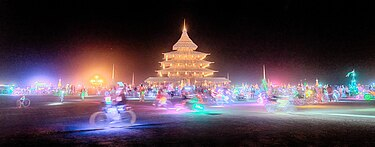
Burning Man is a week-long large-scale desert event focused on "community, art, self-expression, and self-reliance" held annually in the western United States.[1][2] The event's name comes from its culminating ceremony: the symbolic burning of a large wooden effigy, referred to as the Man, that occurs on the penultimate night, the Saturday evening before Labor Day.[3]
Since 1991, the event has been at Black Rock City in northwestern Nevada, a temporary city erected in the Black Rock Desert about 100 miles (160 km) north-northeast of Reno. According to Burning Man co-founder Larry Harvey in 2004, the event is guided by ten stated principles: radical inclusion, gifting, decommodification, radical self-reliance, radical self-expression, communal effort, civic responsibility, leaving no trace, participation, and immediacy.[4]
At Burning Man, there are no headliners or scheduled performers. Instead, the participants design and build all the art, activities, and events.[5] Artwork includes experimental and interactive sculptures, buildings, performances, and art cars, among other media. These contributions are inspired by a theme chosen annually by the Burning Man Project.[6]
The event has been called "countercultural revelry" and described by its organizers as an "excuse to party in the desert".[7] However, NPR said of Burning Man in 2019, "Once considered an underground gathering for bohemians and free spirits of all stripes, Burning Man has since evolved into a destination for social media influencers, celebrities and the Silicon Valley elite."[8]
Burning Man originated on June 22, 1986, on Baker Beach in San Francisco as a small function organized by Larry Harvey and Jerry James, the builders of the first Man. It has since been held annually, spanning the nine days leading up to and including Labor Day. Over the event's history, attendance has generally increased. In 2019, 78,850 people participated.[9]
Burning Man is organized by the Burning Man Project, a nonprofit organization that, in 2013, succeeded Black Rock City LLC, a for-profit limited liability company. Black Rock City LLC was formed in 1999 to represent the event's organizers and is now considered a subsidiary of the nonprofit organization. The Burning Man Project endorses multiple smaller regional events guided by the Burning Man principles, in the United States and internationally.
History
1980s
 Two of the founders of Burning Man: John Law (left) and Michael Mikel (right)
Burning Man began as a bonfire ritual on the summer solstice. Sculptor Mary Grauberger, a friend of Larry Harvey's girlfriend, Janet Lohr, held solstice bonfire gatherings on Baker Beach for several years before 1986, some of which Harvey attended. When Grauberger stopped organizing it, Harvey "picked up the torch", with Grauberger's permission, and ran with it.[10] He and Jerry James built the first wooden effigy on June 21, 1986, cobbled together using scrap wood, to be torched that evening. On June 22, Harvey, James, and a few friends met on Baker Beach in San Francisco[11][12] and burned an 8-foot-tall (2.4 m) wooden man and a smaller wooden dog. Harvey later described his inspiration for burning these effigies as a spontaneous act of "radical self-expression".[10] In 1987, the Man grew to 15 feet (5 m) tall, and by 1988, it had grown to 30 feet (9 m).[13][14]
By 1988, Harvey formally named the summer solstice ritual "Burning Man" by titling flyers for the happening as such. This was apparently done to ward off references to "wicker man", the reputed Celtic pagan practice of burning live sacrifices in human-shaped wicker cages. Harvey has said that he had not seen the 1973 cult filmThe Wicker Man until many years after and that it did not inspire the action.[13][15]
1990 to 1996
8mm film footage of Burning Man in 1995 by Ammon Haggerty
In 1990, a separate event was planned by Kevin Evans and John Law on the remote and largely unknown playa, known as the Black Rock Desert, about 110 miles (180 km) north of Reno, Nevada.[16] Evans conceived it as a dadaist temporary autonomous zone with sculptures to be burned and situationist performance art. He asked John Law, who also had experience on the dry lake and was a defining founder of the Cacophony Society, to take on central organizing functions of the events. In the Cacophony Society's newsletter, it was announced as Zone Trip No. 4, A Bad Day at Black Rock (inspired by the 1955 film of the same name).
Meanwhile, the solstice burn at Baker Beach was interrupted by the park police for not having a permit. After striking a deal to raise the Man but not to burn it, event organizers disassembled it and returned it to the vacant lot where it had been built. Shortly thereafter, the legs and torso of the Man were chain-sawed and the pieces removed when the space was unexpectedly leased as a parking lot. The Man was reconstructed, led by Dan Miller, Harvey's then-housemate of many years, just in time to take it to Zone Trip No. 4.[17]
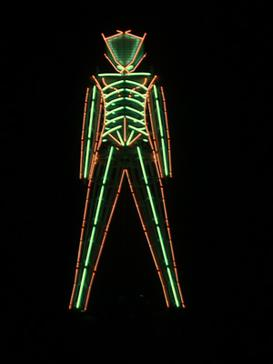
Michael Mikel, another active Cacophonist, realized that participants unfamiliar with the environment of the dry lake would benefit from knowledgeable persons helping to ensure they did not get lost in the deep dry lake and risk dehydration and death. He took the name Danger Ranger and created the Black Rock Rangers to assist them. Thus, Black Rock City began as a fellowship, organized by Law and Mikel, based on Evans's and Grauberger's ideas, along with Harvey's and James's symbolic man. Drawing on experience in the sign business and with light sculpture, Law prepared custom neon tubes for the Man starting in 1991 so it could be seen as a beacon to aid navigation at night long before there were any planned roads.
In its early years, the community grew by word of mouth alone, all were considered (and generally not invited until they could be expected to be) participants under their contribution to the cacophonous situationist vibe. There were no paid or scheduled performers or artists, no separation between art and life nor art-space and living-space, no rules other than "Don't interfere with anyone else's immediate experience" and "no guns in central camp".
1991 marked the first year that the event had a legal permit through the BLM (the Bureau of Land Management).[18] It was also the year that art model and fire dancer (and later Burning Man's first art director) Crimson Rose attended the event.[19] 1992 saw the birth of a smaller, intensive, nearby event named "Desert Siteworks", conceived and directed by William Binzen and co-produced (in 1993 and '94) with Judy West.[20] There were about 20 participants the first year, and approximately 100 in the second and third year. The annual, several weeks-long event, was held over summer Solstice at various fertile hot springs surrounding the desert. Participants built art and participated in self-directed performances.[21]
Some key organizers of Burning Man were also part of Desert Siteworks (Law, Mikel) and Binzen was a friend of Harvey. Hence, the two events saw much cross-pollination of ideas and participants.[22] The Desert Siteworks project ran for three years (1992–1994). 1996 was the first year a formal partnership was created to own the name "Burning Man" and was also the last year that the event was held in the middle of the Black Rock Desert with no fence around it.
Before the event opened to the public in 1996, a worker named Michael Furey was killed in a motorcycle crash[23] while riding from Gerlach, Nevada, to the Burning Man camp in the Black Rock Desert. Harvey insisted that the death had not occurred at Burning Man, since the gates were not yet open. Another couple were run over in their tent by an art car driving to the "rave camp", which was at that time distant from the main camp. After the 1996 event, Law broke with Burning Man and publicly said the event should not continue.
1997 to 2013
...
As the population of Black Rock City grew, more restrictions were added by the BLM, and changes were made in how people were invited to the event, notably the addition of publicized online ticket sales to all comers, further rules were established concerning its survival. Some critics of the later phase of the event cite these rules as impinging on the original freedoms and principles, diminishing the scope of the experience unacceptably, while many newer attendees find the increased level of activity more than balances out the changes:
- A grid street structure.[26]
- A speed limit of 5 mph (8 km/h).[27]
- A ban on driving, except for approved "mutant vehicles" and service vehicles.[28]
- Safety standards on mutant vehicles.[27]
- Burning of any art must be done on an approved burn platform.[29]
- A ban on fireworks.[30]
- A ban on animals.[31] ...
2013 to 2019
In December 2013,[36] Black Rock City LLC was made a subsidiary of a new nonprofit entity known as the Burning Man Project, though this was a controversial move among the founders.[37]
On September 3, 2017,[38] a 41-year-old man, Aaron Joel Mitchell, fought his way past a safety cordon of volunteers and firefighters and threw himself into the flames of the Man. Mitchell died the next day due to cardiac arrest, bodily shock, and third-degree burns to 98% of his body. While a reputable member of the DPW claims this was the result of a dare to run through the flames, his death was ruled a suicide.[39][40][41][42]
2020 to 2021
 2021 Man built of drones
On April 10, 2020, the Burning Man Project announced that Burning Man was canceled for 2020[43] due to the COVID-19 pandemic, making 2020 the first year Burning Man did not happen since its inception. They then decided to offer ticket refunds despite the tickets being sold explicitly as non-refundable.[44]...
In 2022, an additional restriction on the total number of attendees for the entirety of the event was introduced. "The cumulative maximum authorized population for the 2022 event is 87,000 total attendees." The maximum number of attendees on the playa at any one time remained as it was in 2019 at 80,000.[127]: 1
Principles
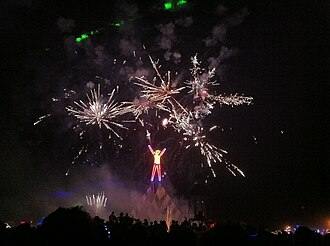
 The man effigy with fireworks before being burned in 2011
Because of the variety of goals fostered by participatory attendees, known as "Burners," Burning Man does not have a single focus. Features of the event are subject to the participants and include community, artwork, absurdity, decommodification and revelry. Participation is encouraged.[139][140]
The Burning Man event and its affiliated communities are guided by 10 principles meant to evoke the cultural ethos that has emerged from the event. They were originally written by Larry Harvey in 2004[141] as guidelines for regional organizing, then later became universal criteria of the general culture of the multifaceted movement. The 10 Principles are:[142]
- radical inclusion
- gifting
- decommodification
- radical self-reliance
- radical self-expression
- communal effort
- civic responsibility
- leaving no trace
- participation
- immediacy
The descriptions in quotes are the actual text:
Radical inclusion
"Anyone may be a part of Burning Man. We welcome and respect the stranger. No prerequisites exist for participation in our community." This was written with a broad stroke for general organizing, meaning anyone is welcome to the Burning Man culture. Prerequisites for the Burning Man[142] event are: participants are expected to provide for their own basic needs, follow the guidelines in the annually updated event "survival guide", and purchase a $475 ticket to get in.[143]
Gifting
"Burning Man is devoted to acts of gift-giving. The value of a gift is unconditional. Gifting does not contemplate a return or an exchange for something of equal value." Instead of cash, burners are encouraged to rely on a gift economy, a sort of potlatch. In the earliest days of the event, an underground barter economy also existed, in which burners exchanged "favors" with each other. While this was originally supported by the Burning Man organization, it is now largely discouraged. Instead, burners are encouraged to give one another gifts unconditionally.
Decommodification
"To preserve the spirit of gifting, our community seeks to create social environments that are unmediated by commercial sponsorships, transactions, or advertising. We stand ready to protect our culture from such exploitation. We resist the substitution of consumption for participatory experience." No cash transactions are permitted between burners. Cash can be used for a select few charity, fuel, and sanitation vendors as follows:[144]
- Café beverages such as coffee, chai, lemonade, etc., which are sold at Center Camp Café, operated by the organizers of the event.[145] Citing cost, decreased need, environmental impact, and decommodification, beverage sales were halted in 2022.[146]
- Ice sales benefit the local Gerlach-Empire school system.[147]
- Tickets for the shuttle bus to the nearest Nevada communities of Gerlach and Empire which is operated by a contractor not participating in the event: Green Tortoise.[148]
- A reentry wristband, which allows a person to leave and reenter the event and may be purchased at the gate upon exit.[149]
- An airport use fee, payable at the airport upon first entry.[150]
- Diesel and biodiesel sold by third-party contractors.
- RV dump service and camp graywater disposal service.[151]
- Private portable toilets and servicing, which can be arranged with the official contractor.
Radical self-reliance
)Dust storms are common at Burning Man, so many come prepared with appropriate protection such as goggles and masks to reduce dust inhalation.
"Burning Man encourages the individual to discover, exercise, and rely on his or her inner resources." The event's harsh environment and remote location require participants to be responsible for their subsistence. Since the LLC forbids most commerce, participants must be prepared and bring all their own supplies with the exception of the items stated in Decommodification.[152] Public portable toilets are also available throughout the city; some of these are, like art cars, decorated in imaginative ways by volunteers.[153]
Radical self-expression
Duration: 1 minute and 5 seconds.1:05Trojan Horse Pull – Burning Man 2011
"Radical self-expression arises from the unique gifts of the individual. No one other than the individual or a collaborating group can determine its content. It is offered as a gift to others. In this spirit, the giver should respect the rights and liberties of the recipient." Burners are encouraged to express themselves in a number of ways through various art forms and projects. The event is clothing-optional and public nudity is common, though not practiced by the majority.[154][155][156]
Communal effort
"Our community values creative cooperation and collaboration. We strive to produce, promote and protect social networks, public spaces, works of art, and methods of communication that support such interaction." Burners are encouraged to work with and help one another.[157]
Civic responsibility
"We value civil society. Community members who organize events should assume responsibility for public welfare and endeavor to communicate civic responsibilities to participants. They must also assume responsibility for conducting events in accordance with local, state and federal laws."
Leave no trace
 Burning Man Playa Restoration 2015 – attendees carry sticks and buckets to clean the desert of MOOP (matter out of place), as part of the "leave no trace" policy.
"Our community respects the environment. We are committed to leaving no physical trace of our activities wherever we gather. We clean up after ourselves and endeavor, whenever possible, to leave such places in a better state than when we found them."
Participation
"Our community is committed to a radically participatory ethic. We believe that transformative change, whether in the individual or in society, can occur only through the medium of deeply personal participation. We achieve being through doing. Everyone is invited to work. Everyone is invited to play. We make the world real through actions that open the heart." People are encouraged to participate, rather than observe.
Immediacy
"Immediate experience is, in many ways, the most important touchstone of value in our culture. We seek to overcome barriers that stand between us and a recognition of our inner selves, the reality of those around us, participation in society, and contact with a natural world exceeding human powers. No idea can substitute for this experience."
The Temple
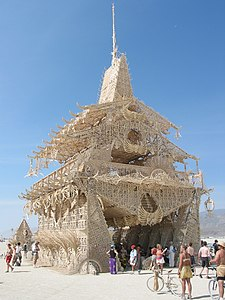
 Temple of Joy by David Best and crew, 2002
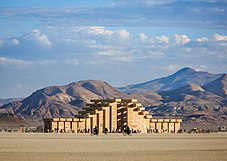
Temple of Direction, 2019
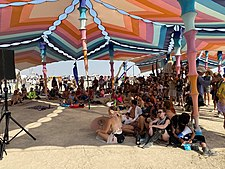
Temple of Constraints, 2021
The Temple is the secondary major recurring art installation at Burning Man after the Man, and is considered just as important to the event culture. According to the Burning Man Project, "The Temple is a community shared space that is an important part of Black Rock City. It is not a temple in recognition of any religion; it's a neutral, non-denominational spiritual space where everyone can gather to share in the experience of remembering the past, honoring or cursing the present, and pondering the future to come."[158]
The prime function of the Temple is to be a canvas upon which people can leave words and objects behind to be burned, and to serve as "a place of contemplation, a place to rest, a place of reflection, a place of rituals, weddings, reunions, etc".[159] During the event, 400 volunteer Temple Guardians monitor the Temple 24 hours a day.[160] The Temple is burned on the eighth and final night of the festival, following the "Man burn" on the previous night.[158]
Timeline...
Gentrification
Burning Man has attracted a number of billionaires and celebrities, many of them from Silicon Valley and Hollywood.[224] It has become a networking event for them,[225] with feckless edgelord CEO Elon Musk once stating that Burning Man "is Silicon Valley."[224]
These billionaires have paid for more luxurious camps to be set up in recent years. Derisively nicknamed "plug-n-play" or "turnkey" camps, they in general consist of lavish RVs and luxury restroom trailers that are driven into the city and connected together to form de facto gated areas. These billionaires then fly in to the airport on private planes, are driven to their camps, served by hired help, nicknamed "sherpas", and sleep in air-conditioned beds.[224] One venture capitalist billionaire threw a $16,500-per-head party at his camp.[226] In 2017, Google employees shipped in a box of lobsters for a meal.[227]
Despite allowing the rich to participate in Burning Man per the "radical inclusion" principle, many traditional attendees have spoken out against their exclusive practices.[228] Larry Harvey wrote that they also conflict with the "radical self-reliance" and other principles,[229] but has also said that permitting the wealthy to attend is beneficial to Burning Man.[230] Vandalism that occurred at the White Ocean sound camp in 2016 was said to have been a "revolution" against these attendees, describing them as a "parasite class" or "rich parasites".[228][231][232][233]
Meanwhile, the regular admission price has increased over the years. In addition, Nevada lawmakers have modified the state's entertainment and sales tax code to include nonprofit organizations like Burning Man that sell more than 15,000 tickets. As a result, an individual ticket, including taxes, cost $424 in 2016. Even tickets sold under Burning Man's low-income program are subject to these taxes.[234] Including transportation, food, camp fees, clothing and costumes, and gifts, CNBC estimated in 2016 that the total cost of attending could range from $1,300 up to $20,000.[235] In 2017, Money magazine estimated an average total cost of $2,348 to attend.[236]
According to the racial makeup of Burning Man attendees in 2014, 87% of them identified themselves as White, 6% as Hispanic / Latino, 6% as Asian, 2% as Native American, and 1% as Black (figures rounded). (Nevada's population, per the 2022 census, is 51% White, 29% Hispanic, 11% Asian, 2% Native, 11% Black).[237] When interviewed by The Guardian about these figures, Harvey replied, "I don't think Black folks like to camp as much as White folks... . We're not going to set racial quotas.... This has never been, imagined by us, as a utopian society."[238]
While there has been criticism that Burning Man has "jumped the shark," this proposition was criticized by cultural anthropologist Graham St John in 2020, who said that Burning Man was never a utopia in the first place.[239]
In popular culture
- In an episode of The Office [S06E16] Jim comments that he and his wife, Pam, conceived their child at Burning Man.[247]
- The Man Burns Tonight: A Black Rock City Mystery, a 2005 novel by Donn Cortez [Don DeBrandt], is set at Burning Man 2003.
- The 2010 South Park episode "Coon vs. Coon and Friends" features Cartman manipulating the Dark Lord Cthulhu to do his bidding, which includes destroying Burning Man.[248]
- Cory Doctorow's 2013 novel Homeland opens at a near-future Burning Man.[249]
- The 2016 video game Watch Dogs 2 features the characters visiting a Burning Man-themed event.[250]
- The Simpsons 2014 episode "Blazed and Confused" features "Blazing Guy", an event based on Burning Man, with one character even referencing "Burning Man" before correcting herself to "Blazing Guy".[251]
- The first Google Doodle, a playful adaptation of the Google logo, announced the founders' attendance at Burning Man in 1998.[252][253]
- The plot of the 2005 Malcolm in the Middle episode "Burning Man" takes place during the event.[254]
- The 2007 Xavier: Renegade Angel episode "Escape from Squatopian Freedom" features protagonist Xavier going to an event known as "Burning Person".[255]
- The 2020 song "Burningman" by Jeff Wittek, Simon Rex and Jonah.
- The festival is one of the major settings of the 2011 French-language novel Tuer le père (literally: Killing the Father) by Belgian writer Amélie Nothomb.
- The ninth and final novel of Armistead Maupin's Tales of the City series ends with many of the characters from the saga assembling at Burning Man.
Films
- Dust & Illusions, a 2009 documentary about 30 years of Burning Man history from the perspective of 20 interviewees.
- Taking My Parents to Burning Man, a 2014 film documenting the adventures and misadventures as Bryant Boesen takes his parents on their first Burn.
- Spark: A Burning Man Story, a 2013 documentary about Burning Man, which includes behind-the-scenes footage and interviews with the founders.