Second Life Rosedale
Second Life is an online multimedia platform that allows people to create an avatar for themselves and then interact with other users and user-created content within a multi-user online virtual world. Developed and owned by the San Francisco–based firm Linden Lab and launched on June 23, 2003, it saw rapid growth for some years and in 2013 it had approximately one million regular users.[6] Growth eventually stabilized, and by the end of 2017 the active user count had declined to "between 800,000 and 900,000".[7] In many ways, Second Life is similar to massively multiplayer online role-playing games; nevertheless, Linden Lab is emphatic that their creation is not a game: "There is no manufactured conflict, no set objective".[8]
The virtual world can be accessed freely via Linden Lab's own client software or via alternative third-party viewers.[9][10] Second Life users, also called 'residents', create virtual representations of themselves, called avatars, and are able to interact with places, objects and other avatars. They can explore the world (known as the grid), meet other residents, socialize, participate in both individual and group activities, build, create, shop, and trade virtual property and services with one another.
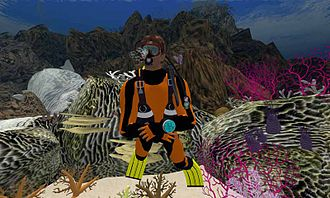
The platform principally features 3D-based user-generated content. Second Life also has its own virtual currency, the Linden Dollar (L$), which is exchangeable with real world currency.[11][12]
Second Life is intended for people ages 16 and over, with the exception of 13–15-year-old users, who are restricted to the Second Life region of a sponsoring institution (e.g., a school).[13][14]

History
 Philip Rosedale, founder of Second Life see below
Philip Rosedale formed Linden Lab in 1999[15] with the intention of developing computer hardware to allow people to become immersed in a virtual world. In its earliest form, the company struggled to produce a commercial version of the hardware, known as "The Rig", which in prototype form was seen as a clunky steel contraption with computer monitors worn on shoulders.[16] That vision changed into the software application Linden World, in which people participated in task-based games and socializing in a three-dimensional online environment.[17]
That effort eventually transformed into the better-known, user-centered Second Life.[18] Although he was familiar with the metaverse of Neal Stephenson's novel Snow Crash, Rosedale has said that his vision of virtual worlds predates that book, and that he conducted early virtual world experiments during his college years at the University of California, San Diego, where he studied physics.[19]
Second Life began to receive significant media attention in 2005 and 2006, including a cover story in BusinessWeek magazine featuring the virtual world and Second Life avatar Anshe Chung.[20] By that time, Anshe Chung had become Second Life's poster child and symbol for the economic opportunities that the virtual world offers to its residents. At the same time, the service saw a period of exponential growth of its user base.
One of the principal developers, Cory Ondrejka, was forced to resign as chief technology officer in December 2007, with Rosedale citing irreconcilable differences in the way the company was run.[21] Nevertheless, the platform continued to grow rapidly, and by January 2008, residents spent a total of 28,274,505 hours "inworld" and on average 38,000 residents were logged in at any moment. The maximum concurrency (number of avatars inworld) recorded was set at 88,200 in the first quarter of 2009.[22]
Second Life was honored at the Technology & Engineering Emmy Awards for advancing the development of online sites with user-generated content in 2008, adding to the media attention. Rosedale accepted the award,[23] although he had announced plans to step down from his position as Linden Lab CEO and to become chairman of Linden Lab's board of directors instead in March 2008 ....
With the platform's failure to continue its high rate of growth after 2009, Linden Lab announced layoffs of 30% of its workforce in 2010.[27] Some 21.3 million accounts were registered by this point, although the company did not make public any statistics regarding actual long-term consistent usage and numbers of dormant accounts.[28]
Despite speculation as to the actual size of the user base, Second Life continued as a commercial success. In 2015, Second Life users cashed out approximately $60,000,000 (60 million US dollars) and Second Life had an estimated GDP of $500,000,000 (500 million US dollars), higher than some small countries.[29]
Recognizing improvements in computing power and particularly in computer graphics, Linden Lab began work on a successor to Second Life, a VR experience called Sansar, launching a public beta in July 2017. Uptake was low and Linden Lab halted development in 2020 to focus their attention fully on Second Life. The rights to Sansar's assets were sold to Wookey Search Technologies, who are expected to continue development on the title without Linden Lab.[30]
Second Life, the usage of which peaked in the first decade of the 21st century, has been cited as the first example of the metaverse,[31] a concept which has been taken up by other major corporations such as Facebook in 2021. As a notable precursor (which retains a small and loyal following), it provides several examples of virtual reality social issues and lessons learned.[32]
Classification
Landscape scenery from The Pilgrim's Dawn located in Second Life
During a 2001 meeting with investors, Rosedale noticed that the participants were particularly responsive to the collaborative, creative potential of Second Life. As a result, the initial objective-driven, gaming focus of Second Life was shifted to a more user-created, community-driven experience.[33]
Second Life's status as a virtual world, a computer game, or a talker, is frequently debated.[who?] Unlike a traditional computer game, Second Life does not have a designated objective, nor traditional game play mechanics or rules. It can also be argued that Second Life is a multi-user virtual world, because its virtual world facilitates interaction between multiple users. As it does not have any stipulated goals, it is irrelevant to talk about winning or losing in relation to Second Life. Likewise, unlike a traditional talker[vague], Second Life contains an extensive world that can be explored and interacted with, and it can be used purely as a creative tool set if the user so chooses. In March 2006, while speaking at Google TechTalks,[34] Rosedale said: "So, we don't see this as a game. We see it as a platform."
Second Life used to offer two main grids: one for adults (18+) and one for teens. In August 2010, Linden Lab closed the teen grid due to operating costs. Since then, users 16 and over can sign up for a free account.[35] Other limited accounts are available for educators who use Second Life with younger students.
There are three activity-based classifications, called "Ratings", for sims in Second Life:
- General (formerly "PG"—no extreme violence or nudity)
- Moderate (formerly "Mature"—some violence, swearing, adult situations, some nudity)
- Adult (may contain overt sexual activity, nudity, and violence)...
2007 "Virtual Riot"
In January 2007, a "virtual riot" erupted between members of the French National Front (FN) who had established a virtual HQ on Second Life, and "anti-racism" activists, including Second Life Left Unity, a socialist and anti-capitalist user-group.[118][119][120][121] Since then, several small Internet-based organizations have claimed some responsibility for instigating the riots.[122]...
In popular culture
Since its debut in 2003, Second Life has been referred to by various popular culture media, including literature, television, film and music. In addition, various personalities in such media have themselves used or employed Second Life for both their own works and for private purposes.
In September 2006, former Governor of Virginia Mark Warner became the first politician to appear in a MMO when he gave a speech in Second Life.[193]
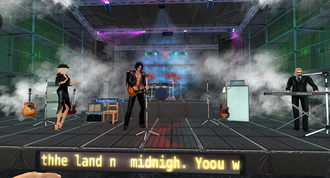
Musicians followed suit, with Redzone being credited by Wired and Reuters as the first band to tour in Second Life in February 2007. Then, in June 2008, author Charles Stross held a conference in Second Life to promote an upcoming novel.[194]
Second Life was also featured prominently, and used as a tool to locate a suspect, in the television show CSI: NY in 2007.[195] In the American sitcom The Office, Dwight Schrute (Rainn Wilson) is known to play the game, most notably in the episode "Local Ad".[196]
Research:
...There have also been healthcare related studies done of SL residents.[202] Studies show that behaviors from virtual worlds can translate to the real world. One survey suggests that users are engaged in a range of health-related activities inSL which are potentially impacting real-life behaviors.[202]
Another focus of SL research has included the relationship of avatars or virtual personas to the 'real' or actual person. These studies have included research into social behavior and reported two main implications.[203] The first is that SL virtual selves shape users' offline attitudes and behavior. The research indicated that virtual lives and physical lives are not independent, and our appearances and actions have both online and offline consequences.[203] The second deals with experimental research and supports the idea that virtual environments, such as SL, can enable research programs in that people behave in a relatively natural spread of behavioral patterns.[203]...
See also
- CyberTown
- Libraries in virtual worlds#Second Life libraries
- Simulated reality
- Social simulation game
- Virtual reality
- Metaverse
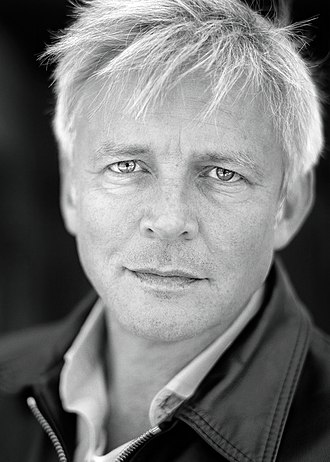
Philip Rosedale (born September 29, 1968) is an American entrepreneur who founded Linden Lab, which develops and hosts the virtual world Second Life.
Biography
Early life
Rosedale was born in San Diego, California, in 1968.[1] He took an interest in computers, technology, and virtual reality from an early age.[1] He started his own company selling database systems to small businesses at 17 and used the proceeds to fund his college education[citation ^needed], ultimately earning a Bachelor of Science degree in physics and computer science from the University of California, San Diego.[1]
Career
In 1995, Rosedale created an Internet video conferencing product (called "FreeVue"), which was later acquired by RealNetworks, where (in 1996) he went on to become vice president and chief technology officer.[2][3] A year later Rosedale left RealNetworks and founded Linden Lab, named after a street in Hayes Valley (a neighborhood in San Francisco).
With the creation of Second Life, he fulfilled his lifelong dream of creating an Internet-scale virtual world.[2] In 2006, he and Linden Lab received WIRED's Rave Award for Innovation in Business.[4][5] On March 14, 2008, Rosedale announced he would be stepping down as the CEO of Linden Lab and assuming the role of Chairman of the Board of Directors.[6]
Rosedale had stated that his goal with Second Life was to demonstrate a viable model for a virtual economy or virtual society. In his own words: "We don't see this as a game. We see it as a platform that is, in many ways, better than the real world" (Google TechTalks, March 2006).[7]
In 2008, Linden Lab's Second Life was one of three products to win a Technology & Engineering Emmy Award in the category of "User Generated Content – Game Modification".[8]
In October 2009, Rosedale announced that he would be less involved in the development of Second Life, because he was focusing on a new project.[9] The announced project turned out to be a company named LoveMachine Inc, founded with Ryan Downe.[10]
 Scenery from Second Life in 2012.
In June 2010, he announced that he was back to the office as CEO of Linden Lab.[11] However, in October 2010, Rosedale announced he was leaving his position as interim CEO.[12]
In November 2011, Rosedale released a new project named Coffee and Power,[13] a site that Rosedale calls a "meta-company", that enables people to connect for small jobs and services.[14] On April 16, 2013, Coffee & Power posted to their company blog that they were going to stop work on Workclub, their mobile application and begin work on a new company named High Fidelity Inc.[15]
In January 2022, High Fidelity acquired an interest in Linden Research and Philip Rosedale rejoined to Second Life as a strategic advisor.[16]