Printing Press
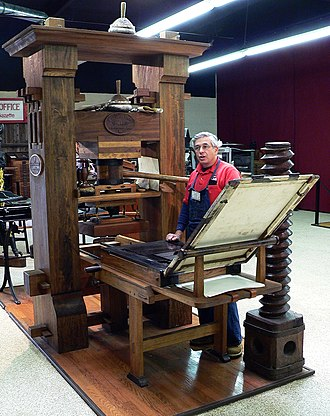
A German named JohannGutenberg* was the most successful of several people who attempted to develop the printing press in the fifteenth century.
Key to his success was the development of ‘moveable typeface,’ still in use today. This was achieved by cutting the shape of a letter into a hard metal die and then using the die to punch a raised version of the letter (reversed) on the surface of a softer alloy (lead, tin and antimony) shaped like a stalk with a head, where the letter was formed and which was known as a ‘typeface’.
These typefaces were then arranged in small wooden frames, heads up, so that a row of them represented a row of letters. The surfaces were then inked and paper brought down in contact with the inked letters.
Pressed onto the paper (hence: ‘printing press’) the ink transferred to the paper and when the press was released, the paper had been ‘printed’ with the row of reversed letters whose inked image was now un-reversed.
The press created the first printed books*.
ONELINER: The printing press is widely regarded as among the most influential events in human history.
BIBLIOGRAPHY:
Epstein, Sam and Beryl Epstein. The First Book of Printing. New York: Franklin Watts, Inc., 1955.
Matthew, Donald. Atlas of Medieval Europe. New York: Equionox; Facts on File Inc., 1983.
Eisenstein's The Printing Press as an Agent of Change, is a two-volume, 750-page exploration of the effects of movable type printing on the literate elite of post-Gutenberg Western Europe. In this work she focuses on the printing press's functions of dissemination, standardization, and preservation and the way these functions aided the progress of the Protestant Reformation, theRenaissance, and the Scientific Revolution. Eisenstein's work brought historical method, rigor, and clarity to earlier ideas of Marshall McLuhan and others, about the general social effects of such media transitions.
Wikipedia on moveable type