Paper
Paper is a thin sheet material produced by mechanically or chemically processing cellulose fibres derived from wood, rags, grasses or other vegetable sources in water, draining the water through fine mesh leaving the fibre evenly distributed on the surface, followed by pressing and drying.
Although paper was originally made in single sheets by hand, almost all is now made on large machines—some making reels 10 metres wide, running at 2,000 metres per minute and up to 600,000 tonnes a year. It is a versatile material with many uses, including printing, painting, graphics, signage, design, packaging, decorating, writing, and cleaning. It may also be used as filter paper, wallpaper, book endpaper, conservation paper, laminated worktops, toilet tissue, or currency and security paper, or in a number of industrial and construction processes.
The papermaking process developed in east Asia, probably China, at least as early as 105 CE,[1] by the Han court eunuch Cai Lun, although the earliest archaeological fragments of paper derive from the 2nd century BCE in China.[2] The modern pulp and paper industry is global, with China leading its production and the United States following.
History
Main article: History of paper

Hemp wrapping paper, China, c. 100 BCE
The oldest known archaeological fragments of the immediate precursor to modern paper date to the 2nd century BCE in China. The pulp papermaking process is ascribed to Cai Lun, a 2nd-century CE Han court eunuch.[2]
It has been said that knowledge of papermaking was passed to the Islamic world after the Battle of Talas in 751 CE when two Chinese papermakers were captured as prisoners. Although the veracity of this story is uncertain, paper started to be made in Samarkand soon after.[3] In the 13th century, the knowledge and uses of paper spread from the Middle East to medieval Europe, where the first water-powered paper mills were built.[4] Because paper was introduced to the West through the city of Baghdad, it was first called bagdatikos.[5] In the 19th century, industrialization greatly reduced the cost of manufacturing paper. In 1844, the Canadian inventor Charles Fenerty and the German inventor Friedrich Gottlob Keller independently developed processes for pulping wood fibres.[6]
Early Sources of Fibre
See also: wood pulp and deinking
Before the industrialisation of paper production the most common fibre source was recycled fibres from used textiles, called rags. The rags were from hemp, linen and cotton.[7] A process for removing printing inks from recycled paper was invented by German jurist Justus Claproth in 1774.[7] Today this method is called deinking. It was not until the introduction of wood pulp in 1843 that paper production was not dependent on recycled materials from ragpickers.[7]
Etymology
Further information: Papyrus
The word paper is etymologically derived from Latin papyrus, which comes from the Greek πᾰ́πῡρος (pápūros), the word for the Cyperus papyrus plant.[8][9] Papyrus is a thick, paper-like material produced from the pith of the Cyperus papyrus plant, which was used in ancient Egypt and other Mediterranean cultures for writing before the introduction of paper.[10]
Although the word paper is etymologically derived from papyrus, the two are produced very differently and the development of the first is distinct from the development of the second. Papyrus is a lamination of natural plant fibre, while paper is manufactured from fibres whose properties have been changed by maceration.[2]
Papermaking
Main article: Papermaking
...Archaeological evidence of papermaking predates the traditional attribution given to Cai Lun,[6] an imperial eunuch official of the Han dynasty (202 BCE – 220 CE), thus the exact date or inventor of paper cannot be deduced. The earliest extant paper fragment was unearthed at Fangmatan in Gansu province, and was likely part of a map, dated to 179–141 BCE.[7] Fragments of paper have also been found at Dunhuang dated to 65 BCE and at Yumen pass, dated to 8 BCE.[8]
The invention traditionally attributed to Cai Lun, recorded hundreds of years after it took place, is dated to 105 CE. The innovation is a type of paper made of mulberry and other bast fibres along with fishing nets, old rags, and hemp waste which reduced the cost of paper production, which prior to this, and later, in the West, depended solely on rags.[8][9][2]
Techniques
During the Shang (1600–1050 BCE) and Zhou (1050–256 BCE) dynasties of ancient China, documents were ordinarily written on bone or bamboo (on tablets or on bamboo strips sewn and rolled together into scrolls), making them very heavy, awkward to use, and hard to transport. The light material of silk was sometimes used as a recording medium, but was normally too expensive to consider.
The Han dynasty Chinese court official Cai Lun (c. 50–121 CE) is credited as the inventor of a method of papermaking (inspired by wasps and bees) using rags and other plant fibers in 105 CE.[2] However, the discovery of specimens bearing written Chinese characters in 2006 at Fangmatan in north-east China's Gansu Province suggests that paper was in use by the ancient Chinese military more than 100 years before Cai, in 8 BCE, and possibly much earlier as the map fragment found at the Fangmatan tomb site dates from the early 2nd century BCE.[7] It therefore would appear that "Cai Lun's contribution was to improve this skill systematically and scientifically, fix a recipe for papermaking".[10]
...
Islamic World
Paper page fragment from a Coptic language Bible from Egypt in the Islamic period, 8th century or later.
Origin
Paper was used in Central Asia by the 8th century but its origin is not clear. According to the 11th century Persian historian, Al-Thaʽālibī, Chinese prisoners captured at the Battle of Talas in 751 introduced paper manufacturing to Samarkand.[28][29] However there are no contemporary Arab sources for this battle. A Chinese prisoner, Du Huan, who later returned to China reported weavers, painters, goldsmiths, and silversmiths among the prisoners taken, but no papermakers. According to Al-Nadim, a writer in Baghdad during the 10th century, Chinese craftsmen made paper in Khorasan:[30]
Then there is the Khurasani paper made of flax, which some say appeared in the days of the Umayyads, while others say it was during the Abbasid regime. Some say that it was an ancient product and others say that it is recent. It is stated that craftsmen from China made it in Khurasan in the form of Chinese paper.[30]
— Al-Nadim
According to Jonathan Bloom – a scholar of Islamic and Asian Art with a focus on paper and printing, the connection between Chinese prisoners and the introduction of paper in Central Asia is "unlikely to be factual". Archaeological evidence shows that paper was already known and used in Samarkand decades before 751 CE. Seventy-six texts in Sogdian, Arabic, and Chinese have also been found near Panjakent, likely predating the Muslim conquest of Transoxiana. Bloom argues that based on differences in Chinese and Central Asian papermaking techniques and materials, the story of Chinese papermakers directly introducing paper to Central Asia is probably metaphorical.
Chinese paper was mostly made of bast fibers while Islamic paper was primarily made of waste material like rags.[30][31] The paper-making innovations in Central Asia may be pre-Islamic, probably aided by the Buddhist merchants and monks of China and Central Asia. The Islamic civilization helped spread paper and paper-making into the Middle East after the 8th-century, from where it arrived into Europe centuries later, and then to many other parts of the world. A historical remnant of this legacy is the continued use of the word "ream" to count bundles of paper, a word derived from Arabic rizma (bundle, bale).[30]
Shift from Parchment to Paper
During the 8th century, paper started to replace parchment as the primary writing material for administrative uses in Baghdad, the capital of Abbasids. According to Ibn Khaldun, a renowned Muslim historiographer, parchment was rare, and a great increase in the number of correspondents throughout Islamic territories, resulted in an order issued by Al-Fadl ibn Yahya, the Abbasid’s Grand Vizier, for the manufacture of paper to replace parchment.[32]
There are records of paper being made at Gilgit in Pakistan by the sixth century, in Samarkand by 751, in Baghdad by 793, in Egypt by 900, and in Fes, Morocco around 1100, in Syria e.g. Damascus, and Aleppo, in Andalusia around 12th century, in Persia e.g. Maragheh by 13th century, Isfahan by 14th century, Ghazvin and Kerman, in India e.g. Dowlat Abad by the 16th century.[33]
A Persian geography book written by an unknown author in the 10th century, Hodud al-Alam, is the oldest known manuscripts mentioning papermaking industry in Samarkand. The writer stated that the city was famous for paper manufacturing and the product was exported to many other cities as a high-quality item.[34] Samarkand kept its reputation for papermaking over few centuries even once the industry spread across other Islamic areas. For instance, it is said that some Ministers in Egypt preferred ordering their required paper to Samarkand from which the paper was transported all the way to Egypt.[35]
In Baghdad, particular neighborhoods were allocated to paper manufacturing [36] and in Bazaar paper merchants and sellers owned distinct sectors being called Paper Market or Suq al-Warraqin, a street which was lined with more than 100 paper and booksellers' shops.[37] In 1035 a Persian traveler, Nasir Khusraw, visiting markets in Cairo noted that vegetables, spices and hardware were wrapped in paper for the customers.[38] In the 12th century one street named "Kutubiyyin" or book sellers Morocco as it contained more than 100 bookshops.[39]
The expansion of public and private libraries and illustrated books within Islamic lands was one of the notable outcomes of the drastic increase in the availability of paper.[40] However, paper was still an upmarket good given the remarkable required inputs, e.g. primary materials and labours, to produce the item in the absence of advanced mechanical machinery. In one account Ibn al-Bawwab, a Persian calligrapher and illuminator, had been promised by the Sultan to be given precious garments in response to his services. When the Sultan deferred delivering the promised clothes, he instead proposed taking the papers stored in the Sultan’s library as his present.[35] In another account, the hospitality of a Minister in Baghdad, Ibn Al-Forat, had been described by his generosity in freely giving away papers to his guests or visitors.[41]
...
Paper in Europe
[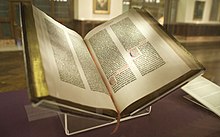
A copy of the Gutenberg Bible, printed on paper during the 1450s, in the New York Public Library
The oldest known paper document in Europe is the Mozarab Missal of Silos from the 11th century,[66] probably using paper made in the Islamic part of the Iberian Peninsula. They used hemp and linen rags as a source of fiber. The first recorded paper mill in the Iberian Peninsula was in Xàtiva in 1056.[67][68] Papermaking reached Europe as early as 1085 in Toledo and was firmly established in Xàtiva, Spain by 1150. During the 13th century mills were established in Amalfi, Fabriano, and Treviso, Italy, and other Italian towns by 1340. Papermaking then spread further northwards, with evidence of paper being made in Troyes, France by 1348, in Holland sometime around 1340–1350, and in Nuremberg, Germany by 1390 in a mill set up by Ulman Stromer.[69]
This was just about the time when the woodcut printmaking technique was transferred from fabric to paper in the old master print and popular prints. There was a paper mill in Switzerland by 1432 and the first mill in England was set up by John Tate around 1490 near Hertford,[70][71] but the first commercially successful paper mill in Britain did not occur before 1588 when John Spilman set up a mill near Dartford in Kent.[72] During this time, paper making spread to Austria by 1469,[73] to Poland by 1491, to Russia by 1576, to the Netherlands by 1586, to Denmark by 1596, and to Sweden by 1612.[33]
Arab prisoners who settled in a town called Borgo Saraceno in the Italian Province of Ferrara introduced Fabriano artisans in the Province of Ancona the technique of making paper by hand. At the time they were renowned for their wool-weaving and manufacture of cloth. Fabriano papermakers considered the process of making paper by hand an art form and were able to refine the process to successfully compete with parchment which was the primary medium for writing at the time. They developed the application of stamping hammers to reduce rags to pulp for making paper, sizing paper by means of animal glue, and creating watermarks in the paper during its forming process. The Fabriano used glue obtained by boiling scrolls or scraps of animal skin to size the paper; it is suggested that this technique was recommended by the local tanneries. The introduction of the first European watermarks in Fabriano was linked to applying metal wires on a cover laid against the mould which was used for forming the paper.[74]
They adapted the waterwheels from the fuller's mills to drive a series of three wooden hammers per trough. The hammers were raised by their heads by cams fixed to a waterwheel's axle made from a large tree trunk.[75][76]
...
19th-Century Advances in Papermaking
Although cheaper than vellum, paper remained expensive, at least in book-sized quantities, through the centuries, until the advent of steam-driven paper making machines in the 19th century, which could make paper with fibres from wood pulp.
Although older machines pre-dated it, the Fourdrinier papermaking machine became the basis for most modern papermaking. Nicholas Louis Robert of Essonnes, France, was granted a patent for a continuous paper making machine in 1799. At the time he was working for Leger Didot with whom he quarrelled over the ownership of the invention. Didot sent his brother-in-law, John Gamble, to meet Sealy and Henry Fourdrinier, stationers of London, who agreed to finance the project.
Gamble was granted British patent 2487 on 20 October 1801. With the help particularly of Bryan Donkin, a skilled and ingenious mechanic, an improved version of the Robert original was installed at Frogmore Paper Mill, Hertfordshire, in 1803, followed by another in 1804. A third machine was installed at the Fourdriniers' own mill at Two Waters. The Fourdriniers also bought a mill at St Neots intending to install two machines there and the process and machines continued to develop....