Compound engine
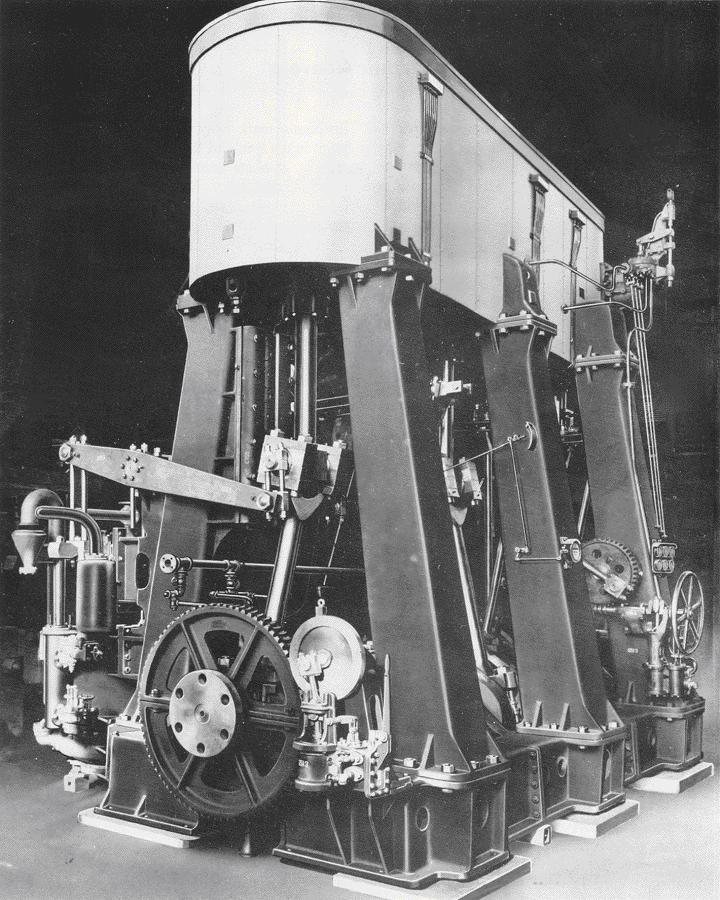
A compound engine is an engine that has more than one stage for recovering energy from the same working fluid, with the exhaust from the first stage passing through the second stage, and in some cases then on to another subsequent stage or even stages. Originally invented as a means of making steam engines more efficient, the compounding of engines by use of several stages has also been used on internal combustion engines and continues to have niche markets there.
The stages of a compound engine may be either of differing or of similar technologies, for example:
- In a turbo-compound engine, the exhaust gas from the cylinders passes through a turbine, the two stages being dissimilar.
- In a compound steam locomotive, the steam passes from the high-pressure cylinder or cylinders to the low-pressure cylinder or cylinders, the two stages being similar.
- In a triple-expansion steam engine, the steam passes through three successive cylinders of increasing size and decreasing pressure. Such engines were the most common marine engines in the golden age of steam.
These examples and compound turbines are the main but not the only uses of compounding in engines, see below.
Contents
Terminology
A compound engine uses several stages to produce its output.
Not all engines that use multiple stages are called compound engines. In particular, if an engine uses a later stage purely to extract energy from the exhaust for some other purpose, and notably for turbo charging, is not called a compound engine. Similarly, proposed engines that use a free piston engine to drive a turbine would not be called compound engines, as only the second stage produces output power.
However, if a turbo compound engine is also supercharged by feeding some of the shaft power back to the supercharger, as in some aircraft engines, it is still a compound engine. Usage of the terms supercharged and turbosupercharged has varied with time, for example the makers of the Wright R-3350 Duplex-Cyclone compound engine described it at the time as turbosupercharged. It is however a compound engine, and a similar engine produced today would be described as supercharged rather than turbocharged.
The term compounding is a little less restrictive than compound engine. Large compound turbines are an application of compounding, as are the multiple rows of blades used in many gas turbines, but neither is normally referred to as a compound engine. The several sets of blades in a single turbine are perhaps better thought of as similar in principle to the uniflow steam engine than to compounding. Unlike the uniflow steam engine, which has found niche uses only, multiple row turbines have found enormous practical application.
An engine that does not use compounding is referred to as a simple engine, particularly in the case of a steam locomotive, or more precisely as a simple expansion engine, particularly in the case of a marine steam engine.
Note however that in the case of any steam engine, simple engine can also be used to mean one that does not use a condenser to generate negative pressure and so improve efficiency. Use of separate condensers for this purpose is one of the key features that distinguishes the Watt steam engine of 1765 from the Newcomen steam engine of 1712.
No ambiguity arises in the case of a steam locomotive, as in a condensing steam locomotive the condenser is not there to increase efficiency, and may even reduce efficiency in order to conserve water and reduce emissions. So for example the Metropolitan Railway A Class is in every sense a simple locomotive despite its condensers, and the term simple engine applied to steam locomotives always in practice means one that does not use compounding, again irrespective of its use of condensers. The terms simple expansion locomotive and simple expansion engine are sometimes applied to locomotives to remove any possible confusion.
History
Steam

Woolf compound beam engine, 1858, with the light-coloured high- and low-pressure cylinders clearly visible
The oldest examples of compound engines are compound steam engines. In 1805 Arthur Woolf patented the Woolf high pressure compound engine which used this principle.
Compounding was particularly used on stationary steam engines, marine steam engines, and on some but by no means all steam locomotives starting from the 1850s, particularly but not only in continental Europe.[1]
Three stage or triple expansion reciprocating steam engines, with three cylinders of increasing bore in line, were particularly popular for steamship propulsion. "Doctor" Alexander Carnegie Kirk, experimentally fitted his first triple expansion engine to a ship called *Propontis* in 1874. In 1881, Kirk installed a refined version of his engine in SS *Aberdeen* on Clydeside, Scotland.[2] This ship proved the advantages of power and economy of the new engine, in commercial service between the United Kingdom and the Far East.[3] The first warship to be so equipped was the Spanish warship *Destructor*, which was also built on Clydeside, and the first engine of this type used in ships of the Royal Navy was designed by J. W. Reed, who also created the Reed water tube boiler.[4][5] Other navies and commercial shipowners soon followed. Four-stage, or quadruple, expansion engines were also used.
Several classes of steam locomotive have existed in both simple and compound form, most commonly when locomotives originally built as compound were converted to simple in order to gain power at the expense of efficiency, for example the majority of the NZR X class. Other conversions involved redesigning the details of the compounding, for example many compound locomotives designed by Alfred de Glehn and state of the art in their day were modified by André Chapelon to use his later scheme.
...
Main article: Marine steam engine
Near the end of the 19th century, compound engines came into widespread use. Compound engines exhausted steam into successively larger cylinders to accommodate the higher volumes at reduced pressures, giving improved efficiency. These stages were called expansions, with double- and triple-expansion engines being common, especially in shipping where efficiency was important to reduce the weight of coal carried.[18] Steam engines remained the dominant source of power until the early 20th century, when advances in the design of the steam turbine, electric motors and internal combustion engines gradually resulted in the replacement of reciprocating (piston) steam engines, with merchant shipping relying increasingly upon diesel engines, and warships on the steam turbine.[18][3]
However, a 140-ton vertical triple expansion compound steam engine of obsolete design was selected to power Liberty ships because it was cheaper and easier to build in the numbers required for the Liberty ship program and because more companies could manufacture it. Eighteen different companies eventually built the engine. These were crucial in Allied victory in WWII.
Steam locomotives
Main articles: Steam locomotive, Traction engine, and Steam tractor
As the development of steam engines progressed through the 18th century, various attempts were made to apply them to road and railway use.[33] In 1784, William Murdoch, a Scottish inventor, built a model steam road locomotive.[34] An early working model of a steam rail locomotive was designed and constructed by steamboat pioneer John Fitch in the United States probably during the 1780s or 1790s.[35] His steam locomotive used interior bladed wheels[clarification needed] guided by rails or tracks.
[
The first full-scale working railway steam locomotive was built by Richard Trevithick in the United Kingdom and, on 21 February 1804, the world's first railway journey took place as Trevithick's unnamed steam locomotive hauled a train along the tramway from the Pen-y-darren ironworks, near Merthyr Tydfil to Abercynon in south Wales.[33][36][37] The design incorporated a number of important innovations that included using high-pressure steam which reduced the weight of the engine and increased its efficiency. Trevithick visited the Newcastle area later in 1804 and the colliery railways in north-east England became the leading centre for experimentation and development of steam locomotives.[38]
Trevithick continued his own experiments using a trio of locomotives, concluding with the Catch Me Who Can in 1808. Only four years later, the successful twin-cylinder locomotive Salamanca by Matthew Murray was used by the edge railed rack and pinion Middleton Railway.[39] In 1825 George Stephenson built the Locomotion for the Stockton and Darlington Railway. This was the first public steam railway in the world and then in 1829, he built The Rocket which was entered in and won the Rainhill Trials.[40] The Liverpool and Manchester Railway opened in 1830 making exclusive use of steam power for both passenger and freight trains.
Steam locomotives continued to be manufactured until the late twentieth century in places such as China and the former East Germany (where the DR Class 52.80 was produced).[41]
Steam turbines
Main article: Steam turbine
The final major evolution of the steam engine design was the use of steam turbines starting in the late part of the 19th century. Steam turbines are generally more efficient than reciprocating piston type steam engines (for outputs above several hundred horsepower), have fewer moving parts, and provide rotary power directly instead of through a connecting rod system or similar means.[42] Steam turbines virtually replaced reciprocating engines in electricity generating stations early in the 20th century, where their efficiency, higher speed appropriate to generator service, and smooth rotation were advantages. Today most electric power is provided by steam turbines. In the United States, 90% of the electric power is produced in this way using a variety of heat sources.[3] Steam turbines were extensively applied for propulsion of large ships throughout most of the 20th century....
Steam engine - Wikipedia Triple Expansion