Steam Engine
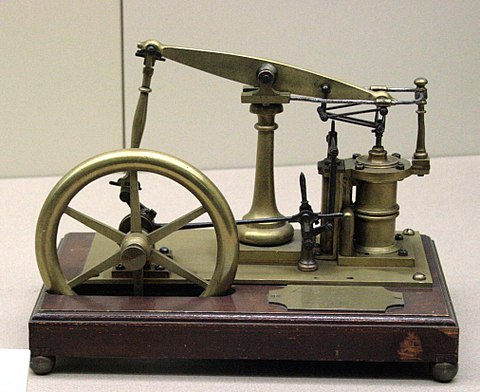
DATE INVENTED/BEGAN: 1698, 1712, 1765
PLACE INVENTED/BEGAN: Great Britain
DATE ENDED: Steam engines remained the dominant source of power until the early 20th century, when advances in the design of the steam turbine, electric motors and internal combustion engines gradually resulted in the replacement of reciprocating (piston) steam engines. See Compound Engine.
CATEGORY: Technology
DISCIPLINE: Invention
ASSESSMENT: Triggered the Industrial Revolution
DETAILS:
The steam engine, developed at different times by <developed by> Savery (1698), <developed by> Newcomen (1712) and <developed by> Watt* (1765) let steam under pressure enter a metal cylinder containing a piston and piston-rod. As the steam expanded inside the cylinder, it pushed the piston. When the cylinder piston was pushed as far as it would go, the steam in the cylinder would be release, via a tube, into a container immersed in ice water. The fall in temperature would cause all the steam throughout the system to condense. This would cause a partial vacuum to form in the cylinder. External atmospheric pressure would then push the piston back into the cylinder. Hot steam would then be reintroduced and the next piston stroke would begin.
In Watt’s final version, at the start of the stroke, as the piston was pushed by the steam, the piston-rod attached to the piston moved outward from the cylinder and pushed on an attached crank set on a flywheel, to produce rotary movement. This could be used to rotate wheels on which drive belts were fitted. The belts in turn drove a wide variety of machinery.
ONELINER: The steam engine dramatically boosted burning of wood and coal leading to climate change
EXTRA-CONNECTIONS: None
BIBLIOGRAPHY:
DSB
EB
Wikipedia:
A steam engine is a heat engine that performs mechanical work using steam as its working fluid. The steam engine uses the force produced by steam pressure to push a piston back and forth inside a cylinder. This pushing force is transformed, by a connecting rod and flywheel, into rotational force for work. The term "steam engine" is generally applied only to reciprocating engines as just described, not to the steam turbine.
Steam engines are external combustion engines,[1] where the working fluid is separated from the combustion products. The ideal thermodynamic cycle used to analyze this process is called the Rankine cycle.
In general usage, the term steam engine can refer to either complete steam plants (including boilers etc.) such as railway steam locomotives and portable engines, or may refer to the piston or turbine machinery alone, as in the beam engine and stationary steam engine.
Steam-driven devices were known as early as the aeolipile in the first century AD, with a few other uses recorded in the 16th and 17th century. Thomas Savery's dewatering pump used steam pressure operating directly on the water. The first commercially successful engine that could transmit continuous power to a machine was developed in 1712 by Thomas Newcomen.

James Watt made a critical improvement by removing spent steam to a separate vessel for condensation, greatly improving the amount of work obtained per unit of fuel consumed. By the 19th century, stationary steam engines powered the factories of the Industrial Revolution. Steam engines replaced sail for ships, and steam locomotives operated on the railways.
Reciprocating piston type steam engines were the dominant source of power until the early 20th century, when advances in the design of electric motors and internal combustion engines gradually resulted in the replacement of reciprocating (piston) steam engines in commercial usage. Steam turbines replaced reciprocating engines in power generation, due to lower cost, higher operating speed, and higher efficiency.[2]
- 1 History
- 2Components and accessories of steam engines
- 3Engine configuration
- 4Types of motor units
- 5Safety
- 6Steam cycle
- 7Efficiency
- 8See also
- 9Notes
- 10References
- 11References
- 12Further reading
- 13External links
History
Main article: History of the steam engine
Early experiments:
The first recorded rudimentary steam-powered "engine" was the aeolipile described by Hero of Alexandria, a mathematician and engineer in Roman Egypt in the first century AD.[3] In the following centuries, the few steam-powered "engines" known were, like the aeolipile,[4] essentially experimental devices used by inventors to demonstrate the properties of steam. A rudimentary steam turbine device was described by Taqi al-Din[5] in Ottoman Egypt in 1551 and by Giovanni Branca[6] in Italy in 1629.[7] Jerónimo de Ayanz y Beaumont received patents in 1606 for 50 steam powered inventions, including a water pump for draining inundated mines.[8] Denis Papin, a Huguenot refugee, did some useful work on the steam digester in 1679, and first used a piston to raise weights in 1690.[9]
Pumping engines:
The first commercial steam-powered device was a water pump, developed in 1698 by Thomas Savery.[10] It used condensing steam to create a vacuum which raised water from below and then used steam pressure to raise it higher. Small engines were effective though larger models were problematic. They had a limited lift height and were prone to boiler explosions. Savery's engine was used in mines, pumping stations and supplying water to water wheels that powered textile machinery.[11] Savery's engine was of low cost. Bento de Moura Portugal introduced an improvement of Savery's construction "to render it capable of working itself", as described by John Smeaton in the Philosophical Transactions published in 1751.[12] It continued to be manufactured until the late 18th century.[13] One engine was still known to be operating in 1820.[14]
Piston steam engines:
The first commercially successful engine that could transmit continuous power to a machine was the atmospheric engine, invented by Thomas Newcomen around 1712.[b][16] It improved on Savery's steam pump, using a piston as proposed by Papin. Newcomen's engine was relatively inefficient, and mostly used for pumping water. It worked by creating a partial vacuum by condensing steam under a piston within a cylinder. It was employed for draining mine workings at depths hitherto impossible, and for providing reusable water for driving waterwheels at factories sited away from a suitable "head". Water that passed over the wheel was pumped up into a storage reservoir above the wheel.[17][18] In 1780 James Pickard patented the use of a flywheel and crankshaft to provide rotative motion from an improved Newcommen engine.[19]
In 1720 Jacob Leupold described a two-cylinder high-pressure steam engine.[20] The invention was published in his major work "Theatri Machinarum Hydraulicarum".[21] The engine used two heavy pistons to provide motion to a water pump. Each piston was raised by the steam pressure and returned to its original position by gravity. The two pistons shared a common four-way rotary valve connected directly to a steam boiler.

Early Watt pumping engine
The next major step occurred when James Watt developed (1763–1775) an improved version of Newcomen's engine, with a separate condenser. Boulton and Watt's early engines used half as much coal as John Smeaton's improved version of Newcomen's.[22] Newcomen's and Watt's early engines were "atmospheric". They were powered by air pressure pushing a piston into the partial vacuum generated by condensing steam, instead of the pressure of expanding steam. The engine cylinders had to be large because the only usable force acting on them was atmospheric pressure.[17][23]
Watt developed his engine further, modifying it to provide a rotary motion suitable for driving machinery. This enabled factories to be sited away from rivers, and accelerated the pace of the Industrial Revolution.[23][17][24]
High-pressure engines:
The meaning of high pressure, together with an actual value above ambient, depends on the era in which the term was used. For early use of the term Van Reimsdijk[25] refers to steam being at a sufficiently high pressure that it could be exhausted to atmosphere without reliance on a vacuum to enable it to perform useful work. Ewing 1894, p. 22 states that Watt's condensing engines were known, at the time, as low pressure compared to high pressure, non-condensing engines of the same period.
Watt's patent prevented others from making high pressure and compound engines. Shortly after Watt's patent expired in 1800, Richard Trevithick and, separately, Oliver Evans in 1801[24][26] introduced engines using high-pressure steam; Trevithick obtained his high-pressure engine patent in 1802,[27] and Evans had made several working models before then.[28] These were much more powerful for a given cylinder size than previous engines and could be made small enough for transport applications. Thereafter, technological developments and improvements in manufacturing techniques (partly brought about by the adoption of the steam engine as a power source) resulted in the design of more efficient engines that could be smaller, faster, or more powerful, depending on the intended application.[17]
The Cornish engine was developed by Trevithick and others in the 1810s.[29] It was a compound cycle engine that used high-pressure steam expansively, then condensed the low-pressure steam, making it relatively efficient. The Cornish engine had irregular motion and torque though the cycle, limiting it mainly to pumping. Cornish engines were used in mines and for water supply until the late 19th century.[30]
...