Holt, Alfred
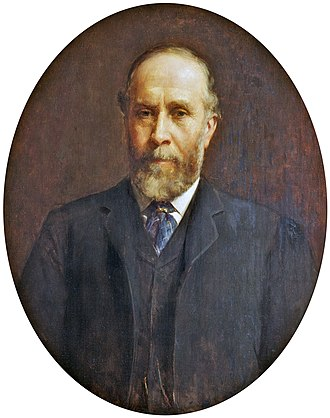
Holt, Alfred (1829–1911), engineer and shipowner, was born on 13 June 1829 at 2 Rake Lane, Liverpool, third of the six children of George Holt (1790–1861), cotton broker, and Emma, daughter of William Durning, a prosperous Liverpool merchant, and his wife, Jane. George Holt was born in Rochdale and bred to the family mill and dye-works, but in 1807 he was apprenticed to Samuel Hope, a leading Liverpool cotton broker.
His marriage into the Durning family drew him into the influential circle of Unitarian businessmen. Having set up his own broking business, he helped to found the Bank of Liverpool and the Liverpool and London Assurance Company and became fully involved in the public life of Liverpool, especially in the dock and water committees.
Education and early career
From childhood Alfred Holt showed an adventurous spirit (he once escaped from a dame-school). From 1838 to 1844 he attended a private boys' school kept by a Unitarian minister at Knutsford, Cheshire. One of the pupils was George Fairbairn, son of the engineer Sir William Fairbairn, who, by giving Alfred his own working model steam engine, generated his lifelong interest in steam.
On 1 July 1846 Alfred began a five-year apprenticeship to Edward Woods, engineer to the Liverpool and Manchester Railway. During that time, in his own workshop, he made model steam engines and took lessons in mathematics, chemistry, and drawing, and also in literature, which may have accounted for the Homeric names of his ships. However, by the time his apprenticeship had ended the railway industry was in depression and job prospects bleak.
Fortunately Holt was able to find clerical employment with the shipowners Lamport and Holt, in which his brother Philip Henry (1830–1915) was a partner. Alfred Holt soon learned the basic principles of marine engineering and, by sailing to the Mediterranean in the [steamship(https://app.thebrain.com/brain/f3e16344-7cd9-4fa3-ae1d-59876e128474/0b4e4e54-94bb-526d-9b19-1f1f6ce02bbd) Orontes as supernumerary engineer, its practical aspects. In January 1852 Holt set up as a consulting engineer in an office in India Buildings (built by his father in 1834 and occupied by Holt until his retirement), finding work testing locomotives for his old master and supervising the construction of iron steamships.
The Ocean Steam Ship Company
Holt soon abandoned locomotive work to concentrate on the problems that beset iron steamships in the early days, mainly connected with the screw propeller, the iron construction, and the compound engine. His golden opportunity came when Thomas Ainsworth of Cleator, Cumberland, sought his advice on the defective engines of his steam-powered hybrid brig, Alpha, built for the iron-ore trade between Whitehaven and Cardiff.
Holt became engineer and agent to Ainsworth and, most importantly, got to know Isaac Middleton (d. 1878), who became his pioneer captain in all his undertakings. Such mutual respect between managers and captains was to be a keystone in the Holt management style for a century. Holt's success with Alpha led his father to invest with Ainsworth in another steamer, the Dumbarton Youth, of which Holt was also engineer and agent; its blue funnel became the symbol of the line that carried Holt's name around the world. Holt also designed the Cleator, built in Liverpool.
In 1855 Alfred and Philip Holt invested in five larger vessels for the competitive and therefore risky West India trade. At one stage Alfred even considered giving up and going into the family cotton-broking business, but he held out until 1864 before selling out to a rival firm, keeping only the Cleator. In January 1864 Philip left his partnership in Lamport and Holt and joined Alfred permanently. Together they considered possible trade routes and decided on China. Because of the vast distance involved China was considered beyond the reach of steamships, which required frequent rebunkering, but the thrill of beating the clipper, the most prestigious sailing ship of its time, appealed to Alfred's adventurous spirit.
With American vessels out of the running because of the civil war, freight rates for tea rose dramatically. Alfred fitted the Cleator with a new, compact, vertical compound tandem engine whose boiler could take a pressure of 60 lb p.s.i., a major breakthrough in that for the first time the Board of Trade accepted such high pressures at sea. The gains in practical and commercial efficiency were immense.
After trials the first three steamers of the Ocean Steam Ship Company were ordered from Scotts of Greenock (at a total cost of £156,000) bearing the majestic names of Agamemnon, Ajax, and Achilles,Homeric heroes all. The company was registered on 11 January 1865, with 51 per cent of the shares held by the two brothers and the rest by family, friends, and the three captains. Each vessel carried about 3000 tons of cargo and could sail non-stop from Liverpool to Mauritius in thirty-seven days, some 8500 miles, carrying sufficient coal for an average speed of 10 knots.
On 16 January 1866 the first public circular was issued. The route was to be Mauritius, Penang, Singapore, Hong Kong, and Shanghai, taking seventy-six days and returning via Foochow (Fuzhou); it was to be the mainstay of the business for more than a century.
The opening of the Suez Canal brought the Mecca pilgrim traffic, but success bred rivalry and by 1876 competition was intense. Unlike their competitors, who acquired larger and faster vessels, Alfred and Philip kept to their original schedules as the China trade sank into depression. Although the Holts had been reared in the classic Liberal ethos of free trade, John Swire, Holts' Shanghai agent, was convinced that a conference system was desirable, so by 1879 an outward and homeward conference was formed, with Swire as chairman, to secure freight rates and a fair division of cargoes.
The Holt brothers were slow to be convinced and, having joined, did not always play by the rules. In 1891 Alfred Holt met the competition by ordering faster and larger ships capable of carrying heavier and more varied freight, and twenty-two steamers were added to his fleet between 1894 and 1902. In 1895 direct trade with the Dutch colonies was secured by the formation of a subsidiary company registered in the Netherlands; paid managers were appointed, including Holt's nephew Richard Durning Holt [*see below*].
Philip, who was responsible for the commercial side, changed the accounting system so that each voyage carried its own overheads. He promoted profitable feeder services and invested in banks and various subsidiary ventures before retiring in 1897. In 1902 Holts became a limited liability company, a move initially resisted by both brothers. Alfred retired in 1904.
Other interests
Outside work Holt's chief joy was sailing. His steam yacht, the Argo, built in 1875 and designed by himself, was originally intended to be a fast mail-carrier to the Far East in hope of getting the government contract. In 1876 it was used for a Liverpool Museum scientific expedition. The honour Holt most prized was his election as a member of the Institution of Civil Engineers in February 1875, earning him both a Watt medal and a Telford premium. He was also a member of the Institution of Naval Architects.
Locally he was an active member of the Mersey Docks and Harbour Company, serving as its chairman in 1889–90, chairman of the Liverpool Underwriters' Register of Iron Vessels, president of the Liverpool Engineering Society, and a director of the Liverpool Institute, an educational foundation. He loyally supported the Unitarian churches and their social outreach through the domestic mission. Although not politically active he was a committed Liberal and long-standing member of the Reform Club. He felt the greatest affinity with John Bright, as a fellow businessman strongly opposed to government interference in the form of factory legislation.
On similar grounds Holt opposed Plimsoll's Merchant Shipping Act of 1875–6. His ships were all built to a higher class than Lloyds A1; indeed, ‘Holts class’ became an official designation, so he argued that attempts to enforce standards, even on humanitarian grounds, would result in standards generally slipping to the legal minimum.
Holt also enjoyed fell-walking, shooting, theatre, horse races, and Christmas parties. He wrote a pamphlet about the burial-place of his hero, Oliver Cromwell, which was published in 1899. He was married first to Catherine Long on 20 September 1865. They had a daughter, Jane, who married Professor Sir William Herdman, eminent marine biologist and benefactor of Liverpool University; a son, George, who became one of the firm's managers; and another son, who died in his teens. After Catherine's death in 1869 Alfred Holt married her cousin Frances Long, on 4 July 1871, and had two more sons. Active to the last, he died of a seizure at his home, Crofton, Sudley Road, Aigburth, Liverpool, on 28 November 1911. He was cremated as one might expect of a founder of the local crematorium; his ashes were interred at Brook Street Unitarian Chapel, Knutsford.
Sources
A. Holt, Fragmentary autobiography (privately printed, 1911)
C. Jones, Pioneer shipowners, 2 (1938), 107–38
F. E. Hyde, Blue Funnel: a history of Alfred Holt and Company of Liverpool from 1865 to 1914, another edn (1957)
M. Falkus, The Blue Funnel legend: a history of the Ocean Steam Ship Company, 1865–1973 (1990)
J. R. Harris, ‘Holt, Alfred’, DBB
Agamemnon was the first of three sister ships, the others being Achilles (1866) and Ajax (1867). Scotts Shipbuilding and Engineering Company of Greenock, Renfrewshire built the three ships for Alfred and Phillip Holt's Ocean Steam Ship Company, later called the Blue Funnel Line. Each was 2,270 GRT and 1,550 NRT. Overall length was 309 feet (94 m) and beam 38 feet (12 m).
Agamemnon (and her sister ships) combined three key features.
The first was a higher boiler pressure than was normally used on British merchant ships. Alfred Holt had experimented with a boiler pressure of 60 psi in the Cleator, a ship he used as a floating testbed. Holt overcame the Board of Trade's objections to boiler pressures above 25 psi in seagoing vessels.
The second feature was her compound steam engine, designed by Alfred Holt. As well as being more efficient than others of the time, it was a relatively compact engine, so used less cargo space.
The third was a hull that was strong in relation to its weight and cost and with modest power requirements – again developed by Alfred Holt.
Agamemnon's fuel efficiency enabled her to compete successfully with tea clippers between Britain and China. She could steam from London to Mauritius, a distance of 8,500 miles (roughly half the distance to China via the Cape of Good Hope) without coaling.
Her normal journey time from Foochow to Liverpool was 58 days, whereas clippers could take anything from a record-breaking 88 days to 140 or more, and averaged 123 days in 1867–68. Further, her cargo carrying capacity was two or three times as much as these sailing ships.
Maiden voyage
The newly built Agamemnon arrived in Liverpool, her home port, from Greenock on 1 April 1866, the year of the clippers' Great Tea Race. She sailed for China on 19 April. Her outward passage was the quickest recorded to date, reaching Mauritius in 40 days and [Singapore in 60. The whole journey from Liverpool to Hong Kong took 65 days. This beat the fastest tea clipper outward passage of 77 days by the Cairngorm in 1853.
Wikipedia:
Alfred Holt (13 June 1829 – 28 November 1911) was a British engineer, ship owner and merchant. He lived at Crofton, Aigburth in Liverpool, England.[1] Holt is credited with establishing the long distance steamship by developing a type that replaced sailing clippers on the route from Britain to China.[2]: 159
Alfred Holt was one of six brothers, born to George Holt and his wife, Emma.[3] In 1866 he and his brother, Philip Holt founded the Alfred Holt and Company and the Ocean Steam Ship Company, which owned and operated the majority of the company's vessels.[4] Alfred Holt & Co later became Blue Funnel Line.
One of his other brothers, George Holt, was also a noted Liverpool merchant and ship owner. His youngest brother, Robert Durning Holt, was Mayor of Liverpool. All were Unitarians.[5]
Contents
| 1 | Steamship design and ownership |
|---|---|
| 2 | Personal life |
| 3 | References |
| 4 | Further reading |
| 5 | External links |
Steamship design and ownership:
Holt served an apprenticeship under the chief engineer of the Liverpool & Manchester Railway, learning the basics of both mechanical and civil engineering. On finishing his apprenticeship, he established himself as an engineering consultant, and soon became involved in ship management.
The efficiencies of compound steam engines, which were widely used in railway locomotives, were not available to steamships as the Board of trade limited the steam pressures of marine boilers to about 20 psi (140 kPa). Not only did Holt understand the well-known benefits of higher steam pressures running compound engines, but he also had the negotiating skills to gain the approval of the Board of Trade to put this into effect. The result was Cleator, the testbed for these ideas, running at 60 psi (410 kPa).
Holt then set about designing a steamship for the China trade. This was a route worked almost entirely by sail. The Peninsular and Oriental Steam Navigation Company had a steamship route to China from Britain that went along the Mediterranean, with an overland section to the north end of the Red Sea and then to China by sea. A few auxiliary steamships sailed to China round the Cape of Good Hope, using their steam engines in light winds.
The more prominent cargo vessels on this route were the clippers engaged in the tea trade, but many ordinary merchant sailing vessels also sailed to China. The passage from London to China is about 14,000 nautical miles. The problem for a steamer was to have space for enough coal for this distance, but still carry a commercial amount of cargo. Holt achieved a big increase in efficiency that made this possible.
Agamemnon was launched in 1865. Holt designed a compact double expansion engine that left the maximum amount of room in the hull for cargo. He also developed an easily driven hull, which was strong yet both economical to build and light in weight. The complete design package, including the higher boiler pressures, gave a ship that could steam from London to China with one coaling stop in Mauritius on the way out, and another on the return trip. This was commercially successful before the opening of the Suez Canal (in 1869). Two sister ships to Agamemnon were ordered before she had completed her maiden voyage. Holt's new technology was soon copied by others, and by 1870, tea clippers were finding strong competition from steamships. In 1871, the success of steamship routes to China was clear, with 45 steamers being built in Clyde shipyards for Far Eastern trade.[2][6]: 209 [1]
Personal life
Holt was married twice. He married his first wife, Catherine Long in 1865. They had a daughter, Jane (1867–1922), who married the marine biologist William Abbott Herdman; a son, George, who became one of the managers of the Blue Funnel Line; and another son, who died in his teens. After Catherine's death in 1869, Alfred Holt married her cousin, Frances Long (in 1871), with whom he had two more sons.[1] The youngest son, also named Alfred (1877–1931), became a Reader in Chemistry at the University of Liverpool.[7]
References:
...