Clinton DeWitt
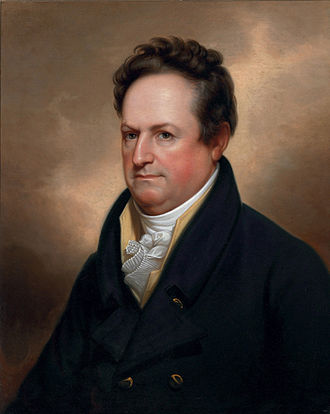
NAME: Clinton, DeWitt
ACHIEVEMENT(S): Erie Canal
DATE AND PLACE OF BIRTH: March 2, 1769, Little Britain, Orange County, New York
DATE/PLACE OF DEATH/AGE AT DEATH: February 11, 1828, Albany, New York; Aged 58
DISCIPLINE: New York Mayor/New York State Governor
FIELD: Politics
LANGUAGE: English
PARENTS: Major-General James Clinton; Mary DeWitt
SIBLINGS: Alexander; George Jr; James Graham (half brother)
SPOUSE: 1) Maria Franklin; 2) Catherine Jones
CHILDREN: 10
EDUCATION: Rev. John Moffat's grammar school; Columbia University, New York City
MAJOR WORK: None
LIFE AND TIMES:
After Clinton graduated from Columbia University in New York City at the age of 17, he decided to follow in the footsteps of a number of relatives and make politics his life. At 21 he became private secretary to his uncle, George Clinton, Governor of New York State. At 26 he was made secretary of the Board of Regents and secretary of the Board of Fortification of New York.
After the defeat of his party in 1795 Clinton lost office and decided to go back to school, where he studied natural science under Professor S.L. Mitchell and David Hossack of Columbia College. Later, as an accomplished naturalist, he discovered a wheat that grew naturally in the U.S., and a new species of fish, Salmo Otsego. His "Introductory Discourse", published in 1814, was considered at the time as one of the best summaries of the state of scientific knowledge in America.
Clinton also continued his political activities and spoke out in 1795 and 1796 against the administration of Jay* and President John Quincy Adams*.
He became a member of the New York State Assembly in 1797, and of the State Senate from 1798 to 1802. He helped pass legislation to end slavery in New York. He also worked for better laws on sanitation, the relief of prisoners for debt, the promotion of steam navigation, and the encouragement of agriculture. He was also one of the delegates at the State Constitutional Convention in 1801.
Following the resignation of Senator John Armstrong, Clinton was elected to the United States Senate as a Republican in 1802, where he served two annual sessions. He campaigned diligently for the 12th Amendment, which separated the selection of President from that of the Vice President. The bill was passed in 1804, after which Clinton resigned as senator.
Clinton had never liked leaving his family for six months at time to be in Washington, and feeling that Burr* could not be trusted to be a good Mayor of New York, he decided to try for himself. Clinton campaigned tirelessly, won, and became the longest serving mayor of New York City in history, taking the position in 1804, at the age of 35, and holding it for 11 years (except for 1807-08 and 1810-11.)
Clinton was elected to the State Senate in 1806 and served until 1811. He was an impassioned advocate of the same education for all children regardless of sex and race and economic status. His early efforts were constrained by lack of funding, which prompted him to suggest the Lancastrian system of tuition, by which older children gave instruction to younger ones. He established a free school system for the poor and promoted education for girls, refugees, the hearing- and speech-impaired, blacks and native Americans.
His work did much to make education the responsibility of the state. Clinton ran as a presidential candidate in 1812 against a background of commercial depression due to the war with England. He is one of only two presidential candidates to have run on a major party coalition ticket (Greeley was the other).
Clinton won 89 electoral votes to James Madison's 128. Clinton was not re-nominated for the post of Lieutenant Governor, which he had held between 1811-13, and he lost his New York mayoral position in 1815.
After these defeats, Clinton devoted himself energetically to the idea of building a canal to connect the port of New York and the Hudson River with the Great Lakes. This Erie Canal scheme had first been presented in the New York legislature in 1792 through the efforts of politician Gouverneur Morris*, but the plan had little support, largely because of the sheer scale of the effort involved. Clinton had begun to take an interest in the scheme in 1810.
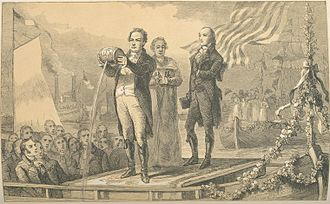
Clinton mingling the waters of Lake Erie and the Atlantic, 1826.aaGHT
In 1811, he and Morris tried unsuccessfully to raise funding for the project. Then the war of 1812 intervened. After the War Clinton succeeded in drumming up public interest at meetings throughout New York state, and on April, 17, 1816, the Erie Canal plan was accepted.
After New York Governor Tompkins resigned in March, 1817 to become Vice-President, Clinton was elected in his stead. But his work for the Canal did not end. He remained personally involved, and continued to promote it until its completion in 1825.
While Governor, Clinton faced persistent calls for a new state constitution for New York. The new constitution curtailed the term of the governor to two years, bringing the next election forward to January, 1823.
In a landslide victory Clinton was re-appointed Governor in November, 1824. He was in office when the Erie Canal was completed and he led the 1825 celebrations. The Completion of "Clinton's Ditch", as his opponents disparagingly dubbed it, made New York the major port of the Northeast, placing it ahead of Philadelphia and Baltimore, and beyond threat from any other eastern American port for decades to come.
President John Quincy Adams offered Clinton the job of Minister to Great Britain, but Clinton declined. In 1828, when his term as Governor expired, Clinton considered running for the presidency again, but had little support outside New York. He died suddenly in 1828.
ASSESSMENT: His persistent lobbying resulted in the building of the Erie Canal, helped make New York City the most important port on the Eastern seaboard.
EXTRA CONNECTIONS: Met U.S. inventor Fulton*.
The canal was superseded by Minot’s* Erie Railroad.
Clinton was a York Rite Freemason.[11] He was initiated in the "Holland" Lodge No. 16 (now No 8), NY on September 3, 1790,[12][13] and, in 1806, he was elected Grand Master of the Grand Lodge of New York. Clinton was essential in establishing the Grand Encampment of Knights Templar in the United States and served as its first, second, and third grand master from 1816 to 1828.[12][14] He retained the title until his death in 1828.[12]
In 1826, the William Morgan Affair occurred in Batavia. Morgan, who threatened to publish an exposé of the rituals of Freemasonry, disappeared and was apparently kidnapped and supposedly murdered by Masons. Clinton issued three proclamations, each increasing the reward for information and conviction of the perpetrators until it reached $2,000.[15] Clinton's proclamations had no effect, however, and the Masonic fraternity underwent a period of severe decline in many regions of the United States because of criticism set off by the scandal.[16]
Together with financier Thomas Eddy, he was a director of New York's earliest savings bank established to serve laborers and the poor, The Bank for Savings in the City of New-York.[19]
In 1813, Clinton became a hereditary member of the New York Society of the Cincinnati in succession to his brother, Lieutenant Alexander Clinton, who was an original member of the society.[21] In that same year, he was elected as a member to the American Philosophical Society.[22]
ONELINER: De Witt Clinton, 11 years Governor of New York
BIBLIOGRAPHY:
Cornog Evan, The Birth of Empire: DeWitt Clinton and the American Experience 1769-1828, New York, Oxford: Oxford University Press. 1998.