Jay, John
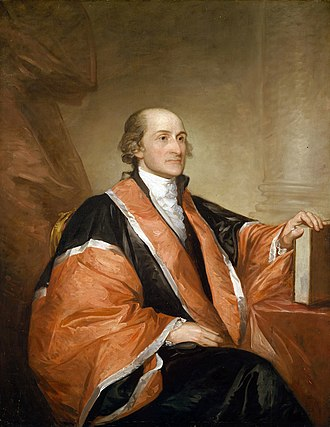
Name: John Jay
Achievements: His achievements were many, varied, and of key importance to the early years of the United States; Member of the New York Committee of Correspondence, 1774; Delegate to the Continental Congress, 1774-1776; Member of the New York Constitutional Convention, First Chief Justice of New York, 1777; Delegate & elected President of the Continental Congress, 1778; Minister to Spain, 1779; Minister to the Treaty of Paris, 1782; Secretary of Foreign Affairs, 1784; Contributor to The Federalist, 1788; First Chief Justice of the Supreme Court, 1789; Negotiator of Jay Treaty with Great Britain, 1794; elected Governor of New York, 1797-1801.
Born: December 12, 1745; New York, NY
Died: May 17, 1829; Bedford, NY
Field & Discipline: Law; Social Sciences
Language: English
Father: Peter
Mother: Mary Van Corlandt
Spouse: Mary Livingston Jay
Siblings: (six)
Children: Peter Augustus; William; (others)
Education: King’s College (now Columbia University)
Major Work:
The Federalist [essays #2, #3, #4, #5, #64]
the Jay Treaty
Life & Times:
John Jay showed his intellectual skills at an early age; he was educated by tutors and at a boarding school in New York and entered King’s College [now Columbia University], graduating there at age 19 with highest honors. He proceeded to study law and. for a short time his colleague and partner was [law partner was] Robert R Livingston*.
In September 1774, he attended the First Continental Congress and was responsible for the “Address to the People of Great Britain” [also known as the “Olive Branch Petition”], which opposed British actions but did not favor independence. He retired from the Continental Congress in 1776 rather than sign the Declaration of Independence, a fact noted by Thomas Jefferson and [fellow Declaration-signer was] Robert Morris*, who both signed this historic document. However, once it became certain a break with Great Britain was going to occur, Jay joined the New York state militia along with [colleague was] Gouverneur Morris* and Livingston.
In 1777, he attended the New York constitutional convention and was selected to assist in drafting its first constitution. Later, he was selected to serve as the first Chief Justice of the state of New York. In 1778, he was elected to the Second Continental Congress and was voted to be its president. In 1779, Jay was appointed by Washington as minister plenipotentiary to Spain to seek recognition of Colonial Independence, financial aid and trading treaties…none of which came to fruition.
In 1782, he, [a colleague of] John Adams*, his friend [a pal of] Franklin* and Laurens met with the British to negotiate and sign the treaty of peace [Treaty of Paris] with Great Britain which ended the American Revolution. That same year, while in London, he commissioned Gilbert Stuart to paint his portrait. Stuart only completed his face, and a completed portrait was done by American artist John [painted by] Trumbull*. When he returned home in 1784, he discovered he had been appointed Secretary of Foreign Affairs.
From 1784 to 1789, he was able to secure minor treaties but found that it was impossible [under the Articles of Confederation] to settle major disputes with Great Britain and Spain. This made him an ardent supporter of a stronger, Federal, central government. During this period, he contributed to five articles in The Federalist, along with [colleague was] Alexander Hamilton* and John Madison, to support the writing of a new constitution.
In 1789, he was appointed by [appointed by] Washington* as first Chief Justice of the Supreme Court under the new constitution. In 1794, Washington appointed him as an envoy to Great Britain to settle continuing border conflicts as well as conflicts with trade on the high seas. This resulted in the Jay Treaty, which was a series of compromises and did not sit well with public opinion. It did not address restitution of slaves taken by the British during the Revolution, nor did it address the matter of British press-ganging of American seamen from their ships at sea to serve in the British navy.
[his treaty opposed by] Andrew Jackson* disliked the Jay Treaty so much he voted “no” on a congratulatory farewell resolution offered to Washington on his departure from office.
On his return home in 1795, Jay found that he had been elected governor of New York through the efforts of [colleague was] Alexander Hamilton*, who wanted to strengthen the federalist cause in New York. Jay had sought the governor’s position three years earlier, but lost to [the incumbent [lost governorship to] Clinton, George*.
Jay then served two terms as governor, constructing a new state prison, fortifying the New York City harbor against potential French attack, seeking judicial reform and the abolition of slavery, as well as beginning a number of canal projects to help the state’s economy.
He retired in 1801, but still maintained an interest in state and national events, as well as the anti-slavery movement.
Extra Connections: He supported Silas [supported] Deane*.
When Jay was Foreign Secretary, Thomas [employed] Jefferson* reported to him.
He was a colleague of a colleague of] James Wilson*
Assessment: An able lawyer, negotiator and politician
Oneliner: John Jay, US revolutionary and Foreign Secretary
Bibliography:
- www.infoplease.com.
- www.columbia.edu.
- www.leftjustified.com.
- www.ushistory.org.
- www.npg.si.edu/colls/jay.htm.
- www.ushistory.org.