Fulton, Robert 2
Robert Fulton (November 14, 1765 – February 24, 1815) was an American engineer and inventor who is widely credited with developing the world's first commercially successful steamboat, the *North River Steamboat* (also known as Clermont). In 1807, that steamboat traveled on the Hudson River with passengers from New York City to Albany and back again, a round trip of 300 nautical miles (560 kilometers), in 62 hours. The success of his steamboat changed river traffic and trade on major American rivers.
In 1800, Fulton had been commissioned by Napoleon Bonaparte, leader of France, to attempt to design a submarine; he then produced *Nautilus*, the first practical submarine in history.[1] Fulton is also credited with inventing some of the world's earliest naval torpedoes for use by the Royal Navy.[2]
Fulton became interested in steam engines and the idea of steamboats in 1777 when he was around age 12 and visited state delegate William Henry of Lancaster, Pennsylvania, who was interested in this topic. Henry had learned about inventor James Watt and his Watt steam engine on an earlier visit to England.
Early life

A drawing of Fulton's invention *Nautilus*
Robert Fulton was born on a farm in Little Britain, Pennsylvania, on November 14, 1765. His father, Robert Fulton, married Mary Smith, daughter of Captain Joseph Smith and sister of Col. Lester Smith,[3] a comparatively well off family.[4] He had three sisters – Isabella, Elizabeth, and Mary, and a younger brother, Abraham.[5]
For six years, he lived in Philadelphia, where he painted portraits and landscapes, drew houses and machinery, and was able to send money home to help support his mother. In 1785, Fulton bought a farm at Hopewell Township in Washington County near Pittsburgh for £80 (equivalent to $13638 in 2018),[6] and moved his mother and family into it.
Jobs
Career in Europe (1786–1806)

Fulton's 1806 submarine design for the U.S. government
At the age of 23, Fulton traveled to Europe, where he would live for the next twenty years. He went to England in 1786, carrying several letters of introduction to Americans abroad from prominent individuals he had met in Philadelphia. He had already corresponded with artist Benjamin West; their fathers had been close friends. West took Fulton into his home, where Fulton lived for several years and studied painting. Fulton gained many commissions painting portraits and landscapes, which allowed him to support himself. He continued to experiment with mechanical inventions.[5]
Fulton became caught up in the enthusiasm of the "Canal Mania". In 1793 he began developing his ideas for tugboat canals with inclined planes instead of locks. He obtained a patent for this idea in 1794, and also began working on ideas for the steam power of boats. He published a pamphlet about canals and patented a dredging machine and several other inventions.
In 1794, he moved to Manchester to gain practical knowledge of English canal engineering. While there he became friendly with Robert Owen, a cotton manufacturer and early socialist. Owen agreed to finance the development and promotion of Fulton's designs for inclined planes and earth-digging machines; he was instrumental in introducing the American to a canal company, which awarded him a sub-contract. But Fulton was not successful at this practical effort and he gave up the contract after a short time.[7]
Bust of Robert Fulton by Jean-Antoine Houdon, 1803
As early as 1793, Fulton proposed plans for steam-powered vessels to both the United States and British governments. The first steamships had appeared considerably earlier. The earliest steam-powered ship, in which the engine moved oars, was built by Claude de Jouffroy in France. Called Palmipède, it was tested on the Doubs in 1776. In 1783, de Jouffroy built *Pyroscaphe*, the first paddle steamer, which sailed successfully on the Saône. The first successful trial run of a steamboat in America had been made by inventor John Fitch, on the Delaware River on August 22, 1787. William Symington had successfully tried steamboats in 1788, and it seems probable that Fulton was aware of these developments.
In Britain, Fulton met the Duke of Bridgewater, Francis Egerton, whose canal, the first to be constructed in the country, was being used for trials of a steam tug. Fulton became very enthusiastic about the canals, and wrote a 1796 treatise on canal construction, suggesting improvements to locks and other features.
Working for the Duke of Bridgewater between 1796 and 1799, Fulton had a boat constructed in the Duke's timber yard, under the supervision of Benjamin Powell. After installation of the machinery supplied by the engineers Bateman and Sherratt of Salford, the boat was duly christened Bonaparte in honour of Fulton having served under Napoleon. After expensive trials, because of the configuration of the design, the team feared the paddles might damage the clay lining of the canal and eventually abandoned the experiment. In 1801, Bridgewater instead ordered eight vessels for his canal based on *Charlotte Dundas*, constructed by Symington.

Location and plaque of the Fulton experiment of August 9, 1803
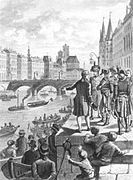
Fulton presents his steamship to Bonaparte in 1803
In 1797, Fulton went to Paris, where he was well known as an inventor. He studied French and German, along with mathematics and chemistry. Fulton also exhibited the first panorama painting to be shown in Paris, Pierre Prévost's Vue de Paris depuis les Tuileries (1800), on what is still called Rue des Panoramas (Panorama Street) today.[8]
While living in France, Fulton designed the first working muscle-powered submarine, *Nautilus*, between 1793 and 1797. He also experimented with torpedoes. When tested, his submarine operated underwater for 17 minutes in 25 feet of water. He asked the government to subsidize its construction, but he was turned down twice. Eventually, he approached the Minister of Marine and, in 1800, was granted permission to build.[9] The shipyard Perrier in Rouen built it, and the submarine sailed first in July 1800 on the Seine River in the same city.
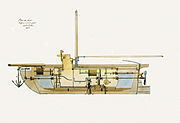
1806 design (enbiggen)

Commemorative plaque to Robert Fulton in the port of Rouen, made in 1918 to thank the United States for their involvement in the First World War
In France, Fulton met Robert R. Livingston, who was appointed U.S. Ambassador to France in 1801. He also had a scientifically curious mind, and the two men decided to collaborate on building a steamboat and to try operating it on the Seine. Fulton experimented with the water resistance of various hull shapes, made drawings and models, and had a steamboat constructed. At the first trial the boat ran perfectly, but the hull was later rebuilt and strengthened. On August 9, 1803, when this boat was driven up the River Seine, it sank. The boat was 66 feet (20 m) long, with an 8-foot (2.4 m) beam, and made between 2+1⁄2 and 3+1⁄2 knots (5 and 6 km/h) against the current.
In 1804, Fulton switched allegiance and moved to Britain, where he was commissioned by Prime Minister William Pitt the Younger to build a range of weapons for use by the Royal Navy during Napoleon's invasion scares. Among his inventions were the world's first modern naval "torpedoes" (modern "mines"). These were tested, along with several other of his inventions, during the 1804 Raid on Boulogne, but met with limited success. Although Fulton continued to develop his inventions with the British until 1806, the crushing naval victory by Admiral Horatio Nelson at the 1805 Battle of Trafalgar greatly reduced the risk of French invasion. Fulton was increasingly sidelined as a result.[2]
Career in the United States (1806–1815)
In 1806, Fulton returned to the United States. In 1807, he and Robert R. Livingston built the first commercially successful steamboat, *North River Steamboat* (later known as Clermont). Livingston's shipping company began using it to carry passengers between New York City and up the Hudson River to the state capital Albany. Clermont made the 150-nautical-mile (280 km) trip in 32 hours. Passengers on the maiden voyage included a lawyer Jones and his family from Bethlehem, Pennsylvania. His infant daughter Alexandra Jones later served as a Union nurse on a steamboat hospital in the American Civil War.[10]
The Clermont was the first real steamboat in America. While it was being built people called it "Fulton's Folly". The Clermont had sails as well as a steam engine. At each end of the boat was a short mast with a small square sail that could be unfurled when needed. The engine was in the center of the boat and was surrounded by cord wood. The engine was 24-horsepower. Above the engine was a tall and slender smoke stack. On each side was a big paddle wheel that was open and uncovered. The diameter of the paddle wheels was 15 feet (4.6 m). The boat itself was 136 feet (41 m) long and 18 feet (5.5 m) wide. Its displacement was 160 tons.[11]
From 1811 until his death, Fulton was a member of the Erie Canal Commission, appointed by the Governor of New York.
Fulton's final design was the floating battery *Demologos*. This first steam-driven warship in the world was built for the United States Navy for the War of 1812. The heavy vessel was not completed until after Fulton's death and was named in his honor.
From October 1811 to January 1812, Fulton, along with Livingston and Nicholas Roosevelt (1767–1854), worked together on a joint project to build a new steamboat, *New Orleans*, sturdy enough to take down the Ohio and Mississippi rivers to New Orleans, Louisiana. It traveled from industrial Pittsburgh, Pennsylvania, where it was built, with stops at Wheeling, Virginia; Cincinnati, Ohio; past the "Falls of the Ohio" at Louisville, Kentucky; to near Cairo, Illinois, and the confluence with the Mississippi River; and down past Memphis, Tennessee, and Natchez, Mississippi, to New Orleans some 90 miles (140 km) by river from the Gulf of Mexico coast.
This was less than a decade after the United States had acquired the Louisiana Territory from France. These rivers were not well settled, mapped, or protected. By achieving this first breakthrough voyage and also proving the ability of the steamboat to travel upstream against powerful river currents, Fulton changed the entire trade and transportation outlook for the American heartland.
Fulton was elected a member of the American Antiquarian Society in 1814.[12]
Personal life
Harriet Livingston, portrait by Robert Fulton
On January 8, 1808, Fulton married Harriet Livingston (1783–1826), the daughter of Walter Livingston and niece of Robert R. Livingston, prominent men in the Hudson River area, whose family dated to the colonial era.[3][13] Harriet, who was nineteen years his junior, was well educated and was an accomplished amateur painter and musician.[4] Together, they had four children:[14]
- Robert Barlow Fulton (1808–1841), who died unmarried.[14]
- Julia Fulton (1810–1848), who married lawyer Charles Blight of Philadelphia.[14]
- Cornelia Livingston Fulton (1812–1893), who married lawyer Edward Charles Crary (1806–1848) in 1831.[13]
- Mary Livingston Fulton (1813–1861), who married Robert Morris Ludlow (1812–1894), parents of Robert Fulton Ludlow.[3]
Fulton died in 1815 in New York City from tuberculosis (then known as "consumption"). He had been walking home on the frozen Hudson River when one of his friends, Thomas Addis Emmet, fell through the ice. In rescuing his friend, Fulton got soaked with icy water. He is believed to have contracted pneumonia. When he got home, his sickness worsened. He was diagnosed with consumption and died at 49 years old. After his death, his widow remarried to Charles Augustus Dale on November 26, 1816.
He is buried in the Trinity Church Cemetery for Trinity Church (Episcopal) at Wall Street in New York City, near other notable Americans such as former U.S. Secretaries of the Treasury, Alexander Hamilton and Albert Gallatin. His descendants include Cory Lidle, a former Major League Baseball pitcher.[15]
Legacy
Posthumous honors
The Commonwealth of Pennsylvania donated a marble statue of Fulton to the National Statuary Hall Collection in the United States Capitol. Fulton was also honored for his development of steamship technology in New York City's Hudson-Fulton Celebration of the Centennial in 1909. A replica of his first steam-powered steam vessel, Clermont, was built for the occasion.
Five ships of the United States Navy have borne the name USS *Fulton* in honor of Robert Fulton.
Fulton Hall at the United States Merchant Marine Academy houses the Department of Marine Engineering and included laboratories for diesel and steam engineering, refrigeration, marine engineering, thermodynamics, materials testing, machine shop, mechanical engineering, welding, electrical machinery, control systems, electric circuits, engine room simulators and graphics.
Robert Fulton (with Samuel F. B. Morse) depicted on the reverse of the 1896 $2 Silver Certificate from the United States Treasury
Bronze statues of Fulton and Christopher Columbus represent commerce on the balustrade of the galleries of the Main Reading Room in the Thomas Jefferson Building of the Library of Congress on Capitol Hill in Washington, D.C. They are two of 16 historical figures, each pair representing one of the 8 pillars of civilization.
The Guatemalan government in 1910 erected a bust of Fulton in one of the parks of Guatemala City.[16]
In 2006, Fulton was inducted into the "National Inventors Hall of Fame" in Alexandria, Virginia.[17]...
NAME: Fulton, Robert.
ACHIEVEMENTS: Developed the steamboat.
NICKNAME/ALIAS: None.
DATE AND PLACE OF BIRTH: 14th November 1765, in Lancaster County, PA.
DATE/PLACE OF DEATH/AGE AT DEATH: 24th February 1815, New York, NY. Aged 50.
DISCIPLINE: Engineer and inventor.
FIELD: Engineering.
LANGUAGE: English.
PARENTS: Father, Robert Fulton, mother, Mary Smith.
SIBLINGS: 1 brother, Abraham, 3 sisters Elizabeth, Isabella and Mary.
SPOUSE: Harriet Livingston.
CHILDREN: 1 son, Robert, 3 daughters, Julia, Mary and Cornelia.
EDUCATION: Quaker school, Lancaster County.
MAJOR WORK:
‘Treatise on the Improvement of Canal Navigation’ (1796).
‘Torpedo War and Submarine Explosions’ (1810).
‘Report on the Practicability of Navigating with Steamboats on the Southern
Waters of the United States’ (1813).
LIFE AND TIMES:
At the age of twenty-one, Fulton developed a chest ailment and went to Bath, VA, to convalesce. He was by now an accomplished painter of miniatures on ivory and it was suggested that he should go to Europe to study art.
He had been given a letter of introduction to the London-based artist <taught by> West*, who began to tutor him. Two of his paintings were accepted by the Royal Academy in 1791 and in the same year Fulton met the Duke of Bridgewater, who had built a canal to transport the coal mined on his estate in the north of England.
Intrigued by canal engineering, Fulton threw himself into this new occupation. He lived in Devon, in the South-East of England, for two years then went to the main industrial centres, Birmingham and Manchester.
In Manchester, Fulton met <formed club with> Robert Owen*, who owned the first textile mill to use steam-power, and they established a club where people with scientific interests met to discuss inventions and philosophy. They called themselves “the philosophers.”
Among club members were the chemist, <formed club with> Dalton*, and the poet <formed club with> Coleridge*.
In 1796, Fulton published his first major work, ‘Treatise on the Improvement of Canal Navigation’. At the same time, he became interested in the ideas for marine propulsion being explored by engineers and inventors at that time, and decided that revolving paddles situated at the stern of a boat could be the most efficient method of propulsion.
In 1797, Fulton went to France, where his plan for a canal connecting Paris with Dieppe and Cambrai had been approved. Two years later, he began work on designs for a submarine, the ‘Nautilus’, which he proposed should be used by the French in their fight against the British.
In theory, the submarine would be able to travel under water for up to six hours, guided by a compass. Fulton's idea was that it could steal under the hulls of the British ships and deposit explosives, which could be exploded once the submarine had departed. The initial reaction of the French government was that use of the submarine would be dishonorable.
In 1800, Fulton financed a prototype with his own money. He carried out trials in the Seine, where he could go to a depth of 25 feet. When the trials proved successful, the French had a change of heart and agreed to try it out against Royal Navy warships in the English Channel, but the submarine was too slow. In 1802, the peace treaty of Amiens was signed, France and Britain were no longer at war, and the project was cancelled.
The following year, Fulton began to experiment with small steamboats on the Seine. He met the American minister to France, <collaborated with> Robert R Livingston*, who had been in Paris for a couple of years. Livingston was also interested in marine engineering and already had a monopoly of steamboat navigation in the New York State. He liked Fulton's designs and agreed to share the cost of construction of a boat with a side paddlewheel driven by an eight-horsepower French engine.
During the first trial, the engine broke the hull, but further trials looked promising, so they decided to build a more powerful steamboat for eventual use on the Hudson River in the USA. In preparation for the project, Livingston extended his monopoly and Fulton ordered a twenty-four horsepower engine from the English engineering firm of <bought engine from> Boulton* & <bought engine from> Watt* .
Fulton returned to New York at the end of 1806 to begin work on his <invented> steamboat*. While it was being built, he tried to sell his submarine idea to the government, but the demonstration he gave was a disaster.
<offered work by> Jefferson* asked Fulton to write a report on the possibility of building a canal uniting the Mississippi and Lake Pontchartrain, but he declined in favour of work on his steamboat.
In 1807, the steamboat was ready: 150 feet long and propelled by two huge side paddlewheels, 15 feet in diameter, which were driven by a single-cylinder condensing steam engine. The trial was a huge success, covering the 150 miles from New York to Albany in 32 hours, a journey that normally took four days under sail.
The terms of Livingston’s monopoly were that a vessel had to move at a speed of four miles per hour, and Fulton’s steamboat beat that by 0.7 mph. Fulton and Livingston went on to built a bigger boat, with an engine house and berths in the cabins, and started commercial service in September 1807. The ‘North River Steamboat’ made three round trips every two weeks between New York and Albany, carrying light freight as well as passengers.
During the winter of 1807-8, Fulton built another improved steamship, among the improvements being guards over the paddlewheels. The new boat was called the ‘North River Steamboat of Clermont.’
Within two years, Fulton steamboats were being used on the Hudson and Raritan rivers and had replaced the horse ferries used in river crossings in New York, Boston and Philadelphia. Fulton and Livingston acquired another steamboat monopoly for the New Orleans area and in 1811, Fulton went south on his new boat, the ‘New Orleans’. Although the boat could not travel any further upriver than Natchez, the Mississippi had at last been opened up to steamboats.
In 1812, Fulton was appointed to the commission which recommended the construction of the Erie Canal and he also started work on the world's first steam warship, the ‘Demologus’, which was nothing more than a heavily armoured mobile floating gun platform.
Launched in 1814, it consisted of two parallel hulls with a paddlewheel between them, with the steam engine in one hull and the boilers and stacks in the other. Although it was never used in battle, the ‘Demologus’ served as the prototype for the first seagoing US navy steamship, the ‘USS Fulton,’ which sailed under the command of <designed ship commanded by> Perry*.
In 1814, Fulton wrote a paper on the ‘Advantages of the Proposed Canal from Lake Eerie to the Hudson River’. The canal was built later, largely due to the efforts of <influenced> Clinton*.
ASSESSMENT: Fulton's inventive mind and practical talents produced inventions which were sometimes ahead of their time.
EXTRA CONNECTIONS: <knew> John Hancock*
ONELINER: Robert Fulton, developed first operational steamboat
BIBLIOGRAPHY:
Sutcliffe, Alice Crary, Robert Fulton, MacMillan Company, New York, 1915.
Dickinson H W, Robert Fulton, Engineer and Artist, 1913.
Encyclopaedia Britannica.