Hummingbird
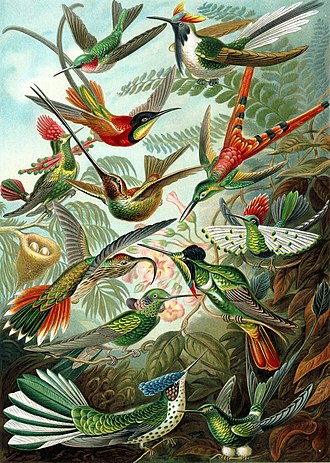
Hummingbirds are birds native to the Americas and comprise the biological family Trochilidae. With about 360 species, they occur from Alaska to Tierra del Fuego, but the vast majority of the species are found in the tropics. They are small birds, with most species measuring 7.5–13 cm (3–5 in) in length.
The smallest extant hummingbird species is the 5 cm (2.0 in) bee hummingbird, which weighs less than 2.0 g (0.07 oz). The largest hummingbird species is the 23 cm (9.1 in) giant hummingbird, weighing 18–24 grams (0.63–0.85 oz). They are specialized for feeding on flower nectar, but all species consume flying insects or spiders.
Hummingbirds split from their sister group, the swifts and treeswifts, around 42 million years ago. The common ancestor of extant hummingbirds is estimated to have lived 22 million years ago in South America. They are known as hummingbirds because of the humming sound created by their beating wings, which flap at high frequencies audible to humans.
They hover in midair at rapid wing-flapping rates, which vary from around 12 beats per second in the largest species to around 80 per second in small hummingbirds. Of those species that have been measured during flying in wind tunnels, their top speeds exceed 15 m/s (54 km/h; 34 mph). During courtship, some male species dive from 30 metres (100 ft) of height above a female at speeds around 23 m/s (83 km/h; 51 mph).[1][2]
Hummingbirds have the highest mass-specific metabolic rate of any homeothermic animal.[3] To conserve energy when food is scarce and nightly when not foraging, they can go into torpor, a state similar to hibernation, and slow their metabolic rate to 1/15 of its normal rate.[4]...
With the exception of insects, hummingbirds while in flight have the highest metabolism of all animals – a necessity to support the rapid beating of their wings during hovering and fast forward flight.[3][52] Their heart rate can reach as high as 1,260/min, a rate once measured in a blue-throated hummingbird, with a breathing rate of 250/min, even at rest.[53][54] During flight, oxygen consumption per gram of muscle tissue in a hummingbird is about 10 times higher than that measured in elite human athletes.[3]
Hummingbirds are rare among vertebrates in their ability to rapidly make use of ingested sugars to fuel energetically expensive hovering flight,[55] powering up to 100% of their metabolic needs with the sugars they drink (in comparison, human athletes maximize around 30%). Hummingbirds can use newly ingested sugars to fuel hovering flight within 30–45 minutes of consumption.[56][57] These data suggest that hummingbirds are able to oxidize sugar in flight muscles at rates high enough to satisfy their extreme metabolic demands. A 2017 review indicated that hummingbirds have in their flight muscles a mechanism for "direct oxidation" of sugars into maximal ATP yield to support their high metabolic rate for hovering, foraging at altitude, and migrating.[58]
By relying on newly ingested sugars to fuel flight, hummingbirds can reserve their limited fat stores to sustain their overnight fasting or to power migratory flights.[56] Studies of hummingbird metabolism address how a migrating ruby-throated hummingbird can cross 800 km (500 mi) of the Gulf of Mexico on a nonstop flight.[54] This hummingbird, like other long-distance migrating birds, stores fat as a fuel reserve augmenting its weight by as much as 100%, then enabling metabolic fuel for flying over open water.[54][59]
...
Culture
- Aztecs wore hummingbird talismans, both artistic representations of hummingbirds and fetishes made from actual hummingbird parts: emblematic for their vigor, energy, and propensity to do work along with their sharp beaks that symbolically mimic instruments of weaponry, bloodletting, penetration, and intimacy. Hummingbird talismans were prized as drawing sexual potency, energy, vigor, and skill at arms and warfare to the wearer.[165]
- The Aztec god of war Huitzilopochtli is often depicted as a hummingbird. It was also believed that fallen warriors would return to earth as hummingbirds and butterflies.[166] The Nahuatl word huitzil (hummingbird) is an onomatopoeic word derived from the sounds of the hummingbird's wing-beats and zooming flight.
- One of the Nazca Lines depicts a hummingbird
- The Hopi and Zuni cultures have a hummingbird creation myth about a young brother and sister who are starving because drought and famine have come to the land. Their parents have left to find food, so the boy carves a piece of wood into a small bird to entertain his sister. When the girl tosses the carving into the air, the bird comes to life, turning into a hummingbird. The small bird then flies to the God of Fertility and begs for rain, and the god obliges the request, which helps the crops to grow again.[167]
- Trinidad and Tobago, known as "The land of the hummingbird," displays a hummingbird on that nation's coat of arms,[168] 1-cent coin[169] and emblem of its national airline, Caribbean Airlines (right).
- The Gibson Hummingbird is an acoustic guitar model/series produced by the Gibson Guitar Corporation.
- During the National Costume competition of the Miss Universe 2016 beauty pageant, Miss Ecuador Connie Jiménez wore a costume inspired by the hummingbirds of her land[170] that included golden wings supposed to follow the movements of her arms.[171][172] However, it accidentally got damaged during the dress rehearsal, and she appeared onstage with a broken, drooping left wing.[173][174]