Shovell, Adm
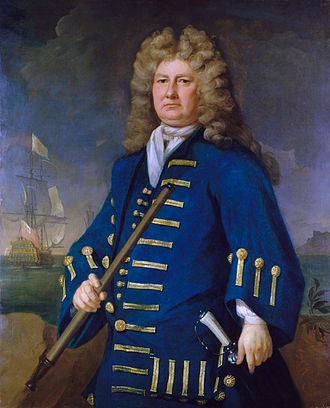
Shovel, Sir Cloudesley, big-wig
ACHIEVEMENT(S): Admiral of the Fleet whose death triggered the search for the solution to longitudinal navigation.
NICKNAME/ALIAS: also spelled Sir Clowdisley Shovell
DATE/PLACE OF BIRTH: November 1650, at Cockthorpe, Norfolk, England
DATE/PLACE/AGE AT DEATH: October 1707, Porthellick Cove, Scilly Isles. Aged 56
DISCIPLINE: Admiral of the Fleet
FIELD: Navy
LANGUAGE: English
EDUCATION: Unknown
MAJOR WORK: None
LIFE AND TIMES:
Nothing is known of Shovel’s childhood or education until 1664, when he went to sea first under a kinsman, Sir Christopher Myngs, and then another, Sir John Narborough. According to tradition, he won distinction at the Battle of Lowestoft (13 June 1665) during the Second Dutch War (1665-67), where he swam with a message between two English ships under enemy fire.
During the late 1660s, Shovel got a reputation for courage and amiability, while also teaching himself the essentials of navigation, and in September 1673 he was promoted to second lieutenant on one of Narborough's ships, the 'Henrietta', in the Mediterranean. He served on a number of vessels, and in January 1676 led a force that burnt four pirate ships under the walls of Tripoli.
He was promoted to captain of the 'Sapphire' in 1677, and spent most of the following ten years engaged in almost constant cruising, harassing pirates in the Mediterranean, capturing or assisting in the capture of several of their ships. He returned to England in November 1686, and two years later was given a command in the fleet formed under Lord Dartmouth to prevent the landing of William of Orange but, like most sailors at the time, he found no difficulty in supporting the Protestant Prince after the success of the Glorious Revolution (1688).
The following year he was present at the inconclusive Battle of Bantry Bay (1689), in command of the 70-gun ship-of-the-line HMS 'Edgar', and was knighted on his return to England. In 1690 he was given a squadron in the Irish sea, with which he convoyed King William from England to Ireland in March 1690, and was appointed rear admiral of the Blue later the same year. In 1691 he married Elizabeth Hill, the widow of Sir John Narborough, with whom he had two daughters.
In 1692, Shovel was again promoted, to rear admiral of the Red, and served under Admiral Edward Russell with the Grand Fleet in the English Channel. During the Battle of Barfleur at La Hogue (29 May 1692), Shovel and his squadron were the first to break through a gap in the French line and by this maneuvre compromised Admiral Tourville's formation and contributed to the complete defeat of the French. As a result, Shovel was made vice-admiral of the Red and was sent as second-in-command on several expeditions against the French in the following years.
Shovel was promoted to admiral of the Blue in 1696 and put in command of the Channel and Biscay fleets until the end of the war in 1697. Under King William, he accumulated various offices and lucrative positions - including major of the first regiment of marines (1691), then lieutentant-colonel of the second regiment of marines (1692), and extra commissioner of the navy (1693) - and in 1698 won a seat in Parliament as M.P. for Rochester, which he retained until his death. In March 1699, he was also made comptroller of victualling, an office which he held until 1704.
On the accession of Queen Anne in 1702, Shovel was made admiral of the White and was sent to Spain, where he joined Sir George Rooke in time to bring back to England the captured Spanish treasure from the Battle of Vigo Bay (14 October 1702). In 1703 he commanded a squadron in the Mediterranean, and in 1704 was sent out to join Rooke, whom he then assisted in the brief siege and capture of Gibraltar (July-August 1704), and again at the drawn battle of Velez-Malaga (August 1704).
In September 1704 Shovel returned to England with Rooke, and within a few months had been appointed first rear-admiral of England, and then admiral of the fleet. In September-October 1705, he shared command with the Earl of Peterborough of the joint expedition to Spain and provided naval support for the siege and capture of Barcelona. In 1707, Shovel commanded the fleet that blockaded Toulon and assisted Prince Eugene and the Duke of Savoy in their unsuccessful attempt to take that city, although the attack did result in the complete destruction of the French Mediterranean fleet.
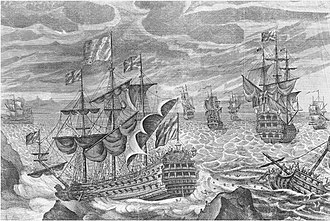
On the return voyage to England, an error in navigation led the fleet in among the rocks of the Scilly Isles, and three ships, including the flagship 'Association', sank and went down with all hands (almost two thousand men) on the evening of 22 October 1707. According to tradition, Admiral Shovel was still alive when he was swept ashore, but was buried in the sand by a local woman for the sake of his emerald ring.
His body was recovered and is buried in Westminster Abbey. One result of this tragedy was the establishment by the British government of a Board of Longitude in 1714, which offered a series of prizes up to anyone who could construct an instrument which could calculate accurately longitude at sea - a prize which was eventually won by John Harrison* for his chronometer (1763).
ASSESSMENT: He is also remembered for the expensive, heavy, full-bottomed wig, with a mass of tight curls framing the face, which he made fashionable and was named ‘Shovel’ wig after him, inspiring the term "big wig", which came to be applied to men of wealth and importance.
EXTRA CONNECTIONS: None
BIBLIOGRAPHY:
DNB
Dictionary of Military Biography
Cooke, J.H., The Shipwreck of Sir Cloudesley Shovel, Gloucester, 1883
PARENTS: John Shovell (1625-54) and Anne Clowdisley Jenkinson
SIBLINGS: Elder brother
SPOUSE: Elizabeth Narbrough (nee Hill), married 1691
CHILDREN: Elizabeth and Anne