Stanton EM
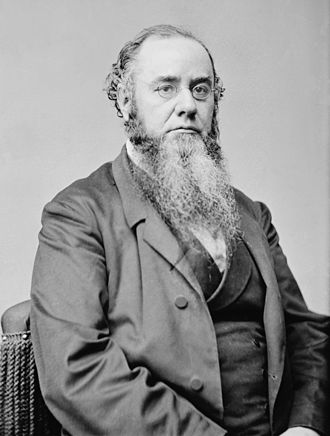
Achievements: President Lincoln’s Secretary of State for War
Born: December 19, 1814; Steubenville, Ohio
Died: December 24, 1869; Washington DC (Aged 55)
Field & Discipline: Government & Politics; Politician
Language: English
Father: David Stanton
Mother: Lucy Norman
Siblings: 3.
Spouse: 1) Mary Ann Lamson; 2) Ellen Hutchinson
Children: 6
Education: Local schools; Kenyon College, Gambier, Ohio
Life & Times:
Stanton came to the notice of [worked for] Lincoln* after working as counsel for the State of Pennsylvania (1849 –1856) on a lengthy, high-profile patent case that involved the inventor, Cyrus McCormick of [worked for] International Harvester*. In 1856, Stanton went to Washington DC and set up in practice working in the Federal Court.
Within two years, he was involved in the most important case of his career, when he won a series of victories for the US government concerning land claims in Mexico. His success resulted in President James [attorney general to] Buchanan* giving him the job of Attorney General in 1860.
Like the President, Stanton was a Democrat and against slavery but, as Attorney General, had to support the letter of the constitutional law that allowed ownership of slaves. When the Union Army abandoned Fort Sumter in Charleston, Buchanan was forced to accept Stanton’s reluctant decision that the army was acting within the law.
As a committed Unionist, he desperately wanted to avoid secession and so kept the Republicans well aware of Cabinet views on the war with the South. Stanton was opposed to Lincoln’s selection as President-elect, but after he became President, Stanton took a job as legal advisor to Simon Cameron, the Secretary of War.
Cameron believed that slaves should be armed in the coming conflict against the South and Stanton drafted the recommendation for him. Lincoln, however, was against the move and Cameron resigned, with Stanton succeeding him in January 1862.
The appointment allowed Stanton to reorganise the Department of War, bringing about a much more vigorous administration than before and adding extra staff, who immediately began public investigation of patronage and contracts.
Stanton also assumed control of railroads and telegraph lines when the war situation allowed it. He gave [appointed] McCallum*, the railroad engineer, the rank of Colonel and made him military director and superintendent of railroads throughout the United States.
Stanton’s attitude and management qualities resulted in a much more positive attitude toward the war, but his abrasive attitude did not endear him to the Union’s military commanders. One of those who suffered at Stanton’s hand (probably due to his ineffectiveness as a military leader) was General George [fired] McClellan*. McClellan’s unfounded complaints about lack of logistical support from the Department of War caused Stanton to call for his dismissal.
The support that Stanton was giving the war effort was ultra-efficient, a fact demonstrated when he moved 23,000 men and supplies to Chattanooga in less than a week. For this brilliant feat of organisation, as well as others, General Ulysses [a fan was] Grant * complimented Stanton.
He was unpopular with the press because of his firm censorship over war news.
Stanton’s respect for Lincoln grew and, when he was assassinated, Stanton moved heaven and earth to bring [brought to justice] John Wilkes Booth* and his fellow conspirators to justice. He stayed on as Secretary of War under Lincoln’s successor, Democrat Andrew Johnson, and took charge of the demobilization of the Union forces, a job he carried out with his usual efficiency.
From then on, Stanton’s relationship with the President deteriorated, beginning with a serious disagreement over the Reconstruction of the Southern States, which resulted in him being suspended by Johnson.
Stanton took the side of the radical Republicans in Congress, who favoured a tougher programme of reconstruction and wanted an active military presence in the South as well as black suffrage.
He decided to try to curb the powers of the President, by drafting a proposal that would force the President to defer to the Secretary of War or the army’s generals when involved in any military decisions. He was instrumental in a bill which authorised military commanders to reject the opinions of civilians, whatever their political position.
Johnson tried to get rid of Stanton but he refused to go when asked to resign in August 1867. Stanton maintained that, according to the recent Tenure of Office Act, the President was working in contravention of the Constitution if he tried to act without the support of Congress, so nothing could be done until Congress reassembled in December.
Johnson suspended Stanton but in January 1868 the Senate refused to ratify the suspension and Stanton was given his job back. A month later, Johnson tried again but Stanton simply refused to go, staying in his office day and night for weeks, working on the President’s impeachment, an action was brought on 26th May 1868, but which failed by only one vote, following which Stanton resigned.
By now, Stanton’s health had suffered, and he decided not to stand for public office again, in spite of support in Congress. He went back into private legal practice and, in December 1869, President Grant offered him a position on the Supreme Court. Four days later, Stanton died.
Assessment: Stanton was an able and energetic leader as Secretary of War, whose efficient administration in office greatly helped the Union cause.
Extra Connections:
In February 1856 Stanton became engaged to Ellen Hutchinson, sixteen years Stanton's junior.[39] She came from a prominent family in the city; her father was Lewis Hutchinson, a wealthy merchant and warehouseman and a descendant of Merriweather Lewis.
Daniel Sickles was a member of the United States House of Representatives from New York. He was married to Teresa Bagioli Sickles, the daughter of composer Antonio Bagioli. Sickles' wife had begun an affair with Philip Barton Key, the United States Attorney for the District of Columbia and the son of Francis Scott Key, writer of The Star-Spangled Banner. On Sunday, February 27, 1859, Sickles confronted Key in Lafayette Square, declaring, "Key, you scoundrel, you have dishonored my home; you must die", then shot Key to death. Stanton got him acquitted using an early use of temporary insanity defense.
Oneliner: EM Stanton, US Secretary of War under Lincoln
Bibliography:
- Dictionary of American Biography.
- Encyclopaedia Britannica.