Grant, US 2
(see main node)
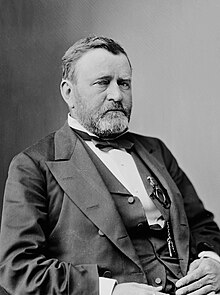
Ulysses S. Grant (born Hiram Ulysses Grant, /ˈhaɪrəm juːˈlɪsiːz/ *HY-rəm yoo-LISS-eez*; April 27, 1822 – July 23, 1885) was an American military officer and politician who served as the 18th president of the United States from 1869 to 1877. As Commanding General, he led the Union Army to victory in the American Civil War in 1865 and thereafter briefly served as U.S. Secretary of War. Later, as president, Grant was an effective civil rights executive who signed the bill that created the Justice Department and worked with Radical Republicans to protect African Americans during Reconstruction.
Born and raised in Ohio, Grant possessed an exceptional ability with horses. Admitted to West Point, Grant graduated in the class of 1843 and served with distinction in the Mexican–American War. He resigned from the army in 1854 but returned to civilian life impoverished. He joined the Union Army shortly after the American Civil War broke out in 1861 and rose to prominence after winning early Union victories in the western theater.
In 1863, he led the Vicksburg campaign, which gained control of the Mississippi River, dealing a serious strategic blow to the Confederacy, splitting it in two. President Abraham Lincoln promoted him to lieutenant general after his victory at Chattanooga. For thirteen months, Grant fought Robert E. Lee during the high-casualty Overland Campaign and at Petersburg. After Lee fled Petersburg, Grant surrounded and captured his army at Appomattox, where Lee formally surrendered to Grant. In 1866, president Andrew Johnson promoted Grant to General of the Army. Later, Grant openly broke with Johnson over Reconstruction policies. A war hero, drawn in by his sense of duty, Grant was unanimously nominated by the Republican Party and then elected president in 1868.
As president, Grant stabilized the post-war national economy, supported congressional Reconstruction and the ratification of the Fifteenth Amendment, and crushed the Ku Klux Klan. Under Grant, the Union was completely restored. He appointed African Americans and Jewish Americans to prominent federal offices. In 1871, he created the first Civil Service Commission, advancing the civil service more than any prior president. The Liberal Republicans and Democrats united behind Grant's opponent in the 1872 election, but Grant was handily reelected.
The Panic of 1873 plunged the nation into a severe economic depression that allowed the Democrats to win the House majority. Grant's Native American policy was to assimilate Indians into White culture. His foreign policy was mostly peaceful, without war, the *Alabama* Claims against Great Britain skillfully resolved. However, his prized Caribbean Dominican Republic annexation was rejected by the Senate. The Grant administration was often remembered primarily for a number of scandals, but modern scholarship has better appreciated Grant's appointed reformers and prosecutions. In the intensely disputed 1876 presidential election, Grant facilitated the approval by Congress of a peaceful compromise.
With the tour he took in his retirement, Grant became the first president to circumnavigate the world, meeting many prominent foreign leaders. In 1880, Grant was unsuccessful in obtaining the Republican presidential nomination for a third term. In the final year of his life, facing severe financial reversals and dying of throat cancer, he wrote his memoirs, which were published in two volumes in 1885 and 1886, shortly after Grant's death. They proved to be a major critical and financial success.
At the time of his death, he was memorialized as a symbol of national unity. Grant was a modern general and has been called "a skillful leader who had a natural grasp of tactics and strategy". Historical assessments and rankings of Grant were negative about him and his presidency before recovering beginning in the 21st century.
Grant's critics take a negative view of his economic mismanagement, his failed Dominican Republic annexation treaty, and corruption within his administration. His admirers emphasize Grant's peace policy with Native Americans, vigorous enforcement of civil and voting rights for African Americans, and securing North and South as a single nation within the Union.[1]
- Early life and education
- Early military career and personal life
- Civilian struggles, slavery, and politics
- Civil War
- Commanding General
- Presidency (1869–1877)
- Post-presidency (1877–1885)
- Historical reputation
- Memorials and presidential library
- Dates of rank
- See also
- Notes
- References
- Bibliography
Early life and education
Further information: Early life and career of Ulysses S. Grant
[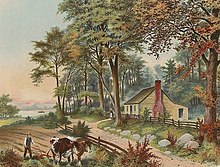
Grant's birthplace in Point Pleasant, Ohio
Hiram Ulysses Grant was born in Point Pleasant, Ohio, on April 27, 1822, to Jesse Root Grant, a tanner and merchant, and Hannah Simpson Grant.[2] His ancestors Matthew and Priscilla Grant arrived aboard the ship Mary and John at Massachusetts Bay Colony in 1630.[3] Grant's great-grandfather fought in the French and Indian War, and his grandfather, Noah, served in the American Revolution at Bunker Hill.[4]
Afterward, Noah settled in Pennsylvania and married Rachel Kelley, the daughter of an Irish pioneer.[5] Their son Jesse (Ulysses's father) was a Whig Party supporter and a fervent abolitionist.[6] Jesse Grant moved to Point Pleasant in 1820 and found work as a foreman in a tannery.[7] He soon met his future wife, Hannah, and the two were married on June 24, 1821.[8] Hannah descended from Presbyterian immigrants from Ballygawley in County Tyrone, Ireland.[9][10] Ten months after she was married, Hannah gave birth to Ulysses, her and Jesse's first child.[11] The boy's name, Ulysses, was drawn from ballots placed in a hat. To honor his father-in-law, Jesse named the boy Hiram Ulysses, though he would always refer to him as Ulysses.[12]
In 1823, the family moved to Georgetown, Ohio, where five more siblings were born: Simpson, Clara, Orvil, Jennie, and Mary.[13] At the age of five, Ulysses began his formal education, starting at a subscription school and later in two private schools.[14] In the winter of 1836–1837, Grant was a student at Maysville Seminary, and in the autumn of 1838, he attended John Rankin's academy. In his youth, Grant developed an unusual ability to ride and manage horses.[15] Grant disliked the tannery, so his father put his ability with horses to use by giving him work driving wagon loads of supplies and transporting people.[16]
Unlike his siblings, Grant was not forced to attend church by his Methodist parents.[b][18] For the rest of his life, he prayed privately and never officially joined any denomination.[19] To others, including his own son, Grant appeared to be an agnostic.[20] He inherited some of Hannah's Methodist piety and quiet nature.[21] Grant was largely apolitical before the war but wrote, "If I had ever had any political sympathies they would have been with the Whigs. I was raised in that school."[22]
Early military career and personal life
West Point and first assignment

Grant c. 1845–1847
Grant's father wrote to Representative Thomas L. Hamer requesting that he nominate Ulysses to the United States Military Academy (USMA) at West Point, New York. Despite political differences with Jesse Root Grant, Hamer, a Democrat, nominated his 17-year-old son to West Point in spring 1839.[23] Grant was accepted on July 1, although he doubted his academic abilities.[24] Hamer, unfamiliar with Grant, submitted an incorrect name to West Point. On September 14 Grant was enlisted Cadet "U.S. Grant" at the national academy.[c][29] His nickname at West Point became "Sam" among army colleagues since the initials "U.S." also stood for "Uncle Sam".[30]
Initially, Grant was indifferent to military life, but within a year he reexamined his desire to leave the academy and later wrote that "on the whole I like this place very much".[31] While at the academy, his greatest interest was horses, and he earned a reputation as the "most proficient" horseman.[32] During the graduation ceremony, while riding York, a large and powerful horse that only Grant could manage, he set a high-jump record that stood for 25 years.[33] Seeking relief from military routine, he studied under Romantic artist Robert Walter Weir, producing nine surviving artworks.[34]
He spent more time reading books from the library than his academic texts, including works by James Fenimore Cooper and others.[35] On Sundays, cadets were required to march to and attend services at the academy's church, a requirement that Grant disliked.[36] Quiet by nature, Grant established a few intimate friends among fellow cadets, including Frederick Tracy Dent and James Longstreet. He was inspired both by the Commandant, Captain Charles F. Smith, and by General Winfield Scott, who visited the academy to review the cadets. Grant later wrote of the military life, "there is much to dislike, but more to like."[37]
Grant graduated on June 30, 1843, ranked 21st out of 39 in his class and was promoted the next day to the rank brevet second lieutenant.[38] Small for his age at 17, he had entered the academy weighing only 117 pounds (53 kg) at 5 feet 2 inches (1.57 m) tall; upon graduation four years later he had grown to a height of 5 feet 7 inches (1.70 m).[39] Grant planned to resign his commission after his four-year term of duty.
He would later write to a friend that among the happiest days of his life were the day he left the presidency and the day he left the academy.[40] Despite his excellent horsemanship, he was not assigned to the cavalry, but to the 4th Infantry Regiment.[d] Grant's first assignment took him to the Jefferson Barracks near St. Louis, Missouri. Lt. Col. Robert C. Buchanan fined Grant wine bottles for Grant's late returns from White Haven.[42] Commanded by Colonel Stephen W. Kearny, the barracks was the nation's largest military base in the West.[43] Grant was happy with his new commander but looked forward to the end of his military service and a possible teaching career.[44]
Marriage and family
In Missouri, Grant visited Dent's family and became engaged to Dent's sister, Julia, in 1844.[44] Four years later on August 22, 1848, they were married at Julia's home in St. Louis. Grant's abolitionist father disapproved of the Dents' owning slaves, and neither of Grant's parents attended the wedding.[45] Grant was flanked by three fellow West Point graduates, all dressed in their blue uniforms, including Longstreet, Julia's cousin.[e][48] At the end of the month, Julia was warmly received by Grant's family in Bethel, Ohio.[49] They had four children: Frederick, Ulysses Jr. ("Buck"), Ellen ("Nellie"), and Jesse.[50] After the wedding, Grant obtained a two-month extension to his leave and returned to St. Louis when he decided, with a wife to support, that he would remain in the army.[51]
Mexican–American War
Main article: Mexican–American War

The Battle of Monterrey during which Grant saw military action.
After rising tensions with Mexico following the United States annexation of Texas, war broke out in 1846. During the conflict, Grant distinguished himself as a daring and competent soldier.[52] Before the war President John Tyler had ordered Grant's unit to Louisiana as part of the Army of Occupation under Major General Zachary Taylor.[53] In September 1846, Tyler's successor, James K. Polk, unable to provoke Mexico into war at Corpus Christi, Texas, ordered Taylor to march 150 miles south to the Rio Grande. Marching south to Fort Texas, to prevent a Mexican siege, Grant experienced combat for the first time on May 8, 1846, at the Battle of Palo Alto.[54]
Grant served as regimental quartermaster, but yearned for a combat role; when finally allowed, he led a charge at the Battle of Resaca de la Palma.[55] He demonstrated his equestrian ability at the Battle of Monterrey by volunteering to carry a dispatch past snipers, where he hung off the side of his horse, keeping the animal between him and the enemy. Before leaving the city he assured some wounded Americans he would send for help.[56] Polk, wary of Taylor's growing popularity, divided his forces, sending some troops (including Grant's unit) to form a new army under Major General Winfield Scott.[57]
Traveling by sea, Scott's army landed at Veracruz and advanced toward Mexico City.[58] The army met the Mexican forces at the battles of Molino del Rey and Chapultepec outside Mexico City.[59] For his bravery at Molino del Rey, Grant was brevetted first lieutenant on September 30.[60] At San Cosmé, Grant directed his men to drag a disassembled howitzer into a church steeple, then reassembled it and bombarded nearby Mexican troops.[59] His bravery and initiative earned him his brevet promotion to captain.[61] On September 14, 1847, Scott's army marched into the city; Mexico ceded the vast territory, including California, to the U.S. on February 2, 1848.[62]
During the war, Grant established a commendable record, studied the tactics and strategies of Scott and Taylor, and emerged as a seasoned officer, writing in his memoirs that this is how he learned much about military leadership.[63] In retrospect, although he respected Scott, he identified his leadership style with Taylor's. However, Grant also wrote that the Mexican war was morally unjust and that the territorial gains were designed to expand slavery, stating, "I was bitterly opposed to the measure ... and to this day, regard the war which resulted as one of the most unjust ever waged by a stronger against a weaker nation." He opined that the Civil War was divine punishment on the U.S. for its aggression against Mexico.[64] During the war, Grant discovered his "moral courage" and began to consider a career in the army.[65]
Historians increasingly have pointed to the importance of Grant's experience as an assistant quartermaster during the war. Although he was initially averse to the position, it prepared Grant in understanding military supply routes, transportation systems, and logistics, particularly with regard to "provisioning a large, mobile army operating in hostile territory," according to biographer Ronald White.[55] Grant came to recognize how wars could be won or lost by crucial factors that lay beyond the tactical battlefield. Serving as assistant quartermaster made Grant a complete soldier, and learning how to supply an entire army gave Grant the training to sustain large armies.[f][68]
Post-war assignments and resignation
Grant's first post-war assignments took him and Julia to Detroit on November 17, 1848, but he was soon transferred to Madison Barracks, a desolate outpost in upstate New York, in bad need of supplies and repair. After four months, Grant was sent back to his quartermaster job in Detroit.[69] When the discovery of gold in California brought droves of prospectors and settlers to the territory, Grant and the 4th infantry were ordered to reinforce the small garrison there. Grant was charged with bringing the soldiers and a few hundred civilians from New York City to Panama, overland to the Pacific and then north to California.
4 Julia, eight months pregnant with Ulysses Jr., did not accompany him. While Grant was in Panama, a cholera epidemic broke out and claimed the lives of many soldiers, civilians, and children. Grant established and organized a field hospital in Panama City, and moved the worst cases to a hospital barge one mile offshore.[70] When orderlies protested having to attend to the sick, Grant did much of the nursing himself, earning high praise from observers.[71] In August, Grant arrived in San Francisco. His next assignment sent him north to Vancouver Barracks in the Oregon Territory.[72]
Grant tried several business ventures but failed, and in one instance his business partner absconded with $800 of Grant's investment, equivalent to $21,000 in 2021.[73][74] Concerning local Indians, Grant assured Julia, by letter, they were harmless, and he developed empathy for their plight.[75] Grant witnessed white agents cheating Indians of their supplies, and the devastation of smallpox and measles, transferred by white settlers.[76]
Promoted to captain on August 5, 1853, Grant was assigned to command Company F, 4th Infantry, at the newly constructed Fort Humboldt in California.[77] Grant arrived at Fort Humboldt on January 5, 1854, commanded by Lieutenant Colonel Robert C. Buchanan, a martinet officer, with whom Grant had earlier crossed paths at Jefferson Barracks.[78] Separated from his wife and family, Grant began to drink.[79] Colonel Buchanan reprimanded Grant for one drinking episode and told Grant to "resign or reform." Grant told Buchanan he would "resign if I don't reform."[80] On Sunday, Grant was found influenced by alcohol, but not incapacitated, at his company's paytable.[81]
Keeping his pledge to Buchanan, Grant resigned, effective July 31, 1854.[82] Buchanan endorsed Grant's letter of resignation but did not submit any report that verified the incident.[g][88] Grant did not face court-martial, and the War Department said: "Nothing stands against his good name."[89] Grant said years later, "the vice of intemperance (drunkenness) had not a little to do with my decision to resign."[90] With no means of support, Grant returned to St. Louis and reunited with his family, uncertain about his future.[91]
Civilian struggles, slavery, and politics

"Hardscrabble", the log house built by Grant in between wars.
In 1854, at age 32, Grant entered civilian life, without any money-making vocation to support his growing family. It was the beginning of seven years of financial struggles, poverty, and instability.[92] Grant's father offered him a place in the Galena, Illinois, branch of the family's leather business, but demanded Julia and the children stay in Missouri, with the Dents, or with the Grants in Kentucky. Grant and Julia declined the offer. Grant farmed (for the next four years[93]), using Julia's slave Dan, on his brother-in-law's property, Wish-ton-wish, near St. Louis.[94] The farm was not successful and to earn an alternate living he sold firewood on St. Louis street corners.[95]
In 1856, the Grants moved to land on Julia's father's farm, and built a home called "Hardscrabble" on Grant's Farm. Julia described the rustic house as an "unattractive cabin", but made the dwelling as homelike as possible with the family's keepsakes and other belongings.[96] Grant's family had little money, clothes, and furniture, but always had enough food.[97] During the Panic of 1857, which devastated Grant as it did many farmers, Grant pawned his gold watch in order to buy Christmas gifts for his family.[98] In 1858, Grant rented out Hardscrabble and moved his family to Julia's father's 850-acre plantation.[99] That fall, after suffering from malaria, Grant finally gave up farming.[100]
The same year, Grant acquired a slave from his father-in-law, a thirty-five-year-old man named William Jones.[101] Although Grant was not an abolitionist, he was not considered a "slavery man", and could not bring himself to force a slave to do work.[102] In March 1859, Grant freed William by a manumission deed, potentially worth at least $1,000 (equivalent to $33,000 in 2022), when Grant needed the money.[103]
Grant moved to St. Louis, taking on a partnership with Julia's cousin Harry Boggs working in the real estate business as a bill collector, again without success and with Julia's prompting ended the partnership.[104] In August, Grant applied for a position as county engineer, believing his education qualified him for the job. He had thirty-five notable recommendations, but the position was given on the basis of political affiliation and Grant was passed over by the Free Soil and Republican county commissioners because he was believed to share his father-in-law's Democratic sentiments.[105] In the 1856 presidential election, Grant cast his first presidential vote for Democrat James Buchanan, later saying he was really voting against Republican John C. Frémont over concern that his anti-slavery position would lead to southern secession and war and because he considered Frémont to be a shameless self-promoter.[106]
In April 1860, Grant and his family moved north to Galena, accepting a position in his father's leather goods business, "Grant & Perkins", run by his younger brothers Simpson and Orvil. In a few months, Grant paid off his debts.[107] The family attended the local Methodist church and he soon established himself as a reputable citizen of Galena.[108] For the 1860 election, he could not vote because he was not yet a legal resident of Illinois, but he favored Democrat Stephen A. Douglas over the eventual winner, Abraham Lincoln, and Lincoln over the Southern Democrat, John C. Breckinridge.[109] He was torn between his increasingly anti-slavery views and the fact that his wife remained a staunch Democrat.[110]
Civil War
Main article: Ulysses S. Grant and the American Civil War
[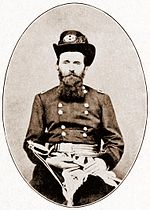
On April 12, 1861, the American Civil War began when Confederate troops attacked Fort Sumter in Charleston, South Carolina.[111] The news came as a shock in Galena, and Grant shared his neighbors' concern about the war.[112] On April 15, Lincoln called for 75,000 volunteers.[113] The next day, Grant attended a mass meeting to assess the crisis and encourage recruitment, and a speech by his father's attorney, John Aaron Rawlins, stirred Grant's patriotism.[h][114] Ready to fight, Grant recalled with satisfaction, "I never went into our leather store again."[i] On April 18, Grant chaired a second recruitment meeting, but turned down a captain's position as commander of the newly formed militia company, hoping his previous experience would aid him to obtain a more senior military rank.[116]
Early commands
Further information: Kentucky in the American Civil War
Grant's early efforts to be recommissioned were rejected by Major General George B. McClellan and Brigadier General Nathaniel Lyon. On April 29, supported by Congressman Elihu B. Washburne of Illinois, Grant was appointed military aide to Governor Richard Yates and mustered ten regiments into the Illinois militia. On June 14, again aided by Washburne, Grant was promoted to colonel and put in charge of the unruly 21st Illinois Volunteer Infantry Regiment, which he soon restored to good order and discipline.[117] Colonel Grant and his 21st Regiment were transferred to Missouri to dislodge Confederate forces.[118]
On August 5, with Washburne's aid, Grant was appointed brigadier general of volunteers.[119] Major General John C. Frémont, Union commander of the West, passed over senior generals and appointed Grant commander of the District of Southeastern Missouri.[120] On September 2, Grant arrived at Cairo, Illinois, assumed command by replacing Colonel Richard J. Oglesby, and set up his headquarters to plan a campaign down the Mississippi, and up the Tennessee and Cumberland rivers.[121] After the Confederates moved into western Kentucky, taking Columbus,[122] with designs on southern Illinois, Grant, after notifying Frémont, and without waiting further for his reply, strategically advanced on Paducah, Kentucky, taking it without a fight on September 6.[123] Having understood the importance to Lincoln of Kentucky's neutrality, Grant assured its citizens, "I have come among you not as your enemy, but as your friend."[124] On November 1, Frémont ordered Grant to "make demonstrations" against the Confederates on both sides of the Mississippi, but prohibited him from attacking the enemy.[125]...
Defeated Lee and victory (1865)
Main articles: Third Battle of Petersburg, Appomattox Campaign, and Battle of Appomattox Court House
[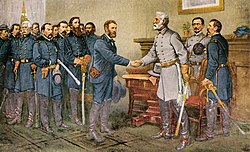
Defeated by Grant, Lee surrendered at Appomattox Court House.
On April 2, Grant ordered a general assault on Lee's entrenched depleted forces. Lee abandoned Petersburg and Richmond, while Grant's conquering Union troops easily took Petersburg and captured Richmond the next day.[257] A desperate Lee, and part of his army cut and ran, attempted to link up with the remnants of Joseph E. Johnston's defeated army. Sheridan's cavalry, however, stopped the two armies from converging, cutting them off from their supply trains.[258]
Grant was in communication with Lee before he entrusted his aide Orville Babcock to carry his last dispatch to Lee that demanded his surrender with instructions to escort him to a meeting place of Lee's choosing.[259] Grant immediately rode west, bypassing Lee's army, to join Sheridan who had captured Appomattox Station, blocking Lee's escape route. On his way, Grant received a letter sent by Lee informing him Lee would surrender his army.[260]
On April 9, Grant and Lee met at Appomattox Court House.[261] Upon receiving Lee's dispatch about the proposed meeting Grant had been jubilant. Although Grant felt depressed at the fall of "a foe who had fought so long and valiantly," he believed the Southern cause was "one of the worst for which a people ever fought."[262] After briefly discussing their days of old in Mexico, Grant wrote out the terms of surrender. Men and officers were to be paroled, but in addition, there was amnesty: "Each officer and man will be allowed to return to his home, not to be disturbed by U.S. authority so long as they observe their paroles and the laws in force where they may reside."
Lee immediately accepted Grant's terms and signed the surrender document, without any diplomatic recognition of the Confederacy. The vanquished Lee, afterward asked Grant that his former Confederate troops keep their horses. Grant generously allowed Lee's request.[263][264] Grant ordered his troops to stop all celebration, saying the "war is over; the rebels are our countrymen again."[265] Johnston's Tennessee army surrendered on April 26, 1865, Richard Taylor's Alabama army on May 4, and Kirby Smith's Texas army on May 26, ending the war.[266]
Lincoln's assassination
Main article: Assassination of Abraham Lincoln
On April 14, 1865, five days after Grant's victory at Appomattox, he attended a cabinet meeting in Washington. Lincoln invited him and his wife Julia to Ford's Theatre but they declined, because they had plans to travel to their home in Burlington. In a conspiracy that also targeted top cabinet members in one last effort to topple the Union, Lincoln was fatally shot by John Wilkes Booth at the theater and died the next morning.[267]
Many, including Grant himself, thought that he, Grant, had been a target in the plot, and during the subsequent trial, the government tried to prove that Grant had been stalked by Booth's conspirator Michael O'Laughlen.[268] Stanton notified Grant of the President's death and summoned him back to Washington. Vice President Andrew Johnson was sworn in as president on April 15. Attending Lincoln's funeral on April 19, Grant stood alone and wept openly; he later said Lincoln was "the greatest man I have ever known".[269] Grant was determined to work with Johnson, and he privately expressed "every reason to hope" in the new president's ability to run the government "in its old channel".[270]
Commanding General
Main article: Ulysses S. Grant as commanding general, 1865–1869
...
Election of 1868
Main article: 1868 United States presidential election

Grant–Colfax Republican Ticket
When the Republican Party met at the 1868 Republican National Convention in Chicago, the delegates unanimously nominated Grant for president and Speaker of the House Schuyler Colfax for vice president.[298] Although Grant had preferred to remain in the army, he accepted the Republican nomination, believing that he was the only one who could unify the nation.[301]
The Republicans advocated "equal civil and political rights to all" and African American enfranchisement.[302][303] The Democrats, having abandoned Johnson, nominated former governor Horatio Seymour of New York for president and Francis P. Blair of Missouri for vice president.[304] The Democrats opposed suffrage for African Americans and advocated the immediate restoration of former Confederate states to the Union and amnesty from "all past political offenses".[305]
Grant played no overt role during the campaign and instead was joined by Sherman and Sheridan in a tour of the West that summer.[306] However, the Republicans adopted his words "Let us have peace" as their campaign slogan.[307] Grant's 1862 General Order No. 11 became an issue during the presidential campaign; he sought to distance himself from the order, saying "I have no prejudice against sect or race, but want each individual to be judged by his own merit."[308] The Democrats and their Klan supporters focused mainly on ending Reconstruction, intimidating black people and Republicans, and returning control of the South to the white Democrats and the planter class, alienating War Democrats in the North.[309]
An example was the murder of Republican Congressman James M. Hinds in Arkansas by a Klansman in October 1868, as Hinds campaigned for Grant. Grant won the popular vote by 300,000 votes out of 5,716,082 votes cast, receiving an Electoral College landslide of 214 votes to Seymour's 80.[310] Seymour received a majority of white voters, but Grant was aided by 500,000 votes cast by black people,[304] winning him 52.7 percent of the popular vote.[311] He lost Louisiana and Georgia, primarily due to Ku Klux Klan violence against African-American voters.[312] At the age of 46, Grant was the youngest president yet elected, and the first president after the nation had outlawed slavery.[313]
Presidency (1869–1877)
Main article: Presidency of Ulysses S. Grant

Official White House portrait of President Grant by Henry Ulke, 1875
On March 4, 1869, Grant was sworn in as the eighteenth President of the United States by Chief Justice Salmon P. Chase. In his inaugural address, Grant urged the ratification of the Fifteenth Amendment, while large numbers of African Americans attended his inauguration.[314] He also urged that bonds issued during the Civil War should be paid in gold, called for "proper treatment" of Native Americans and encouraged their "civilization and ultimate citizenship".[315]
Grant's cabinet appointments sparked both criticism and approval.[316] He appointed Elihu B. Washburne Secretary of State and John A. Rawlins Secretary of War.[317] Washburne resigned, and Grant appointed him Minister to France. Grant then appointed former New York Senator Hamilton Fish Secretary of State.[317] Rawlins died in office, and Grant appointed William W. Belknap Secretary of War.[318] Grant appointed New York businessman Alexander T. Stewart Secretary of Treasury, but Stewart was found legally ineligible to hold office by a 1789 law.[319] Grant then appointed Massachusetts Representative George S. Boutwell Secretary of Treasury.[317] Philadelphia businessman Adolph E. Borie was appointed Secretary of Navy, but found the job stressful and resigned.[320] Grant then appointed New Jersey's attorney general, George M. Robeson, Secretary of Navy.[321] Former Ohio Governor Jacob D. Cox (Interior), former Maryland Senator John Creswell (Postmaster-General), and Ebenezer Rockwood Hoar (Attorney General) rounded out the cabinet.[322]
Grant nominated Sherman to succeed him as general-in-chief and gave him control over war bureau chiefs.[323] When Rawlins took over the War Department he complained to Grant that Sherman was given too much authority. Grant reluctantly revoked his own order, upsetting Sherman and damaging their wartime friendship. James Longstreet, a former Confederate general who had endorsed Grant's nomination, was nominated for the position of Surveyor of Customs of the port of New Orleans; this was met with general amazement, and seen as a genuine effort to unite the North and South.[324] In March 1872, Grant signed legislation that established Yellowstone National Park, the first national park.[325] Grant was sympathetic to women's rights; including support of female suffrage, saying he wanted "equal rights to all citizens".[326]
To make up for his infamous General Order No. 11, Grant appointed more than fifty Jewish people to federal office, including consuls, district attorneys, and deputy postmasters.[327] He appointed Edward S. Salomon territorial governor of Washington, the first time an American Jewish man occupied a governor's seat. Grant was sympathetic to the plight of persecuted Jewish people. In November 1869, reports surfaced of the Russian Tsar Alexander II penalizing 2,000 Jewish families for smuggling by expelling them to the interior of the country. In response, Grant publicly supported the Jewish American B'nai B'rith petition against the Tsar. In December 1869, Grant appointed a Jewish journalist as Consul to Romania, to protect Jewish people there from "severe oppression".[327]
In 1875, Grant proposed a constitutional amendment that limited religious indoctrination in public schools.[328] Instruction of "religious, atheistic, or pagan tenets", would be banned, while funding "for the benefit or in aid, directly or indirectly, of any religious sect or denomination", would be prohibited. Schools would be for all children "irrespective of sex, color, birthplace, or religions".[329] Grant's views were incorporated into the Blaine Amendment, but it was defeated by the Senate.[330]
In October 1871, under the Morrill Act, using federal marshals, Grant rounded up and prosecuted hundreds of Utah Territory Mormon polygamists, including Mormon leader Brigham Young, who was indicted for "lewd and lascivious cohabitation".[331] Grant had called polygamy a "crime against decency and morality".[332] In 1874, Grant signed into law the Poland Act, which made Mormon polygamists subject to trial in U.S. District Courts and limited Mormons on juries.[332]
Beginning in March 1873, under the Comstock Act, Grant prosecuted, through the Postal Department, immoral and indecent pornographers, in addition to abortionists. To administer the prosecutions, Grant put in charge a vigorous anti-vice activist and reformer Anthony Comstock.[333] Comstock headed a federal commission and was empowered to seize and destroy obscene material and hand out arrest warrants to offenders of the law.[332]
Reconstruction
Main article: Reconstruction era
[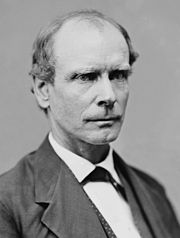
Amos T. Akerman, appointed Attorney General by Grant, who vigorously prosecuted the Ku Klux Klan
Grant was considered an effective civil rights president, concerned about the plight of African Americans.[334] On March 18, 1869, Grant signed into law equal rights for black people, to serve on juries and hold office, in Washington D.C., and in 1870 he signed into law the Naturalization Act that gave foreign black people citizenship.[334] During his first term, Reconstruction took precedence. Republicans controlled most Southern states, propped up by Republican-controlled Congress, northern money, and southern military occupation.[335]
Grant advocated the ratification of the Fifteenth Amendment that said states could not disenfranchise African Americans.[336] Within a year, the three remaining states—Mississippi, Virginia, and Texas—adopted the new amendment—and were admitted to Congress.[337] Grant put military pressure on Georgia to reinstate its black legislators and adopt the new amendment.[338] Georgia complied, and on February 24, 1871, its senators were seated in Congress, with all the former Confederate states represented, the Union was completely restored under Grant.[l][340] Under Grant, for the first time in American history, Black-American males served in the United States Congress, all from the Southern states.[341]
In 1870, to enforce Reconstruction, Congress and Grant created the Justice Department that allowed the Attorney General and the new Solicitor General to prosecute the Klan.[342] Congress and Grant passed a series of three Enforcement Acts, designed to protect black people and Reconstruction governments.[343] Using the powers of the Enforcement Acts, Grant crushed the Ku Klux Klan.[344] By October, Grant suspended habeas corpus in part of South Carolina and sent federal troops to help marshals, who initiated prosecutions.[345]
Grant's Attorney General, Amos T. Akerman, who replaced Hoar, was zealous to destroy the Klan.[346] Akerman and South Carolina's U.S. marshal arrested over 470 Klan members, while hundreds of Klansmen, including the wealthy leaders, fled the state.[347] By 1872, the Klan's power had collapsed, and African Americans voted in record numbers in elections in the South.[m][349] Attorney General George H. Williams, Akerman's replacement, in the Spring of 1873, suspended prosecutions of the Klan in North Carolina and South Carolina, but prior to the election of 1874, he changed course and prosecuted the Klan.[n][352]
During Grant's second term, the North retreated from Reconstruction, while southern conservatives called "Redeemers" formed armed groups, the Red Shirts and the White League, who openly used violence, intimidation, voter fraud, and racist appeals to overturn Republican rule.[353] Northern apathy toward black people, the depressed economy and Grant's scandals made it politically difficult for the Grant administration to maintain support for Reconstruction. Power shifted when the House was taken over by the Democrats in the election of 1874.[354] Grant ended the Brooks–Baxter War, bringing Reconstruction in Arkansas to a peaceful conclusion. He sent troops to New Orleans in the wake of the Colfax massacre and disputes over the election of Governor William Pitt Kellogg.[355] Grant recalled Sheridan and most of the federal troops from Louisiana.[356]
By 1875, Redeemer Democrats had taken control of all but three Southern states. As violence against black Southerners escalated once more, Grant's Attorney General Edwards Pierrepont told Republican Governor Adelbert Ames of Mississippi that the people were "tired of the autumnal outbreaks in the South", and declined to intervene directly, instead of sending an emissary to negotiate a peaceful election.[357]
Grant later regretted not issuing a proclamation to help Ames, having been told Republicans in Ohio would bolt the party if Grant intervened in Mississippi.[358] Grant told Congress in January 1875 he could not "see with indifference Union men or Republicans ostracized, persecuted, and murdered."[359] Congress refused to strengthen the laws against violence but instead passed a sweeping law to guarantee black people access to public facilities.[360] Grant signed it as the Civil Rights Act of 1875, but there was little enforcement and the Supreme Court ruled the law unconstitutional in 1883.[361] In October 1876, Grant dispatched troops to South Carolina to keep Republican Governor Daniel Henry Chamberlain in office.[362]
After Grant left office in 1877, the nation returned to compromise. Grant's Republican successor, President Rutherford B. Hayes, was conciliatory toward the South and favored "local control" of civil rights on the condition that Democrats make an honorary pledge to confirm the constitutional amendments that protected black people.[363] During Republican negotiations with Democrats, that Grant took no direct part in, the Republicans received the White House for Hayes in return for ending enforcement of racial equality for black people and removing federal troops from the last three states.[364] As promised, Hayes withdrew federal troops from South Carolina and Louisiana, which marked the end of Reconstruction.[365]
Financial affairs
Soon after taking office, Grant took conservative steps to return the nation's currency to a more secure footing.[366] During the Civil War, Congress had authorized the Treasury to issue banknotes that, unlike the rest of the currency, were not backed by gold or silver. The "greenback" notes, as they were known, were necessary to pay the unprecedented war debts, but they also caused inflation and forced gold-backed money out of circulation; Grant was determined to return the national economy to pre-war monetary standards.[367]
On March 18, 1869, he signed the Public Credit Act of 1869 that guaranteed bondholders would be repaid in "coin or its equivalent", while greenbacks would gradually be redeemed by the Treasury and replaced by notes backed by specie. The act committed the government to the full return of the gold standard within ten years.[368] This followed a policy of "hard currency, economy and gradual reduction of the national debt." Grant's own ideas about the economy were simple, and he relied on the advice of wealthy and financially successful businessmen that he courted.[366]
Gold corner conspiracy
Further information: Black Friday (1869)
In April 1869, two railroad tycoons Jay Gould and Jim Fisk conspired a plot to corner the gold market in New York, the nation's financial capital.[369] They both controlled the Erie Railroad, and a high price of gold would allow foreign agriculture buyers to purchase exported crops, shipped east over the Erie's routes.[370] Boutwell's bi-weekly policy of selling gold from the Treasury, however, kept gold artificially low.[371] Unable to corrupt Boutwell, the two schemers built a relationship with Grant's brother-in-law, Abel Corbin, and gained access to Grant.[372] Gould bribed Assistant Treasurer Daniel Butterfield $10,000 to gain insider information into the Treasury.[373]
In July, Grant reduced the sale of Treasury gold to $2,000,000 per month and subsequent months.[374] Fisk played a role in August in New York, having a letter from Gould, he told Grant his gold policy would destroy the nation.[375] By September, Grant, who was naive in matters of finance, was convinced that a low gold price would help farmers, and the sale of gold for September was not increased.[376] On September 23, when the gold price reached 143+1⁄8, Boutwell rushed to the White House and talked with Grant.[377] The following day, September 24, known as Black Friday, Grant ordered Boutwell to sell, whereupon Boutwell wired Butterfield in New York, to sell $4,000,000 in gold.[378] The bull market at Gould's Gold Room collapsed, the price of gold plummeted from 160 to 133+1⁄3, a bear market panic ensued, Gould and Fisk fled for their own safety, while severe economic damages lasted months.[379] By January 1870, the economy resumed its post-war recovery.[o][381]
Foreign affairs
Grant had limited foreign policy experience, acquired during his service in the Mexican-American war. As a result, he relied heavily on his talented Secretary of State Hamilton Fish. Fundamentally, Grant had an expansionist impulse to protect American interests abroad and was a strong advocate of the Monroe Doctrine.[382] He also had an idealist side to his foreign policy. For instance, Grant appointed a Jewish lawyer, Benjamin F. Peixotto, U.S. Consul in Bucharest, in response to the Romanian persecution of Jews. Grant said that respect "for human rights is the first duty for those set as rulers" over the nations.[383]
Grant and Fish had a reserved but cordial friendship. There were no foreign-policy disasters and no wars to engage in. Besides Grant himself, the main players in foreign affairs were Secretary Fish and the chairman of the Senate Foreign Relations Committee Charles Sumner. They had to cooperate to get a treaty ratified. Sumner, who hated Grant, led the opposition to Grant's plan to annex Santo Domingo despite the fact that he previously, and hypocritically, fully supported the annexation of Alaska.[384] In 1871, a U.S. expedition to Korea failed to open up trade and ended with an American military victory at the battle of Ganghwa.[385]
....
Historical reputation
Further information: Historical reputation of Ulysses S. Grant and Historical rankings of presidents of the United States
Grant was hailed across the North as the winning general in the American Civil War and overall his military reputation has held up quite well. Achieving great national fame for his victories at Vicksburg and the surrender at Appomattox, he was widely credited as the General who "saved the Union".[599] Grant was the most successful general, Union or Confederate, to dominate the Civil War.[600] Criticized by the South for using excessive force, his overall military reputation stands intact.[601] Grant's drinking was often exaggerated by the press and falsely stereotyped by many of his rivals and critics.[602] During the late 19th and early 20th centuries, Grant's reputation was damaged by the Lost Cause movement and the Dunning School.[603]
Views of Grant reached new lows as he was seen as an unsuccessful president and an unskilled, if lucky, general.[604] In the 1950s, some historians made a reassessment of Grant's military career, shifting the analysis of Grant as the victor by brute force to that of successful, skillful, modern strategist and commander.[605] Historian William S. McFeely's biography, Grant (1981), won the Pulitzer Prize, and brought renewed scholarly interest in Grant. McFeely believed Grant was an "ordinary American" trying to "make his mark" during the 19th century. [606] In the 21st century, Grant's reputation improved markedly among historians after the publication of Grant (2001), by historian Jean Edward Smith.[607][608] Opinions of Grant's presidency demonstrate a better appreciation of Grant's personal integrity, Reconstruction efforts, and peace policy towards Indians, even when they fell short.[609][610][611]
H.W. Brands' The Man Who Saved the Union (2012), Ronald C. White's American Ulysses (2016) and Ron Chernow's Grant (2017) continued the elevation of Grant's historical reputation.[612] White said Grant, "demonstrated a distinctive sense of humility, moral courage, and determination," and as president he "stood up for African Americans, especially fighting against voter suppression perpetrated by the Ku Klux Klan."[613] White believed Grant was "an exceptional person and leader."[614] Charles W. Calhoun's The Presidency of Ulysses S. Grant (2017) noted Grant's successes in office, but asked whether Grant's revived reputation was found in the "popular consciousness."[615]
Historians still debate how effective Grant was at halting corruption.[616] The scandals during the Grant administration were often used to stigmatize his political reputation.[617] Militarily evaluated, Grant was a modern general and "a skillful leader who had a natural grasp of tactics and strategy."[618]
Grant's successful Civil War military strategies have been recognized and adapted into successful business practices.[619] According to historian David Heffernan, Grant's presidency has been "unfairly denigrated" for generations, disregarding his prosecution of the Klan, and peaceful resolution of the controversial Election of 1876.[620] Historian Robert Farley is concerned that the Cult of Lee and the Dunning School were resentful of Grant for his strong enforcement of Reconstruction, prosecution of the Klan, and the defeat of Lee at Appomatox, resulted in Grant's shoddy treatment by historians. Farley said the Cult of Lee had "little room for Grant, in no small part because Grant was the only president to vigorously pursue Reconstruction and the first to treat black people as both human and American."[621]
In a 2021 C-SPAN survey ranking presidents from worst to best, Grant was ranked 20 out of 43 presidents. Grant was noted for being "a strong advocate for civil rights" during his presidency.[622][623]
On December 23, 2022, the bicentenary of Grant's birth, Grant was authorized for posthumous promotion to the rank of General of the Armies of the United States as part of the 2023 Defense Authorization Bill. Preceded by George Washington and John J. Pershing, Grant will become the third person to hold this rank if the authorization is acted on by the President.[624][625][626]
Knowledge Web Content (see main node)
Ulysses Simpson Grant
Nickname/Alias: born: Hiram Ulysses Grant
Achievements: Commander of the Union forces from 1864 to 1865 and US President from 1869 to 1877. Outlawed racial discrimination in voting.
Born: April 27, 1822; Point Pleasant, Ohio
Died: July 23, 1885; Mount McGregor, New York (Aged 63)
Field & Discipline: Government & Politics; Military; President; General
Education: Local schools in Georgetown, Ohio; US Military Academy, West Point (1839-43)
Major Work: 'Personal Memoirs' (1885-86)
Life & Times:
In 1839, Grant was sent to the US Military Academy at West Point and was enrolled, mistakenly, as Ulysses Simpson Grant, the name he adopted. Grant saw military action during the Mexican War of 1846-48, first under General Zachary Taylor, then under General Winfield Scott, as regimental quartermaster. He distinguished himself at the battle of Chatulpec on September 13, 1847, earning brevet commissions as first lieutenant and captain. Grant remained with his regiment until the Treaty of Guadalupe Hidalgo, yielding half of Mexico to the United States, was ratified in the spring of 1848. He then returned to St. Louis, where, on August 22, he married Julia Dent, with whom he had four children. Grant was stationed at army bases in Sackets Harbor, New York and Detroit, from 1848 to 1852.
In July 1852, Grant was forced to leave his family behind when he was transferred to Fort Vancouver, Oregon Territory. Grant tried several business and farming ventures to supplement his army pay, but he could not afford to reunite his family. In August 1853, he was promoted captain and transferred to Fort Humboldt, California. On April 11, 1854, Grant resigned from the army. At the outbreak of the Civil War in April 1861, Grant helped recruit, equip, and drill volunteer infantry troops in Galena, Illinois and was appointed brigadier general, through the influence of Elihu B. Washburne, the congressman for Galena.
In January 1862, Grant received permission from General Henry Wager Halleck to begin an offensive campaign. On February 16, he won the first important Union victory of the war, when Fort Donelson, on the Cumberland River in Tennessee, surrendered with about 15,000 troops, for which he was promoted to major general. Two months later, Grant, in command of 40,000 Union troops, was attacked on April 6-7 at Shiloh Church, near Pittsburg Landing, Tennessee and, although the Union forces managed to hold out until reinforcements arrived, the public outcry over Union losses of 13,000 hurt Grant's reputation.
Grant defeated the Confederates at the battles of Iuka and Corinth on September 19 and October 3-4. These victories prompted Grant to advance towards Vicksburg, the strongest remaining Confederate position, linking the eastern and western halves of the Confederacy and blocking Union control of the Mississippi River. Grant then led the most brilliant action of the war, despite the opposition of his subordinates, including that of his right-hand man, General William T. Sherman. It led to the surrender of Vicksburg on July 4, 1863 and, four days later, that of the Confederacy's only remaining fort on the Mississippi at Port Hudson.
With the Confederacy cut in half, Grant had opened the whole river to Union shipping. Grant was now a national hero and Congress revived the grade of lieutenant general, last held by George Washington, so that [appointed general by] Lincoln* could appoint him general in chief of all Union armies. In the spring of 1864, Grant headquartered with the Army of the Potomac, whose offensive against [defeated] Lee's* Army of Northern Virginia, near the Confederate capital of Richmond, Virginia, would prove to be the decisive action in determining the outcome of the war
By mid-June Lee was pinned down at Petersburg, near Richmond, while Sherman's army was marching through Georgia and cavalry forces under General Philip Sheridan destroyed railroads and supplies in Virginia. On April 2, 1865, after nine months of stalemate in the trenches, Lee was forced to abandon Petersburg and surrender on April 9, at Appomattox Court House, marking, in effect, the end of the Civil War.
After Lincoln's assassination by Booth on April 14, 1865, Grant became the most popular man in the North and in late 1865, at President Andrew Johnson’s request, he toured the South. In 1866, Grant was appointed to the newly established rank of General of the Armies of the United States, but his increasing concern about southern Democratic violence, against freed slaves, Unionists and Federal troops, was moving him politically towards the Republican programme of Radical Reconstruction.
Johnson suspended Secretary of War [succeeded] Stanton* in August 1867 and Grant accepted the position of interim secretary to stop the appointment of a more conservative man. In February 1868, when Congress, under the Tenure of Office Act, insisted on Stanton's reinstatement, Grant infuriated Johnson by resigning, yielding the office to Stanton. This action cemented Grant's Republican ties and ensured his nomination for president in 1868.
On March 4, 1869, at the age of 46 Grant was youngest man yet elected President. One of his major successes was the ratification of the Fifteenth Amendment, banning racial discrimination in voting rights. In 1877 Grant finally left office and the family went on a two-year round the world tour. He returned home to popular demand that he run for a third term, to which he unwisely succumbed, but was defeated by ballot. Grant then settled down as a private citizen in New York City, where he bought a house in 1881 and invested his life savings with the firm Grant and Ward, in which his son Ulysses, Jr., was a partner.
In 1884 the firm collapsed and left Grant in debt. In order to make money, in 1884 and 1885 Grant began to write about his campaigns for the 'Century Magazine', then began to prepare his memoirs. He learned that he had incurable throat cancer and, in order to pay off his debts and support his family after his death, he signed a contract with his friend [a pal of] Twain* to publish the memoirs and resolved to complete them before he died.
His death on July 23, 1885, in Mount McGregor, in the Adirondacks, where the Grant family had moved the month before, came just days after he had completed the final chapter.
Extra Connections: [opposed by] Greeley* opposed him
[commanded] WTG Morton* served under him
He met Emperor [met] Franz Josef*
His appointment as general was supported by editorial in [supported by] Bryant*’s paper
Bought clothes at [shopped at] Wanamaker's*
He appointed George [appointed] Bancroft* Minister to Prussia.
Reversed his policy towards Native Americans after the Panic of 1873 forced him to send Custer into the Black Hills for needed gold.
Assessment: Often ranked as one of the worst American presidents, his great service to the nation was the ratification of the Fifteenth Amendment.
Oneliner: Ulysses S Grant, President of the US
Bibliography:
- American National Biography.
- Hanna, Ronnie, Never Call Retreat: The Life and Times of Ulysses S. Grant, Ulster American Hero, Lurgan: Ulster Society, 1991.
Language: English.
Father: Jesse Root Grant
Mother: Hannah Simpson
Siblings: 2 brothers; 3 sisters
Spouse: Julia Dent (m. 1848)
Children: Frederick; Ulysses; Ellen (Nellie); Jesse