McClellan, Gen Geo
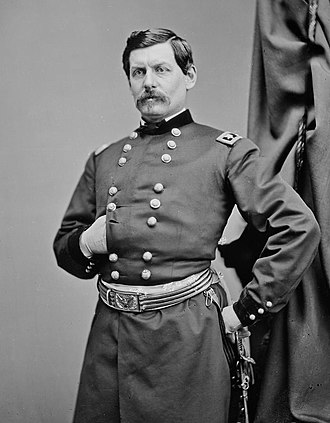
Name: General George Brinton McClellan
Achievements: Civil War General of the Army of the Potomac.
Born: December 3, 1826; Philadelphia, Pennsylvania
Died: October 29, 1885; Orange, New Jersey (Aged 58)
Field & Discipline: Military; General
Language: English
Father: George McClellan
Mother: Elizabeth Steinmetz Brinton
Siblings: Unknown
Spouse: Mary Ellen Marcy (m. 1860)
Children: Two
Education: University of Pennsylvania (1840-42); United States Military Academy, West Point, New York (1842-46)
Major Work:
Seven Days' Battles (June 1862)
Life & Times:
At the start of the two-year Mexican War, in 1846, McClellan served in Veracruz with a company of engineers taking part in the advance on Mexico City. When the war ended, he stayed on the frontier to complete army expeditions to find a possible transcontinental rail route across the Cascade Mountains.
As a military attaché, he went to the Dominican Republic in 1854, to spy out its defences and locate a site for a future U.S. naval base. The following year, he accompanied two superior officers, as part of a US military commission to report on European methods of warfare during the [observed] Crimean War*. He directly observed the world's leading armies in action and assessed the usefulness of the new long-range rifle musket.
When he got back to the United States, he resigned his commission to become superintendent of the Illinois Central Railroad in 1857. Over the next three years, he saved the railroad from financial ruin, protecting investors including [saved] Cobden*, the English economist and politician.
Back in the army in September 1861, McClellan was given command of what was to become the Union Army of the Potomac, after [appointed by] Lincoln* sacked Major General Irvin McDowell for his disastrous defeat at the First Battle of Bull Run, Manassas, on July 21, 1861.
McClellan took responsibility for the defence of Washington and the destruction of the enemy forces in northern and eastern Virginia. At his own insistence, he was made General in Chief of the Army of the Potomac and, ignoring his own intelligence, claimed that the army was not ready to fight against the greater forces of the enemy.
He refused to take the offensive that autumn, even though good intelligence sources, including the famous detective, [employed] Pinkerton* and the balloonist, [employed] Lowe*, showed that his forces actually outnumbered the enemy. As a result, President Abraham Lincoln issued his famous General War Order No. 1, on January 27, 1862, calling for the forward movement of all armies.
During March and April 1862, McClellan began to transport his enormous army down Chesapeake Bay, with the objective of landing at Fort Monroe, at the tip of the peninsula between the York and James Rivers.
He approached the undermanned Confederate fortifications at Yorktown near the end of the peninsula and the two armies met at the Battle of Fair Oaks, but after the battle, launched by the Confederate General Joseph E.Johnston, neither side was able to claim a victory. Johnston was wounded in the fight and replaced by the more aggressive [fought] Robert E Lee(https://app.thebrain.com/brain/f3e16344-7cd9-4fa3-ae1d-59876e128474/be458e53-0619-5ae0-ab59-0268422c4f8f)*.
For most of June, McClellan continued a cautious approach to Richmond, the capital of the Confederacy. Troops commanded by Lee began an all-out attempt to destroy McClellan's army in the Seven Days' Battles, which raged between June 25th ^and July 1st but McClellan and his men put up a fierce resistance. They destroyed a large part of the Confederate army but they were forced away from Richmond and, effectively, retreated from an inferior force.
Lincoln, unimpressed with this action, withdrew the Army of the Potomac from the peninsula and transferred it to northern Virginia, to join up with a new force called the Army of Virginia, with Major General John Pope in command. In August 1862, at the Second Battle of Bull Run, Pope’s inadequacy, McClellan’s lack of co-operation and Lee’s brilliance in battle led to the defeat of the Army of Virginia.
Encouraged by his decisive victory, Lee invaded Maryland and, with his army threatening Washington, Lincoln reinstated McClellan as Commander of the Army of the Potomac, which now included the Army of Virginia. McClellan successfully reorganized the Union forces.
A copy of Lee’s detailed plan of campaign fell into Union hands, giving McClellan an enormous advantage and the opportunity to annihilate the enemy as they moved through Maryland, but McClellan was too slow and completely missed his chance.
His next opportunity was on 17th September 1862, when the two armies met above Antietam Creek in what was the bloodiest day of the entire war. The Confederate Army, trapped with its back to the Potomac, was outnumbered two to one, but McClellan believed it to be the opposite. As a result, he held forty percent of his men in reserve and sent the rest to face the entire Confederate Army.
McClellan launched uncoordinated attacks, allowing Lee to move his forces tactically and, not surprisingly, the Confederates did well. Military tacticians believe that, if McClellan had used his full force, the Confederate Army would have undoubtedly been crushed.
After the disaster at the Battle of Antietam, McClellan, through more inefficiency, then allowed Lee to remove his army from the Shenandoah Valley so, on 5th November, Lincoln removed McClellan from command.
That was the end of McClellan’s military career, but, in 1864, the Democratic Party nominated him for the Presidency. The Peace Democrats, known as Copperheads, dominated the convention, declared the war a failure and demanded an immediate armistice. McClellan distanced himself from the extremists, but the American people saw the Democrats as the party of peace and disunion and they suffered a landslide defeat.
On the day of the election, seriously put out by the results, McClellan resigned his army commission and left for Europe in January 1865, where he stayed for three years.
In 1877, he was elected Governor of New Jersey, serving a single three-year term. During his later years he made several extended trips to Europe with his family and before he died he wrote his memoirs.
Extra Connections: He worked for [worked for] WH Osborn*
Assessment: McClellan understood all of the right ingredients to make a successful army, but he had neither the audacity, nor the military skill, to make it all work.
Oneliner: George McClellan, failed Civil War Union General
Bibliography:
- Sears, Stephen W., George B. McClellan: The Young Napoleon, 1988.
- Woodworth, Steven E., ‘McClellan, George B.’ , Dictionary of American National Biography, New York & Oxford, OUP, 1999.