Modigliani
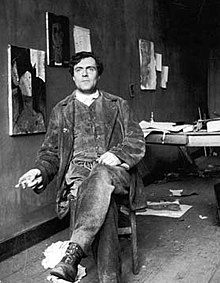
ACHIEVEMENT(S): Portraits and nudes among the most distinctive and important of the 20th century.
NICKNAME/ALIAS: None.
DATE/PLACE OF BIRTH: 12th July 1884, in Livorno, Italy.
DATE/PLACE/AGE AT DEATH: 24th January 1920, at Paris, France. Aged 35.
DISCIPLINE: Painter and sculptor.
FIELD: Art.
LANGUAGE: Italian and French.
PARENTS: Flaminio Modigliani and Eugenia Garsin.
SIBLINGS: Three older siblings.
SPOUSE: None.
CHILDREN: Jeanne Modigliani, daughter with Jeanne Hébuterne.
EDUCATION: Academy of Fine Art, Florence, 1902-03; Academy of Fine Art, Venice, 1903-06.
MAJOR WORK: 'Seated Nude', 1916.
- [
 ](https://en.wikipedia.org/wiki/File:Modigliani_-_Busto_de_mulher.jpg)
Buste de femme, unknown, before 1919, Museo Nacional de Bellas Artes (Buenos Aires)
LIFE AND TIMES: As a beautiful but sickly child, Modigliani was his mother's favourite. He suffered from pleurisy in 1895 and then from typhoid in 1898 and, as a result, he was allowed to give up his schooling to join the studio of Guglielmo Micheli, a Livorno painter.
On 7th May 1902, he enrolled at the Academy of Fine Art in Florence and in May 1903, moved on to the Academy in Venice. He stayed at the Academy for almost three years, then left Venice, in January 1906, for Paris, where he settled in the Montmartre artists’ quarter.
His early paintings in Paris show the influence of Cezanne's* late portraits, with additional influence from the work of Toulouse-Lautrec*. He also admired Fauvism and Picasso's* Blue Period canvases.
Soon after his arrival in Paris, Modigliani became a member of the Societe des Artistes Independents and, in 1908, he exhibited five paintings and a drawing at its Salon. His work during this period was still highly experimental, but were characterised by dense colours and strong lines.
Sometime in the first half of 1909, Modigliani moved to a new studio in Montparnasse met the Romanian sculptor, Constantin Brancusi. This meeting turned out to be of vital importance to the development of Modigliani's work.
From 1909 to 1914, he devoted himself almost entirely to design and sculpture. He studied works of classical antiquity and of the Indian and African civilisations, and was heavily influenced by Brancusi, specially by Brancusi’s 'Head of a Girl' (1907) Most important of all, Brancusi encouraged Modigliani’s individuality.
His thin, elongated stone heads have usually been associated with Baule masks from the Ivory Coast. He exhibited seven of these heads at the Salon d'Automne in 1912, as 'Tetes, ensemble decoratif' and added lit candles on top of each head, to give the effect of elongating the heads even further.
Soon after this, he returned to painting, introducing the style of his sculpture into his portraits. The characteristics of his paintings included the same long oval-shaped heads, on long necks, with simple features. He developed a close friendship with the artist Maurice Utrillo and the Polish poet Leopold Zborowski, who was to become his faithful friend, patron and, with regular payments, the key supporter of his art and life.
To earn money, he painted personalities of the Parisian artistic and literary world, including Diego Rivera (1914), Henri Laurens (1915), Pablo Picasso (1915), Juan Gris (1915), Max Jacob (1916), Cocteau* (1916), Jacques Lipchitz (1916), Chaim Soutine (1916-17), Paul Guillaume (1916), Leopold Zborowski (1918), Beatrice Hastings (1914-16). His unique personal style and vision reached maturity in these works, now considered to be among the finest portraits in early-20th century art.
In 1917, Modigliani, now very ill and an alcoholic, met Jeanne Hebuterne who became the companion of his last years. In the same year he began painting a series of large female nudes. With their warm, glowing colours and sensuous, rounded forms, these are among his best and most popular works.
The paintings caused a storm when they were exhibited in the Berthe Weill Gallery. The nudes were considered indecent and the exhibition was closed.
Modigliani's health began to deteriorate in 1918, when he went to live with Jeanne Hebuterne on the Cote d'Azur. There, in November, their daughter was born. During this period, despite his illness, he worked constantly, producing many portraits and half-length studies of Jeanne.
He returned to Paris in May 1919, where he painted three important last portraits, 'Lunia Czechowska’ (1919), ‘Jeanne Hebuterne’ (1919) and a 'Self-Portrait' (1919). In July, Zborowski sold several of his works at an exhibition in London organised by the Sitwell brothers.
This upturn in his fortunes did not help his physical condition or his state of mind. During the last months of his life, he roamed the streets of Paris at night, drunk. A few months later, on 14th January 1920, he was taken seriously ill.
He died ten days later in a Paris hospital, of tubercular meningitis aggravated by drugs and alcohol, and was buried at Pere-Lachaise cemetery. At dawn the next day, Jeanne Hébuterne, seven months pregnant, killed herself by jumping from a window.
ASSESSMENT: Modigliani was a key figure in the creation of the mythology of 'modern art'.
EXTRA CONNECTIONS: Arp* ?
He knew Chagall*
ONELINER: Amedeo Modigliani, highly distinctive 20th-century painter
BIBLIOGRAPHY:
Hall, Douglas, Modigliani, London: Phaidon Press, 1979.
Wilkinson, Alan G., "Modigliani, Amedeo" in The Grove Dictionary of Art and Artists, New York, 1995.