Picasso, Pablo
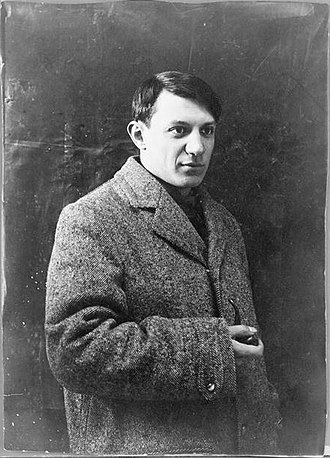
Achievements: Premier modern painter
Born: October 25, 1881; Malaga, Spain
Died: April 8, 1973; Mougins, France (Aged 91)
Field & Discipline: Art; Painter
Language: Spanish
Education: Malaga da Guarda Institute, Coruna La Llotja Art Academy, Barcelona;
Royal Academy of San Fernando, Madrid
Major Works:
"Les Demoiselles" (1907)
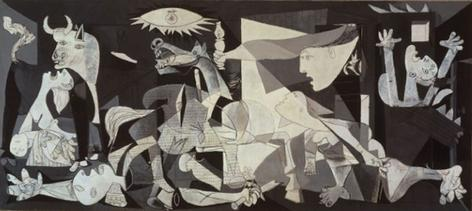
"Guernica" (1937)
Life & Times:
Born to a father who was a professor of drawing, Picasso showed artistic talent from a very early age. By the time he was eight, his father had taken him to bullfights and around 1889, Picasso painted a picture of a picador in a bullring. At the age of ten, having moved to La Coruna, Spain, Picasso became a pupil of his father in the Institute where he taught. When he was thirteen, the family moved to Barcelona, Spain where he studied at the Academy. At this time, he painted many religious paintings and in 1896, he was disappointed not to win a prize at the Exhibition of Fine Arts in Barcelona, for which he had entered "The First Communion.” He did, however, receive an honourable mention for his "Science and Charity" at the Madrid General Fine Arts Exhibition and also won a gold medal at the Malaga Provincial Exhibition.
In 1899 he began working in a small studio owned by the painter Santiago Cardona, where he became known as Pablo Picasso rather than Pablo Ruiz. Later, together with the painter Charles Casagemas, he worked in a large studio for which Casagemas paid the rent. During this time he produced "The Kiss of Death,” "The Cry of Death,” "Two Agonies" and "Presence of Death.” He was part of a group of artists and writers who met in a café called Els Quatre Gats and who saw the Paris schools of art as their source of inspiration and knowledge. Picasso studied the work of [studied work of] Toulouse-Lautrec* and had his first exhibition at the café in February 1900. One of his paintings was chosen for the Exposition Universelle in Paris. He travelled to Paris where he found a studio and a patron, art dealer Pere Manyac. Fascinated by the street life of Paris, he drew and painted it in a variety of mediums. The work of [influenced by] Gauguin* influenced this period of his work.
In June 1901, Manyac introduced him to the art dealer Ambroise Vollard who agreed to exhibit his work. Through the exhibition, Picasso met and became friends with Max Jacob, who had come to Paris from Brittany, determined to be a poet and a painter. Picasso now entered his Blue Period and Jacob soon took over from Manyac as his patron. He moved to Paris permanently in 1904, living and working in the rue Ravignan in a dilapidated building in which many artists, including [used workplace of] Renoir*, had worked. In the summer he met the beautiful Fernande Olivier, who became his mistress, and his Blue Period gave way to what is called his Rose Period. At this time, the poet and art critic [a pal of] Apollinaire* appeared in Picasso's pictures and also wrote about him.
He then met [painted] Stein* and her brother Leo, two Americans living in Paris, who were the first serious collectors of French impressionists. In 1906, Picasso painted a portrait of Gertrude, signalling yet another change of style thanks to the recent influence of an exhibition of primitive Iberian sculpture at the Louvre.
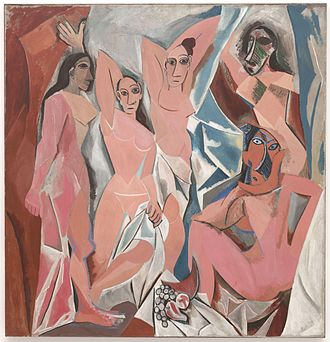
He began work on a large painting which he finished in 1907, called "Les Desmoiselles d'Avignon,” which is recognised as the forerunner of Cubism. Picasso himself later told the French writer [knew] Malraux* that it was his first "exorcism painting" and was directly influenced by primitive art. Art historians also see the influence of [influenced by] Cezanne* and[influenced by] El Greco* in his work. Over the next year, Picasso’s met technique changed to Cubism, which he had developed with [collaborated with] Braque*. In 1907 the two painters expanded into producing collages and playing with the presentation of the objects they depicted.
At the start of the 1914 - 1918 War, Picasso stayed in France. Eva Marcelle had replaced Fernande as his mistress in 1910, but she died in 1915. Picasso was now mixing with an avant garde group led by the writer [collaborated with] Cocteau*, for whose production of "Parade" Picasso worked on the sets and costumes, while [collaborated with] Satie* wrote the music.
In 1917 Picasso went to Rome with Cocteau to meet [collaborated with] Diaghilev*, who ran the Ballets Russes. He also met Olga Kokhlova, a dancer, whom he later married. Picasso continued his association with the ballet, producing, among others, the designs for Manuel de Falla's "Three-Cornered Hat" in 1919 and Igor Stravinsky*'s "Pulcinella" in 1920. His paintings at the time were sometimes Cubist and at other times naturalistic. He then had a period of what is known as Neo-classical Realism, using classical forms and drawing techniques inspired by [inspired by] Ingres* and Renoir.
In 1921, a son, Paulo, was born. During the 1920s, Picasso and Olga became part of fashionable society in Paris, but in 1927, he met his new mistress, the seventeen year old Marie-Therese Walter. In 1931, he left Olga and went with Marie-Therese to live in the country at Boisgeloup. Picasso's art during the 1930s showed the influence of symbolism and he published the poetry "Cahiers d'Art"in 1935 and "La Gaecta de Arte" in 1936. In 1935 his daughter Maya was born and in 1936 he left Marie-Therese and moved back to Paris to live with Dora Maar, a Yugoslav photographer.
He supported the Republican cause in Spain and in 1937, as Franco's generals grew more repressive, he wrote a poem called "Dream and Lie of Franco,” illustrating it with etchings depicting the horror of fascism. He had been commissioned by the Republican Spanish government to produce a work for the Paris World Fair and had not agreed, until the fascists bombed Guernica, the republican Basque town in northern Spain. The huge mural, “Guernica” was completed with Maar's help in under a month, and became a symbol of the forces of oppression. In the same year he painted one of his best known pictures, "Weeping Woman', a portrait of Maar.
During the 1939 - 1945 War, Picasso stayed in Paris. No gallery was allowed to exhibit his art, labelled degenerate by the Germans, but he was not in personal danger, as Arno Breker, Hitler's favourite sculptor, had warned the SS General Muller, that "If you lay a hand on Picasso, the world's press will cause such an uproar you'll be left dizzy.”
Picasso met a young woman painter, Francoise Gilot, who became his mistress in 1943. The following year, he joined the Communist party and refused to help his old friend, Max Jacob, who was imprisoned and died on the way to the concentration camps. In 1946, Picasso and Gilot went to Vallauris in the Mediterranean, where they had two children, but she left him, taking the children with her, in 1953. Picasso became filled with rage and despair and in the next two months, produced nearly two hundred drawings.
In 1961 he married Jacqueline Roque who worked in the pottery shop in Vallauris and spent the next twelve years toying with alternative art forms. He also painted his own variations of pictures by other artists and completed a series of paintings on "Las Meninas" by Velasquez .
Extra Connections: He met [met] Modigliani* in Paris before the 1914 - 1918 War.
Arp*? Le Corbusier*?
Interested in camouflage, dazzle paint.
He influenced his friend [influenced] Leger*
[was published by] Ford Madox Ford* and [was published by] Breton*published his work
He was a pal of [a pal of] Hemingway*, [a pal of] Pound*, and [a pal of] RF Scott*
He influenced [influenced] Klee*
He knew [knew] Massine*, sculptor [knew] Henry Moore* and surrealist [knew] Dali*
He worked with [collaborated with] de Falla*
Assessment: Picasso’s vast and varied output of work both mirrored the changes in artistic expression during the Twentieth Century and influenced its development.
Oneliner: Pablo Picasso, great modern painter
Bibliography:
- Stassinopoulos Huffington, Arianna, Picasso, Creator and Destroyer, Weidenfeld & Nicolson, London,1988.