O'Higgins
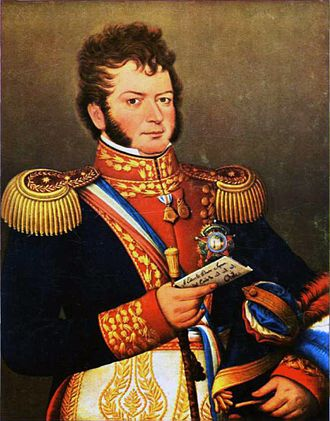
Nickname/Alias: Born: Bernardo Riquelme
Achievements: First Chilean head of state.
Born: August 20, 1778; Chillan, Chile, Viceroyalty of La Plata
Died: October 24, 1842; Callao, Peru (Aged 66)
Field & Discipline: Politics
Language: Spanish
Father: Ambrosio O'Higgins
Mother: Isabel Riquelme
Siblings: Half-sister: Rosa Rodriguez Riquelme.
Spouse: None
Children: Pedro Demetrio O'Higgins
Education: Franciscan monastery, Chillan, 1788-90; Colegio, Lima, 1790-94;
Spain; London, England
Major Work:
Chilean independence (1817)
Life & Times:
Although O'Higgins was born illegitimate, his parents were prominent people in the town of Chillan, then a Spanish colony. At the time, his mother was from a prominent Chillan family and his father was a Spanish officer of Irish origin, who later became Governor of Chile and Viceroy of Peru. In 1794, O'Higgins was sent to England via Spain so that he could complete his education. Along with several other future revolutionary leaders, he joined a secret Masonic lodge in London, known as the “Lautarina.” This was an unusual choice for the son of the Viceroy of Peru, because the lodge was dedicated to the independence of Latin America.
He left England in 1799, on board a ship destined for Buenos Aires, but the ship was captured by British warships and, after several months in captivity, he managed to return to Cadiz in Spain, completely broke. While he was there, during 1800, he caught yellow fever then, in March the following year, he heard of his father's death. With the prospect of an inheritance, he was able to raise enough money to leave Spain and head home. By 1802, the Peace of Amiens meant that ships were sailing freely to South America so, on 14th April, O'Higgins sailed for Chile.
For the next seven years he lived and worked as a farmer and, in 1806, he became a member of the local town council. In this role, he had the opportunity to make both official and unofficial appearances in the southern capital of Concepcion. It was there that he came under the influence and patronage of Juan Martinez de Rozas, a Liberal and a Freemason, who was one of the leading public figures of the south. Through Rozas' connections, the radical O'Higgins became a member of the Chilean high society.
In 1808, Spain was invaded by Napoleon's forces and, occupied with its own defence, the Spanish withdrew from their colonies, including Chile. This was a good time for radical thinkers to set wheels in motion. The first steps towards national independence in Chile were taken in September 1810, when a group loyal to the deposed Spanish king Ferdinand VII, who had been replaced by Napoleon's brother, Joseph Bonaparte, was established in Santiago. The junta, made up of local leaders including Rozas, took over the government and, by 1811, Chile had its own congress.
O'Higgins was made a member of the military in February 1811 and then became a Deputy of Congress. In this job, for the following two years, he played an essential role in the country's turbulent political affairs. By early 1813, Chile had a constitution and a junta that seemed able to control the country and avert the threat of civil war but, in March 1813, the Viceroy of Peru invaded Chile, to re-establish Spanish authority.
O'Higgins immediately rejoined the patriot army and led troops in skirmishes against the enemy. He was then elected both Commander-in-Chief of the defensive forces and Governor of the province of Concepcion, in January 1814. In the same year, at Rancagua, the Chilean patriots were badly beaten by the Peruvian-led forces. Thousands of Chileans patriots, including O'Higgins, took flight and crossed the Andes into Argentina.
He spent three years in Mendoza, where he was welcomed by the Argentine liberator, General Jose de San Martin. San Martin was preparing an army for the invasion of Chile and, regarding the Chilean refugees as allies, chose O'Higgins as his second-in-command. O'Higgins and San Martin led the new allied “Army of the Andes” on a legendary journey across the mountains and, on 12th February 1817, they defeated the Spanish at Chacabuco. Three days later, with Chile largely conquered, after San Martin refused the job, O'Higgins was elected Supreme Dictator of Chile.
The next six years were stormy but O'Higgins successfully expelled the Spanish from Chile, with the exception of the southern island of Chiloe. His success was largely due to the help of the English naval Commander, Lord [head of navy was] Thomas Cochrane*, who had been recruited in London in 1817. With Cochrane's help, O'Higgins created a modern navy, which raided Spanish shipping from southern Chile to Mexico and transported San Martin's liberating army to Peru. Aside from military tactics, he also spent a lot of time and effort on creating a working government, which would establish peace and order in the new republic.
The war against Spain had been an enormous financial strain on the country and O'Higgins soon started losing the support of the wealthy taxpayers. An introduction of new reforms, which hit the conservatives hardest, lost him more and more support. By 1820, he had upset the Church and the aristocracy by abolishing titles of nobility, replacing them with a Legion of Merit to honour accomplishment regardless of social position. He then proposed to abolish estate inheritance by primogeniture. O'Higgins then insisted on the state's right of patronage over ecclesiastical appointments and made it obvious that he intended to tolerate religious dissent, then demanded that public cemeteries be open to non-Catholics.
O’Higgins encouraged the importation of books and increased the number of public schools, in a bid to educate the masses. He improved the highways and financed projects to enhance the beauty of Santiago, all of which contributed to the increase in taxes. In 1822, a new constitution extended the Supreme Dictator's term of office for a further ten years, which immediately provoked an uprising against O'Higgins in Concepcion. The northern province of Coquimbo quickly joined the revolt and, on 28th February 1823 O'Higgins' resignation was demanded. He surrendered power to a four-man junta and submitted himself to an inquiry into his conduct in office. He was completely exonerated. After this experience, O'Higgins went into voluntary exile in Peru, together with his son.
Assessment: O'Higgins was a liberal in the 19th-century sense of the term and an admirer of the British constitutional system.
Oneliner: Bernardo O’Higgins, first Chilean president
Bibliography:
- Kinsbruner, Jay, Bernardo O'Higgins, New York, Twayne Publishers, Inc., 1968.
http://en.wikipedia.org/wiki/Bernardo_O'Higgins
http://www.latinamericanstudies.org/chile/ohiggins-bio.htm
http://www.britannica.com/EBchecked/topic/425959/Bernardo-OHiggins