Cochrane, Thomas
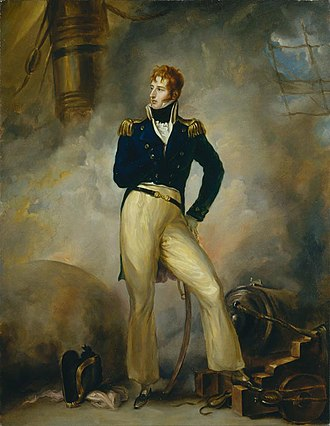
Nickname/Alias: Tenth Earl of Dundonald, The Wolf of the Seas
Achievements: Gas warfare
Born: December 14, 1775; Annsfield, Lanarkshire, Scotland
Died: October 30, 1860; London, England (Aged 84)
Field & Discipline: Military; Invention; Admiral
Language: English.
Father: Archibald Cochrane
Mother: Anne Gilchrist
Siblings: Five younger brothers
Spouse: Katherine Corbett Barnes
Children: Four sons (Capt. Thomas hosted Francis Scott Key on the Surprize)
Education: Private tutors; Military Academy, Kensington Square, London,
1788-93; University of Edinburgh, 1802
Major Work:
“Autobiography of a Seaman”, 2 volumes, 1860-61.
Life & Times:
Cochrane's father, [father was] Archibald Cochrane*, the Ninth Earl, was an inventor whose scientific experiments left his family virtually broke, in spite of some great discoveries. In early 1793, the family could no longer afford to send Cochrane to the military academy, so he was given permission to join his uncle's ship, HMS Hind.
In 1798, he joined Lord Keith on HMS Barfleur and, after a voyage to the Mediterranean Sea, he was promoted. Still young, in March 1800 he was given command of the 158-ton sloop, HMS Speedy with a crew of ninety men, with which he defeated more than fifty enemy ships. He was captured by the French but was exchanged very quickly and went back into action.
After the peace of 1801, Cochrane enrolled at the University of Edinburgh where he began to study science, but war broke out again in 1803 and he was assigned to HMS Arab. He was soon promoted to HMS Pallas, a new 32-gun frigate which was sent to cruise off the Azores for three months. The successful cruise ended in April 1805 and Cochrane returned to Plymouth with riches plundered from Spanish ships. By then, he had made a fortune from his share of prize money from his raids on enemy ships.
In 1806, he stood for Parliament and, by judicious bribery, got himself elected as the Member for Honiton in Devon then, in the general election the following year, he was elected as Member for Westminster.
Soon afterwards he exposed the level of corruption in the Royal Navy in July 1807 and made himself highly unpopular with the government. As a direct result, still a naval officer, he was sent to the Mediterranean as Commander of HMS Imperieuse and, between 1807 and 1809, he made a series of daring raids against the Spanish and the French. One of his most notable exploits took place in the summer of 1808, when he blew up every one of the newly constructed [destroyed work of] Chappe* semaphore telegraph towers along the French coast. In April 1809, he was tasked to burn the French fleet, which involved a dangerous fireship attack involving the trial run of new rockets developed by the inventor [tested rockets of] William Congreve*. Cochrane showed great bravery and succeeded in destroying or beaching most of the French fleet.
Back in London, after receiving a knighthood, Cochrane criticised the Commander-in-Chief, Admiral James Gambier, for not following up the attack on the French fleet. This resulted in Gambier's court-martial, but he was given an honourable acquittal and Cochrane was left discredited and on half-pay. Over the next three years, Cochrane continued his crusade against naval corruption. In some cases, his actions led to reforms but more often made him enemies. In June 1814, he was arrested on a charge of fraud for his (unknowing) involvement in a plot to make money on the stock exchange by spreading false rumours about the abdication of Napoleon.
He was given a fine of £1,000, and sentenced to a year's imprisonment. He was expelled from both Parliament and the Navy and deprived of the Order of the Bath, which he had been awarded for his exploits in 1809. Despite all of this, Cochrane was still popular with his public and, while he was still in prison, they immediately re-elected him as Member of Parliament for Westminster, claiming that “he was perfectly innocent of the Stock Exchange fraud”. In March 1815, he broke out of jail and reappeared in the House of Commons, but he was arrested and returned to prison for the remaining three months of his sentence.
Out of step with the British establishment, Cochrane was unpopular with almost everyone in a position of power in Britain. In May 1817, he accepted an invitation from [hired by] Bernardo O'Higgins*, the first president of the new Chilean republic, to reorganize and command his navy in the War of Independence against Spain. Cochrane led the navies of both Chile and Peru and, in January 1820, they successfully stormed the fifteen royalist-held forts of Valdivia. The following year, he captured the Spanish flagship, Esmeralda, in Callao Harbour, in a war partly fought over bat guano (and using purchased US Civil War ironclad), and which helped secure the independence of Chile and Peru later that year.
In 1822, Cochrane left Chile, now with a romantic reputation as liberator of the oppressed, and took command of the Brazilian navy, serving in the War of Independence against the Portuguese during which he carried out a series of brilliant raids.
He returned to Europe in 1825, after he was asked to command the Greek Navy in its fight for independence against the Turks. Three years later, he was the first to propose using steamships in warfare but, after a delay in the delivery of the ships for the Greek Navy, he resigned.
Back in England in 1828, Cochrane campaigned for his reinstatement to the Royal Navy. His efforts paid off and, in 1832, he regained his commission and a free pardon. In the same year, his father died and he inherited the title of tenth Earl of Dundonald. During the following years he served in the navy and pursued his interest in scientific invention. From 1848 to 1851, he was Commander-in-Chief on the North American and West Indies station, where he first drew attention to the importance of Trinidad’s Pitch Lake. On his return in 1854, he became a Rear Admiral.
Cochrane's many inventions were connected with tubular boilers, screw propulsion and the use of tar and gas. In 1846, a parliamentary committee condemned his plan for the use of sulphur gas in warfare as “too inhuman”. Despite this, the idea was revived in the 20th Century and used in World War I. He wrote two autobiographical works. “Narrative of Services in the Liberation of Chile, Peru and Brazil” was published in two volumes in 1859 and “Autobiography of a Seaman” was published posthumously in 1860-61. Because he was considered to be one of Britain’s greatest naval heroes, he was buried in Westminster Abbey.
Extra Connections: He detained [detained] Francis Scot Key* during the 1812 attack on Fort McHenry
In a plot to rescue Napoleon and bring him to South America.
Friend of Simon Bolivar.
Assessment: one of Britain’s greatest naval heroes
Oneliner: Sir Thomas Cochrane, British Admiral and inventor of gas warfare
Bibliography:
- Encyclopaedia Britannica.
- Collier's Encyclopaedia.
- Lloyd, Christopher, Lord Cochrane: Seaman, Radical, Liberator, London & New York, Longmans, Green & Co., 1947.
http://en.wikipedia.org/wiki/Thomas_Cochrane,_10th_Earl_of_Dundonald
Sandbox: 3q527V
Multimedia:
Great podcast series: Dan Snow's History Hit
- Thomas Cochrane: The Real Master and Commander 1. Thomas Cochrane: The Real Master and Commander - Dan Snow's History Hit | https://shows.acast.com/dansnowshistoryhit/episodes/1-thomas-cochrane-the-real-master-and-commander)
- Thomas Cochrane: The Battle of Basque Roads https://shows.acast.com/dansnowshistoryhit/episodes/2-thomas-cochrane-the-real-master-and-commander
- Thomas Cochrane: From Disgrace to Freedom Fighter https://shows.acast.com/dansnowshistoryhit/episodes/3-thomas-cochrane-the-real-master-and-commander
Snow based his research on Cochrane the Dauntless: The Life and Adventures of Admiral Thomas Cochrane, 1775-1860 by David Cordingly (Paperback – July 7, 2008 ) https://archive.org/details/cochranedauntles0000cord Free online.