Fertilizer
A fertilizer (American English) or fertiliser (British English; see spelling differences) is any material of natural or synthetic origin that is applied to soil or to plant tissues to supply plant nutrients.
Fertilizers may be distinct from liming materials or other non-nutrient soil amendments. Many sources of fertilizer exist, both natural and industrially produced.[1] For most modern agricultural practices, fertilization focuses on three main macro nutrients: nitrogen (N), phosphorus (P), and potassium (K) with occasional addition of supplements like rock flour for micronutrients. Farmers apply these fertilizers in a variety of ways: through dry or pelletized or liquid application processes, using large agricultural equipment or hand-tool methods.
Historically fertilization came from natural or organic sources: compost, animal manure, human manure, harvested minerals, crop rotations and byproducts of human-nature industries (i.e. fish processing waste, or bloodmeal from animal slaughter). However, starting in the 19th century, after innovations in plant nutrition, an agricultural industry developed around synthetically created fertilizers. This transition was important in transforming the global food system, allowing for larger-scale industrial agriculture with large crop yields.
Nitrogen-fixing chemical processes such as the Haber process at the beginning of the 20th century, amplified by production capacity created during World War II led to a boom in using nitrogen fertilizers.[2] In the latter half of the 20th century, increased the use of nitrogen fertilizers (800% increase between 1961 and 2019) have been a crucial component of the increased productivity of conventional food systems (more than 30% per capita) as part of the so-called "Green Revolution".[3]
The use of artificial and industrially-applied fertilizers has led to a number of environmental impacts, creating water pollution and Eutrophication caused by nutritional runoff, carbon and other emissions from fertilizer production and mining, and contamination and pollution of soil. Various types of sustainable agriculture practices can be implemented to reduce the environmental impact of fertilizer uses alongside other environmental impacts of agriculture.
History
Main article: History of fertilizer
[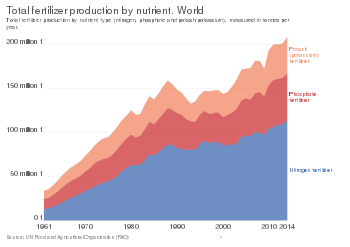
Total fertilizer production by type.
[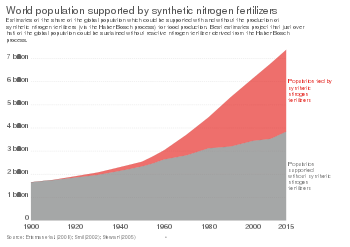
World population supported with and without synthetic nitrogen fertilizers.[5]
Management of soil fertility has preoccupied farmers for thousands of years. Egyptians, Romans, Babylonians, and early Germans are all recorded as using minerals or manure to enhance the productivity of their farms.[1] The science of plant nutrition started well before the work of German chemist Justus von Liebig although his name is most mentioned. Nicolas Théodore de Saussure and scientific colleagues at the time were quick to disprove the simplifications of Justus von Liebig.
There was a complex scientific understanding of plant nutrition, where the role of humus and organo-mineral interactions were central, and which was in line with more recent discoveries from 1990 onwards.[citation needed] Prominent scientists on whom Justus von Liebig drew were Carl Ludwig Sprenger and Hermann Hellriegel. In this field, a 'knowledge erosion'[6] took place, partly driven by an intermingling of economics and research.[7]
John Bennet Lawes, an English entrepreneur, began to experiment on the effects of various manures on plants growing in pots in 1837, and a year or two later the experiments were extended to crops in the field. One immediate consequence was that in 1842 he patented a manure formed by treating phosphates with sulfuric acid, and thus was the first to create the artificial manure industry. In the succeeding year he enlisted the services of Joseph Henry Gilbert; together they performed crop experiments at the Institute of Arable Crops Research.[8]
The Birkeland–Eyde process was one of the competing industrial processes in the beginning of nitrogen-based fertilizer production.[9] This process was used to fix atmospheric nitrogen (N2) into nitric acid (HNO3), one of several chemical processes generally referred to as nitrogen fixation. The resultant nitric acid was then used as a source of nitrate (NO3−). A factory based on the process was built in Rjukan and Notodden in Norway, combined with the building of large hydroelectric power facilities.[10]
The 1910s and 1920s witnessed the rise of the Haber process and the Ostwald process. The Haber process produces ammonia (NH3) from methane (CH4) (natural gas) gas and molecular nitrogen (N2) from the air. The ammonia from the Haber process is then partially converted into nitric acid (HNO3) in the Ostwald process.[11] After World War II, Nitrogen production plants that had ramped up for war-time bomb manufacturing were pivoted towards agriculture uses.[12] The use of synthetic nitrogen fertilizers has increased steadily in the last 50 years, rising almost 20-fold to the current rate of 100 million tonnes of nitrogen per year.[13]
The development of synthetic nitrogen fertilizer has significantly supported global population growth — it has been estimated that almost half the people on the Earth are currently fed as a result of synthetic nitrogen fertilizer use.[14] The use of phosphate fertilizers has also increased from 9 million tonnes per year in 1960 to 40 million tonnes per year in 2000. A maize crop yielding 6–9 tonnes of grain per hectare (2.5 acres) requires 31–50 kilograms (68–110 lb) of phosphate fertilizer to be applied; soybean crops require about half, as 20–25 kg per hectare.[15] Yara International is the world's largest producer of nitrogen-based fertilizers....
Research notes:
http://en.wikipedia.org/wiki/Squanto
http://www.smithsonianmag.com/history-archaeology/squanto.html?c=y&story=fullstory
http://en.wikipedia.org/wiki/Carl_Bosch
http://en.wikipedia.org/wiki/Guano
The word "guano" originates from the Andean indigenous language Quechua, which in its original usage refers to any form of dung used as an agricultural fertilizer. Archaeological evidence suggests that Andean peoples have collected guano from small islands and points located off the desert coast of Peru for use as a soil amendment for well over 1,500 years. Spanish colonial documents suggest that the rulers of the Inca Empire assigned great value to guano, restricted access to it, and punished any disturbance of the birds with death.[2] The Guanay Cormorant has historically been the most abundant and important producer of guano. Other important guano producing species off the coast of Peru are the Peruvian Pelican and the Peruvian Booby.[4][2]
In November 1802, Alexander von Humboldt first encountered guano and began investigating its fertilizing properties at Callao in Peru, and his subsequent writings on this topic made the subject well known in Europe. During the guano boom of the nineteenth century, the vast majority of seabird guano was harvested from Peruvian guano islands, but large quantities were also exported from the Caribbean, atolls in the Central Pacific, and islands off the coast of Namibia, Oman, Patagonia, and Baja California. At that time, massive deposits of guano existed on some islands, in some cases more than 50 m deep. [6] In this context the United States passed the Guano Islands Act in 1856, which gave U.S. citizens discovering a source of guano on an unclaimed island exclusive rights to the deposits. Nine of these islands are still officially U.S. territories.[7] Control over guano played a central role in the Chincha Islands War (1864–1866) between Spain and a Peruvian-Chilean alliance. Indentured workers from China played an important role in guano harvest. The first group of 79 Chinese workers arrived in Peru in 1849, by the time that trade ended a quarter of a century later, over 100,000 of their fellow countrymen had been imported. There is no documentary evidence that enslaved Pacific Islanders participated in guano mining. [8]
After 1870, the use of Peruvian guano as a fertilizer was eclipsed by saltpeter in the form of caliche extraction from the interior of the Atacama Desert, not far from the guano areas. During the War of the Pacific (1879–1883) Chile seized much of the guano as well as Peru's nitrate-producing area, enabling its national treasury to grow by 900% between 1879 and 1902 thanks to taxes coming from the newly acquired lands.[9] Contrary to popular belief, seabird guano does not have high concentrations of nitrates, and was never important to the production of explosives; bat and cave-bird deposits have been processed to produce gunpowder, however. High-grade rock phosphate deposits on Nauru, Banaba Island, Christmas Island (Indian Ocean), and other raised atolls were not produced by marine birds.[10]
Since 1909, when the Peruvian government took over guano extraction for use by Peru farmers, the industry has relied on production by living populations of marine birds. U.S. ornithologists Robert Cushman Murphy and William Vogt promoted the Peruvian industry internationally as a supreme example of wildlife conservation, while also drawing attention to its vulnerability to the El Niño phenomenon. South Africa independently developed its own guano industry based on sustained-yield production from marine birds during this period, as well. Both industries eventually collapsed due to pressure from overfishing.[2] The importance of guano deposits to agriculture elsewhere in the world faded after 1909 when Fritz Haber developed the Haber-Bosch process of industrial nitrogen fixation, which today generates the ammonia-based fertilizer responsible for sustaining an estimated one-third of the Earth's population.[11]
DNA testing has suggested that new potato varieties imported alongside Peruvian seabird guano in 1842 brought a virulent strain of potato blight that began the Irish Potato Famine.[12][13]