Hadley
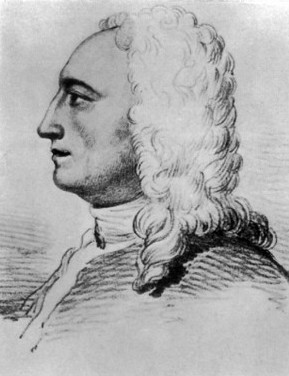
NAME: Hadley, John
ACHIEVEMENT(S): Sextant
NICKNAME/ALIAS: None
DATE/PLACE OF BIRTH: 16 April 1682, at Hertfordshire, England
DATE/PLACE/AGE AT DEATH: 14 February 1744, in East Barnet, Hertfordshire, England. Aged 61
DISCIPLINE: Mathematician and inventor
FIELD: Astronomy
LANGUAGE: English
PARENTS: George Hadley and Katherine Fitzjames
SIBLINGS: George and Henry
SPOUSE: Elizabeth Hodges, married 1734
CHILDREN: John (1738-1816)
EDUCATION: Unknown
MAJOR WORK: "Description of a new Instrument for taking Angles", 1731
LIFE AND TIMES:
Soon after his election to the Royal Society (1717), Hadley began working with Francis Hauksbee the younger on reflecting telescopes, learning - along with his two brothers, George and Henry - the new art of speculum-grinding, and by 1719 had produced paraboloidal mirrors of speculum metal superior to any made by the London master opticians.
He then (1719-21) produced a large Newtonian reflecting telescope of 62 inchessaww focus (f/12; aperture 6 inches), able to enlarge an object almost 200 times, mounted on a stand he had designed himself. Presented to the Royal Society in January 1721, the telescope was tested and praised. <work used by> Halley*, Astronomer Royal, also used the telescope, and commissioned Hadley to construct another, equally large but with many improvements, for his use at Greenwich.
From 1726 until his death Hadley was annually elected a member of the council of the Royal Society, and in 1728 he also became its vice-president. In 1726 he was also one of the committee appointed by the Society to examine and report on the new instruments which Edmund Halley had obtained for Greenwich Observatory.
In 1730 Hadley invented the "reflecting quadrant" (actually a double-reflecting octant, and ancestor of the modern nautical sextant), an instrument used primarily in navigation for calculating latitudes by measuring the angle between some celestial body and the horizon.
Hadley achieved this independently both of Newton, who had described to Halley exactly the same mirror arrangement as a modification of the octant of Robert Hooke (1664), and of <simultaneous invention by> Godfrey* of Pennsylvania, who arrived at exactly the same design later the same year. Hadley presented details of his invention in May 1731 to the Royal Society, in a paper entitled "Description of a new Instrument for taking Angles".
Hadley's quadrant (or octant), had a graduated metal strip, shaped in an arc originally one-eighth of a circumference of a circle, which gave the instrument its name, and used
two mirrors: the horizon mirror, in which only the lower half was silvered, and the index mirror, which could be on an axis perpendicular to the plane of the instrument. An arm attached to the index mirror swept round the calibrated arc, from which angles were read. In use, the instrument was aimed at the horizon and the index mirror rotated until the celestial object could also be seen through the telescope. After careful adjustment to make the image of the celestial body just touch the horizon, the angle was read off the graduated scale.
Once Godfrey's almost identical invention had been announced to the Royal Society in 1732, a row over the question of priority followed. In fact, there were at least six different designs of reflecting quadrant on sale in Great Britain at the time, and the step to the new form (the double-reflecting principle) was not very great.
The convenience for use on board ship of Hadley's portable instrument (which was tested successfully on board the Admiralty's 'Chatham' yacht by James Bradley, now Astronomer Royal, in August 1732, who got altitude readings down to one minute of arc) proved to be the important factor for navigators, and his instrument was sold in large numbers both in England and abroad until the last years of the 19th century.
The names 'octant' and 'quadrant' were applied almost indifferently to it, the former referring to the actual length of the scale (45 degrees), the latter referring to the maximum measurable angle (90 degrees).
In 1732, Hadley fitted an ordinary quadrant with a bubble-level, so that a meridian altitude at sea could be taken when the horizon was not visible. Later, he added this refinement to his own instrument, which can be regarded as the ancestor of the 'bubble sextant' still used in air navigation.
During the 1730s he continued to refine his quadrant, the gradual improvements including the micrometer screw to adjust the index, the magnifying glass to read the scale, telescopic sight, cross-wires to divide the field of view, a solid handle at the back of the instrument, and a frame for the speculum which would resist bending, all of which kept Hadley's quadrant in advance of its rivals.
In 1734 Hadley married Elizabeth Hodges, with whom he established two homes, one at Enfield Chase near East Barnet, and one in Bloomsbury, London, where he was a neighbour (and became a close friend) of <a pal of> Sloane*.
In January 1742, Hadley was one of the signatories to a memorandum from the Royal Society recommending <recommended> John Harrison's* second chronometer (built 1739) to the Board of Longitude. Hadley died two years later.
ASSESSMENT: His sextant was a major contribution to navigation.
EXTRA CONNECTIONS: None
ONELINER: John Hadley, co-inventor of the sextant
BIBLIOGRAPHY:
DSB, EB
Cotter, C.H., A History of the Navigator's Sextant, Glasgow, 1983
King, Henry C., The History of the Telescope, NY, 1955.