Harrison, John

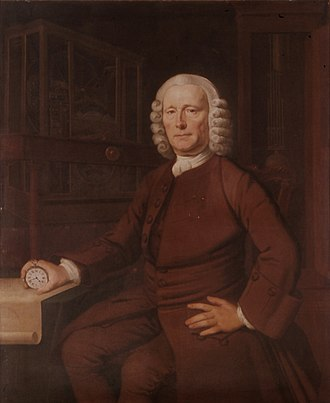
ACHIEVEMENT(S): Maritime chronometer
DATE/PLACE OF BIRTH: 31 March [?] 1693, at Foulby, Yorkshire, England.
DATE/PLACE/AGE AT DEATH: 24 March 1776, in London, England. Aged 82.
DISCIPLINE: Horologist
FIELD: Horology
LANGUAGE: English
EDUCATION: Little formal education
MAJOR WORK: 'The Principles of Mr. Harrison's Timekeeper, with Plates of the
Same', 1767
LIFE AND TIMES:
In the 1710s and early 1720s, with the assistance of his younger brother James, Harrison built a series of unconventional regulator clocks, mainly of wood, for which he designed his almost frictionless 'grasshopper' escapement.
In 1726, in order to prevent the effects of heat and cold upon timekeepers, he then invented the 'gridiron' bimetallic compensation pendulum, which remained the same length at any temperature by making use of the different co-efficients of expansion of two different metals (brass and steel) in order to cancel temperature error. (The pendulum's bob was suspended by a series of parallel rods, alternately of steel and brass, so arranged that the downward expansion of the steel rods from a change in temperature was exactly compensated for by the upward expansion of the brass rods).
Harrison was also the first to use the 'rachet', or secondary spring, which kept the clock going at its usual rate while being wound up.
In 1714, after several disasters at sea caused by poor navigation - one of the worst being that of 1707, when the Royal Navy lost several of its ships and one of its most famous commanders, Shovell* - the newly-established British Board of Longitude had offered a series of prizes to anyone who could construct an instrument which could calculate longitude at sea to an accuracy of 30 minutes (half a degree, or 30 nautical miles) at the end of a voyage to the West Indies.
In theory, the longitude could be found by carrying an accurate clock that would indicate the time at a known longitude, but the requirements of the Board were very exacting : the clock had to have a cumulative error of no more than two minutes after a voyage lasting six weeks.
In June 1730 Harrison took his plans to Halley*, astronomer Royal and Commissioner of the Board of Longitude in London, and was advised to consult with George Graham*, a member of the Royal Society and the leading clock- and instrument-maker of the day, who offered Harrison money and encouragement.
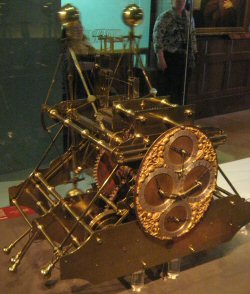
(Harrison's first sea clock, the H1)
Harrison's first chronometer was tested in 1737 on a voyage to Lisbon, and performed so well that the Board of Longitude agreed to finance improved models.
Harrison's second chronometer (completed in 1739) was smaller and lighter than the first, but even before it was tested he had began work on a third and far more complicated machine (of 700 parts, not completed until 1757). The balance of this third machine was controlled by a spiral spring the effective length of which was altered by a bimetallic strip to compensate for changes in temperature.
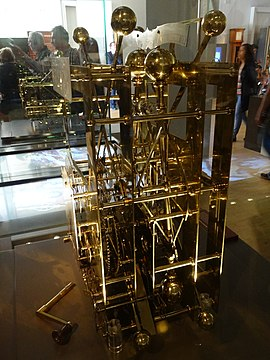
Harrison's second sea clock, the H2
In 1753 Harrison commissioned a London watchmaker, John Jeffreys, to make a watch for his own personal use with a similar self-compensating mechanism for balance-wheel control, that altered the balance spring length with changes in temperature. The timekeeping of this watch proved to be exceptionally good, and Harrison decided to build a larger and more sophisticated version.
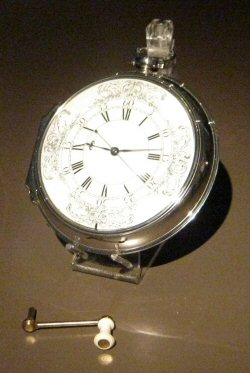
(Harrison's "sea watch" No.1 (H4), with winding crank)
He completed this chronometer in 1759 and, once perfected (1760), this No. 4 Marine Chronometer proved as accurate as his third machine but (being not much larger than a watch of the time) was far more convenient in size, and was tested by Harrison's son William on a nine-week voyage to Jamaica in November 1761.
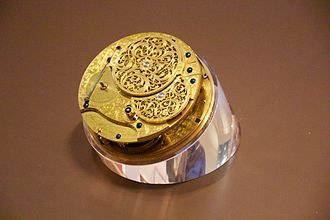
(The clockwork in Harrison's H4 watch)
On its arrival in March 1762, the timekeeper proved to be only five seconds slow, equivalent to just over one minute of longitude, and after a second similar test on a voyage to Barbados (1763-64), Harrison decided to enter it for the longitude prize in place of his third machine.
No. 4 easily met the requirements of the Board of Longitude, and in 1763 the British Government awarded Harrison the sum of £5,000. However, the Board withheld the rest of the prize money until it received proof that the timekeeper could be duplicated. In defence of his claims, in 1767 Harrison published two pamphlets, 'The Principles of Mr. Harrison's Timekeeper' and 'Remarks on the Pamphlet Lately Published by the Rev. Mr. Maskelyne* Under the Authority of the Board of Longitude' and copies of the chronometer were constructed by both Harrison (assisted by his son William) and Larcum Kendall, a well-known watch-maker.
But the Board were bothered by the length of time (two years) it took Kendall to produce his copy of No. 4, and (still expecting the problem of longitude ultimately to be solved by a "lunar method" combining the use of improved nautical tables and Hadley's* sextant) continued to withhold the prize.
Finally, in June 1773, with his claim boosted both by the personal intervention of King George III and by the success of his chronometer on the first leg of the great Antarctic voyage of Cook* of 1772-75, Harrison finally received the remainder of the £20,000.
\He died three years later, in London, at the age of 82, after publishing his final work, 'A Description Concerning Such Mechanisms as Will Afford a Nice or True Mensuration of Time' (1775).
ASSESSMENT: He solved the problem of longitude, but only feature of his chronometers used by later manufacturers was a device that keeps the clock running while it is being wound.
EXTRA CONNECTIONS: Harrison’s springs were made of crucible steel developed by Huntsman*
He based his chronometer on the work of Hooke*
ONELINER: James Harrison, who solved the problem of longitude
BIBLIOGRAPHY:
DNB, DSB, EB
Betts, J., John Harrison, London, 1993
Hobden, Heather & Mervyn Hobden,John Harrison and the Problem of Longitude, London: British Library, 1989
Longitude: The True Story of a Lone Genius Who Solved the Greatest Scientific Problem of His Time by Dava Sobel
http://www.amazon.com/Longitude-Genius-Greatest-Scientific-Problem/dp/080271529X
Multimedia:
# (BBC History of the World)
PARENTS: Henry Harrison and Elizabeth Barber
SIBLINGS: Two sisters and two brothers
SPOUSE: Elizabeth ?, married 1718; remarried 1726
CHILDREN: Two sons (including William) and one daughter