Collins, Michael
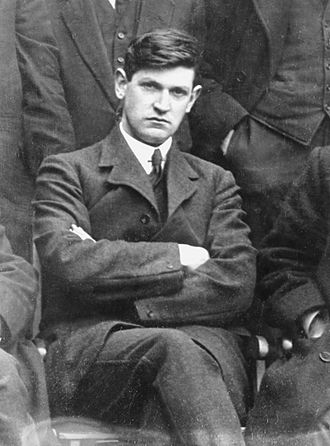
Michael Collins (Irish: Mícheál Ó Coileáin;[2] 16 October 1890 – 22 August 1922) was an Irish revolutionary leader, Minister for Finance, Director of Information, and Teachta Dála (TD) for Cork South in the First Dáil of 1919, Adjutant General, Director of Intelligence, and Director of Organisation and Arms Procurement for the IRA, President of the Irish Republican Brotherhood from November 1920 until his death, and member of the Irish delegation during the Anglo-Irish Treaty negotiations.
Subsequently, he was both Chairman of the Provisional Government andCommander-in-chief of the National Army.[1] Collins was shot and killed in an ambush in August 1922 during the Irish Civil War.
Collins was born in Woodfield, County Cork, the youngest of eight children. He moved to London in 1906 to become a clerk in the Post Office Savings Bank at Blythe House. He was a member of the London GAA, through which he became associated with the Irish Republican Brotherhood and the Gaelic League. He returned to Ireland in January 1916 and fought in the Easter Rising. He was taken prisoner and held in the Frongoch internment camp as a prisoner of war, but he was released in December 1916.
Collins subsequently rose through the ranks of the Irish Volunteers and Sinn Féin. He was elected as a Teachta Dála for South Cork in December 1918. Sinn Féin's elected members formed an Irish parliament, the First Dáil, in January 1919 and declared the independence of the Irish Republic. Collins was appointed Minister for Finance. In the ensuing War of Independence, he was Director of Organisation and Adjutant General for the Irish Volunteers, and Director of Intelligence of the IRA.
He gained fame as a guerrilla warfare strategist, planning many successful attacks on British forces together with 'the Squad', such as the "Bloody Sunday" assassinations of key British intelligence agents in November 1920.
After the July 1921 ceasefire, Collins was one of five plenipotentiaries sent by the Dáil cabinet at the request of Éamon de Valera, to negotiate peace terms in London. The resulting Anglo-Irish Treaty, signed in December 1921, would establish the Irish Free State but depended on an oath of allegiance to the Crown.
This was the clause in the treaty de Valera and other republican leaders found hardest to accept. Collins viewed the treaty as offering "the freedom to achieve freedom", and helped persuade a majority of the Dáil to ratify the treaty. A provisional government was formed under his chairmanship in early 1922.
During this time he secretly provided support for an IRA offensive in Northern Ireland. It was soon disrupted by the Irish Civil War, in which Collins was commander-in-chief of the National Army. He was shot and killed in an ambush by anti-Treaty forces on 22 August 1922.
Contents
- 1 Early years
- 2 Easter Rising
- 3 1917–1918
- 4 First Dáil
- 5 Minister for Finance
- 6 War of Independence
- 7 Truce
- 8 Anglo-Irish Treaty
- 9 Treaty debates
- 10 The North
- 11 Provisional government
- 12 Pact elections
- 13 Assassination of Sir Henry Wilson
- 14 Civil War
- 15 Civil War peace moves
- 16 Death
- 17 Aftermath
- 18 Personal life
- 19 Commemoration
- 20 Legacy
- 21 Societies
- 22 In popular culture
- 23 See also
- 24 References
- 25 Bibliography
- 26 External links
Early years
Collins was born in Woodfield, Sam's Cross, near Rosscarbery, County Cork, on 16 October 1890,[3][note 1] the third son and youngest of eight children. His father, Michael John (1816–1897), was a farmer and amateur mathematician, who had been a member of the Irish Republican Brotherhood (IRB) movement. The elder Collins was 60 years old when he married Mary Anne O'Brien, then 23, in 1876.[4][5][6] The marriage was apparently happy. They brought up eight children on a 90-acre (36 ha) farm called Woodfield, which the Collins family had held as tenants for several generations. Michael was six years old when his father died.[citation needed] Michael Collins (the younger) believed his family were descendants of the Uí Chonaill Gabra...
Easter Rising

Captured Irish soldiers in Stafford Gaol after the failed Easter Rising. Collins is fifth from the right with an 'x' over his head.
The struggle for Home Rule, along with labour unrest, had led to the formation in 1913 of two major nationalist paramilitary groups who later launched the Easter Rising: the Irish Citizen Army was established by James Connolly, James Larkin and his Irish Transport and General Workers Union (ITGWU) to protect strikers from the Dublin Metropolitan Police during the 1913 Dublin Lockout. The Irish Volunteers were created in the same year by nationalists in response to the formation of the Ulster Volunteers (UVF), an Ulster loyalist body pledged to oppose Home Rule by force.
An organiser of considerable intelligence, Collins had become highly respected in the IRB. This led to his appointment as financial advisor to Count Plunkett, father of one of the Easter Rising's organisers, Joseph Plunkett. Collins took part in preparing arms and drilling troops for the insurrection.
The Rising was Collins' first appearance in national events. When it commenced on Easter Monday 1916, Collins served as Joseph Plunkett's aide-de-camp at the rebellion's headquarters in the General Post Office (GPO) in Dublin. There he fought alongside Patrick Pearse, James Connolly, and other members of the Rising leadership. The Rising was put down after six days, but the insurgents achieved their goal of holding their positions for the minimum time required to justify a claim to independence under international criteria.[21]
Following the surrender, Collins was arrested and taken into British custody. He was processed at Dublin's Richmond Barracks by "G-Men", plain-clothes officers from Dublin Metropolitan Police. During his screening, Collins was identified as someone who should be selected for further interrogation, harsher treatment, or execution. However, he overheard his name being called out so he moved to the other side of the building to identify the speaker. In doing so, he joined the group that was transferred to Frongoch internment camp in Wales, a movement that historian Tim Pat Coogan describes as "one of the luckiest escapes of his life".[22]
Collins first began to emerge as a major figure in the vacuum created by the executions of the 1916 leadership. He began hatching plans for "next time" even before the prison ships left Dublin.[23]
At Frongoch he was one of the organisers of a program of protest and non-cooperation with authorities. The camp proved an excellent opportunity for networking with physical-force republicans from all over the country, of which he became a key organiser.[22]
While some celebrated the fact that a rising had happened at all, believing in Pearse's theory of "blood sacrifice" (namely that the deaths of the Rising's leaders would inspire others), Collins railed against the military blunders made, such as the seizure of indefensible and very vulnerable positions like St Stephen's Green, which were impossible to escape from and difficult to supply. Public outcry placed pressure on the British government to end the internment. In December 1916, the Frongoch prisoners were sent home.
1917–1918
Before his death, Tom Clarke, first signatory of the 1916 Proclamation and widely considered the Rising's foremost organiser, had designated his wife Kathleen Clarke as the official caretaker of Rising official business, in the event that the leadership did not survive. By June 1916, Mrs. Clarke had sent out the first post-Rising communiqué to the IRB, declaring the Rising to be only the beginning and directing nationalists to prepare for "the next blow". Soon after his release Mrs. Clarke appointed Collins Secretary to the National Aid and Volunteers Dependents Fund and subsequently passed on to him the secret organisational information and contacts which she had held in trust for the independence movement.

Michael Collins and Arthur Griffith
Collins became one of the leading figures in the post-Rising independence movement spearheaded by Arthur Griffith, editor/publisher of the main nationalist newspaper The United Irishman, (which Collins had read avidly as a boy.)[24][page needed] Griffith's organisation Sinn Féin had been founded in 1905 as an umbrella group to unify all the various factions within the nationalist movement.
Under Griffith's policy, Collins and other advocates of the "physical-force" approach to independence gained the cooperation of Sinn Féin, while agreeing to disagree with Griffith's moderate ideas of a dual monarchy solution based on the Hungarian model.[25] The British government and mainstream Irish media had wrongly blamed Sinn Féin for the Rising. This attracted Rising participants to join the organisation in order to exploit the reputation with which such British propaganda had imbued the organisation. By October 1917 Collins had risen to become a member of the executive of Sinn Féin and director of organisation for the Irish Volunteers. Éamon de Valera, another veteran of 1916, stood for the presidency of Sinn Féin against Griffith, who stepped aside and supported de Valera's presidency.[25]
First Dáil
...
War of Independence
The Irish War of Independence in effect began on the day that the First Dáil convened, 21 January 1919. On that date, an ambush party of IRA Volunteers from the 3rd Tipperary Brigade including Séumas Robinson, Dan Breen, Seán Treacy and Seán Hogan, attacked a pair of Royal Irish Constabulary (RIC) men who were escorting a consignment of gelignite to a quarry in Soloheadbeg, County Tipperary.
The two policemen were shot dead during the engagement, known as the Soloheadbeg ambush. This ambush is considered the first action in the Irish War of Independence.[32] The engagement had no advance authorisation from the nascent government. The legislature's support for the armed struggle soon after became official, with the Dáil ratifying the IRA's claim to be the army of the Irish Republic.[24][page needed] From that time Collins filled a number of roles in addition to his legislative duties.
[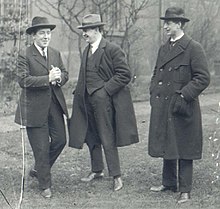
Harry Boland (left), Michael Collins (middle), and Éamon de Valera (right).
On 7 April 1919, Eamon Broy smuggled Collins into G Division's archives in Great Brunswick Street, enabling him to identify "G-Men", six of whom would be killed by the IRA.[33] That summer he was elected president of the IRB (and therefore, in the doctrine of that organisation, de jure President of the Irish Republic). In September, he was made Director of Intelligence for the Irish Republican Army which now had a mandate to pursue an armed campaign, as the official military of the Irish nation.
With Cathal Brugha as Minister of Defence, Collins became Director of Organisation and Adjutant General of the Volunteers. Collins spent much of this period helping to organise the Volunteers as an effective military force, and concentrating on forcing the RIC – which represented British authority in Ireland – out of isolated barracks and seizing their weapons.[34] Collins was determined to avoid the massive destruction, military and civilian losses for merely symbolic victories that had characterised the 1916 Rising. Instead, he directed a guerrilla war against the British, suddenly attacking then just as quickly withdrawing, minimising losses and maximising effectiveness.
The Crown responded with escalation of the war, with the importation of special forces such as the "Auxiliaries", the "Black and Tans", the "Cairo Gang", and others. Officially or unofficially, many of these groups were given a free hand to institute a reign of terror, shooting Irish people indiscriminately, invading homes, looting and burning.
As the war began in earnest, de Valera travelled to the United States for an extended speaking tour to raise funds for the outlawed Republican government. It was in publicity for this tour that de Valera (who had been elected Príomh Aire by the Dáil) was first referred to as "President". While financially successful, grave political conflicts followed in de Valera's wake there which threatened the unity of Irish-American support for the rebels. Some members of the IRB also objected to the use of the presidential title because their organisation's constitution had a different definition of that title...
...
Truce
In 1921 General Macready, commander of British forces in Ireland, reported to his government that the Empire's only hope of holding Ireland was by martial law, including the suspension of "all normal life".[49] Westminster's foreign policy ruled out this option: Irish-American public opinion was important to British agendas in Asia. In addition, Britain's efforts at a military solution had already resulted in a powerful peace movement, which demanded an end to the unrest in Ireland.
Prominent voices calling for negotiation included the Labour Party, The Times and other leading periodicals, members of the House of Lords, English Catholics, and famous authors such as George Bernard Shaw.[50][51]
Still, it was not the British government that initiated negotiations. Individual English activists, including clergy, made private overtures which reached Arthur Griffith. Griffith expressed his welcome for dialogue. The British MP Brigadier General Cockerill sent an open letter to Prime Minister David Lloyd George that was printed in the Times, outlining how a peace conference with the Irish should be organised. Pope Benedict XV made an urgent public appeal for a negotiated end to the violence. Whether or not Lloyd George welcomed such advisors, he could no longer hold out against this tide.[24][page needed]
In July, Lloyd George's government offered a truce. Arrangements were made for a conference between British government and the leaders of the yet-unrecognised Republic. There remains uncertainty as to the two sides' capability to have carried on the conflict much longer. Collins told Hamar Greenwood after signing the Anglo-Irish Treaty: "You had us dead beat. We could not have lasted another three weeks. When we were told of the offer of a truce we were astonished. We thought you must have gone mad".[52] However he stated on the record that "there will be no compromise and no negotiations with any British Government until Ireland is recognised as an independent republic. The same effort that would get us Dominion Home Rule will get us a republic."[53] At no time had the Dáil or the IRA asked for a conference or a truce.[54][page needed]
However, the Dáil as a whole was less uncompromising. It decided to proceed to a peace conference, although it was ascertained in the preliminary stages that a fully independent republic would not be on the table and that the loss of some northeastern counties was a foregone conclusion.[55]...
Anglo-Irish Treaty[edit]

Collins in London as delegate to the Anglo-Irish Treaty negotiations.
The Irish delegates sent to London were designated as "plenipotentiaries", meaning that they had full authority to sign an agreement on behalf of the Dáil government. The Treaty would then be subject to approval by the Dáil.[62] The majority of the delegates, including Arthur Griffith (leader), Robert Barton and Eamonn Duggan (with Erskine Childers as Secretary General to the delegation) set up headquarters at 22 Hans Place in Knightsbridge on 11 October 1921. Collins shared quarters at 15 Cadogan Gardens with the delegation's publicity department, secretary Diarmuid O'Hegarty, Joseph McGrath as well as substantial intelligence and bodyguard personnel including Liam Tobin, Tom Cullen, Eamon Broy, Emmet Dalton and Joseph Dolan of The Squad.[63]
The British team were led by their Prime Minister Lloyd George, the Colonial Secretary Winston Churchill and F. E. Smith. During two months of arduous negotiations the Irish delegates made frequent crossings between London and Dublin to confer with their Dáil colleagues, and Collins' correspondence reflects his frustration at Dáil debates and the Irish delegate's inability to agree clear instruction as to whether or not they should accept a treaty.[24]....
Civil War
Main article: Irish Civil War

The Provisional Government, led by Collins, gave the order to bombard the Four Courts with artillery shells in an attempt to remove the anti-Treaty IRA. This was the start of the Irish Civil War....
The death of Sir Henry Wilson caused a furore in London. Lloyd George, the Prime Minister, sent a letter to Collins saying that the 'ambiguous position' of the Provisional Government with regard to the IRA in the Four Courts could no longer be tolerated.[102]
The British cabinet met the day after the assassination and agreed that Collins' reply had not given a 'definite enough commitment' to disperse the Four Courts occupation. They ordered Nevil Macready, commander of the British garrison still in Dublin, to attack the Four Courts, whose republican garrison they blamed for the shooting of Wilson.[103] The plan was put on hold at the last minute when Macready advised the government, on 26 June, to give Collins' Provisional Government one more chance to act against the Four Courts.[104]...
In August 1922, it seemed as though the Civil War was winding down. The Free State had regained control of most of the country, and Collins was making frequent trips to inspect areas recently recovered from anti-Treaty forces.
His plan to travel to his native Cork on 20 August was considered particularly dangerous, and he was strenuously advised against it by several trusted associates. County Cork was an IRA stronghold as much of it was still held by anti-Treaty forces. Yet he was determined to make the trip without delay. He had fended off a number of attempts on his life in the preceding weeks and had acknowledged more than once, in private conversation, that the Civil War might end his life at any moment. On several occasions, Collins assured his advisors "they won't shoot me in my own county," or words to that effect.
On 22 August 1922 Collins set out from Cork City on a circuitous tour of West Cork. He passed first through Macroom then took the Bandon road via Crookstown. This led through Béal na Bláth, an isolated crossroads. There they stopped at a local pub named 'Long's Pub', now known as The Diamond Bar,[126] to ask a question of a man standing at the crossroad. The man turned out to be an anti-Treaty sentry. He and an associate recognised Collins in the back of the open-top car.
As a result, an ambush was laid by an anti-Treaty column at that point, on the chance that the convoy might come through again on their return journey. Between 7:30 and 8:00 pm, Collins' convoy approached Béal na Bláth for the second time. By then most of the ambush party had dispersed and gone for the day, leaving just five or six men on the scene. Two were disarming a mine in the road, while three on a laneway overlooking them, provided cover. A dray cart, placed across the road, remained at the far end of the ambush site.
The 'Irregulars' in the laneway opened fire with rifles on the convoy. Emmet Dalton, the Free State commander for the county, ordered the driver of the touring car to 'drive like hell', but Collins said 'no, stop and we'll fight 'em'. He then jumped from the vehicle along with the others. At first the group took cover behind a low grass bank bordering the road, but Collins then jumped up and ran back along the road to begin firing with his Lee Enfield rifle from behind the armoured car. The Vickers machine gun in that car had also been firing at the attackers but then stopped because a badly loaded ammunition belt caused it to jam.
Apparently, to get a better view of the laneway up which he had seen the enemy running, Collins left the protection of the armoured car and moved even farther back around a bend in the road out of sight of his comrades. Now standing in the open, he fired a couple of shots and as he was once more working the bolt of his rifle he was struck in the head by a bullet believed to have been fired by one of the ambushing party – Denis "Sonny" O'Neill, a former British Army sniper.[127]
Collins was the only fatality sustained in the ambush, although another member of his party suffered a neck wound. After he was shot the fire from the ambushing party quickly fell off and they withdrew from the scene. Collins was found, face down, on the roadway. One of his men whispered an Act of Contrition into his ear, but Collins was clearly close to death if not already dead. He was lifted into the back of the touring car with his head resting against Dalton's shoulder. The convoy cleared the dray cart obstruction and resumed its journey to Cork.
The lengthy time the convoy took to cover the twenty miles (32 km) back to Cork City was because many of the roads were blocked and the convoy had to travel across muddy fields and through farms to circumnavigate the obstacles, all in darkness. At times, when the vehicles became bogged down, members of the convoy had to carry Collins' body on their shoulders. The touring car eventually had to be abandoned because of mechanical trouble.
There was no autopsy. Collins' field diary was taken by Dalton who had been with him during his tour of the south. The body was first presented at Shanakiel Hospital in Cork, a small military establishment, and then shipped around the coast to Dublin where it was laid out in St Vincent's Hospital Dublin. From there it was removed to the City Hall beside Dublin Castle where it was laid in state.
Conspiracy and collusion
Numerous questions remain about the events surrounding the death of Collins because the only witnesses to his death were the members of the Free State Army convoy and the anti-Treaty ambushers. As no two stories match and participant statements from both sides are contradictory and inconsistent, unanswered questions linger about what happened that day.....
Legacy
...Collins and the IRA were a major source of inspiration for the leader of the Zionist insurgent Lehi group and future Prime Minister of Israel Yitzhak Shamir. During the Israeli War of Independence Shamir adopted "Michael" as his nom de guerre.[138][139] Chinese leader Mao Zedong also studied Collins' practices of guerrilla warfare.[140]...