Chesterton GK
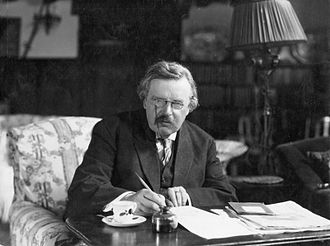
Gilbert Keith Chesterton, KC*SG (29 May 1874 – 14 June 1936) better known as G. K. Chesterton, was an English writer,[1] lay theologian,poet, philosopher, dramatist, journalist, orator, literary and art critic, biographer, and Christian apologist. Chesterton is often referred to as the "prince of paradox."[2] Time magazine, in a review of a biography of Chesterton, observed of his writing style: "Whenever possible Chesterton made his points with popular sayings, proverbs, allegories—first carefully turning them inside out."[3]
Chesterton is well known for his fictional priest-detective Father Brown,[4] and for his reasoned apologetics. Even some of those who disagree with him have recognized the wide appeal of such works as Orthodoxy and The Everlasting Man.[3][5] Chesterton, as a political thinker, cast aspersions on both Progressivism and Conservatism, saying, "The whole modern world has divided itself into Conservatives and Progressives. The business of Progressives is to go on making mistakes. The business of the Conservatives is to prevent the mistakes from being corrected."[6]
Chesterton routinely referred to himself as an "orthodox" Christian, and came to identify this position more and more with Catholicism, eventually converting to Roman Catholicism from High Church Anglicanism. George Bernard Shaw, Chesterton's "friendly enemy" according to Time, said of him, "He was a man of colossal genius."[3] Biographers have identified him as a successor to such Victorian authors as Matthew Arnold, Thomas Carlyle, Cardinal John Henry Newman, and John Ruskin.[7]
Contents
- 1 Early life
- 2 Family life
- 3 Career
- 4 Death and veneration
- 5 Writing
- 6 Views and contemporaries
- 7 Legacy
- 8 Major works
- 9 Notes
- 10 Further reading
- 11 External links
...
Chesterton loved to debate, often engaging in friendly public disputes with such men as George Bernard Shaw,[16] H. G. Wells, Bertrand Russell and Clarence Darrow.[17][18] According to his autobiography, he and Shaw played cowboys in a silent film that was never released...
Legacy
Literary
Chesterton's socio-economic system of Distributism affected the sculptor Eric Gill, who established a commune of Catholic artists at Ditchling in Sussex. The Ditchling group developed a journal called The Game, in which they expressed many Chestertonian principles, particularly anti-industrialism and an advocacy of religious family life.
His novel The Man Who Was Thursday inspired the Irish Republican leader Michael Collins with the idea that "If you didn't seem to be hiding nobody hunted you out."[91] Collins's favourite work of Chesterton was The Napoleon of Notting Hill, and he was "almost fanatically attached to it", according to his friend Sir William Darling.[92]
His column in the Illustrated London News on 18 September 1909 had a profound effect on Mahatma Gandhi.[93] P. N. Furbank asserts that Gandhi was "thunderstruck" when he read it,[94] while Martin Green notes that "Gandhi was so delighted with this that he told Indian Opinion to reprint it."[95]

Another convert was Canadian media theorist Marshall McLuhan, who said that the book What's Wrong with the World changed his life in terms of ideas and religion.[96]
The author Neil Gaiman stated that he grew up reading Chesterton in his school's library, and that The Napoleon of Notting Hill influenced his own book Neverwhere. Gaiman based the character Gilbert from the comic book The Sandman on Chesterton,[97] while the novel he co-wrote with Terry Pratchett is dedicated to him. The Argentine author and essayist Jorge Luis Borges cited Chesterton as influential on his fiction, telling interviewer Richard Burgin that "Chesterton knew how to make the most of a detective story."[98]...