Mikhail Gorbachev
Mikhail Sergeyevich Gorbachev[f] (2 March 1931 – 30 August 2022) was a Soviet and Russian politician who served as the eighth and final leader of the Soviet Union from 1985 to the country's dissolution in 1991. He served as General Secretary of the Communist Party of the Soviet Union from 1985 and additionally as head of state beginning in 1988, as Chairman of the Presidium of the Supreme Soviet from 1988 to 1989, Chairman of the Supreme Soviet from 1989 to 1990 and the only President of the Soviet Union from 1990 to 1991. Ideologically, Gorbachev initially adhered to Marxism–Leninism but moved towards social democracy by the early 1990s.
Gorbachev was born in Privolnoye, Russian SFSR, to a poor peasant family of Russian and Ukrainian heritage. Growing up under the rule of Joseph Stalin, in his youth, he operated combine harvesters on a collective farm before joining the Communist Party, which then governed the Soviet Union as a one-party state. Studying at Moscow State University, he married fellow student Raisa Titarenko in 1953 and received his law degree in 1955. Moving to Stavropol, he worked for the Komsomol youth organization and, after Stalin's death, became a keen proponent of the de-Stalinization reforms of Soviet leader Nikita Khrushchev.
He was appointed the First Party Secretary of the Stavropol Regional Committee in 1970, overseeing the construction of the Great Stavropol Canal. In 1978, he returned to Moscow to become a Secretary of the party's Central Committee, and in 1979 joined its governing Politburo (25th term). Three years after the death of Soviet leader Leonid Brezhnev—following the brief tenures of Yuri Andropov and Konstantin Chernenko—in 1985, the Politburo elected Gorbachev as general secretary, the de facto leader.
Although committed to preserving the Soviet state and its Marxist–Leninist ideals, Gorbachev believed significant reform was necessary for survival. He withdrew troops from the Soviet–Afghan War and embarked on summits with United States president Ronald Reagan to limit nuclear weapons and end the Cold War. Domestically, his policy of glasnost ("openness") allowed for enhanced freedom of speech and press, while his perestroika ("restructuring") sought to decentralize economic decision-making to improve its efficiency.
His democratization measures and formation of the elected Congress of People's Deputies undermined the one-party state. Gorbachev declined to intervene militarily when various Eastern Bloc countries abandoned Marxist–Leninist governance in 1989–1992. Internally, growing nationalist sentiment threatened to break up the Soviet Union, leading Marxist–Leninist hardliners to launch the unsuccessful August Coup against Gorbachev in 1991. In the coup's wake, the Soviet Union dissolved against Gorbachev's wishes. After resigning from the presidency, he launched the Gorbachev Foundation, became a vocal critic of Russian presidents Boris Yeltsin and Vladimir Putin, and campaigned for Russia's social-democratic movement. Gorbachev died in Moscow in 2022, at the age of 91.
Gorbachev is considered one of the most significant figures of the second half of the 20th century. The recipient of a wide range of awards, including the Nobel Peace Prize, he is praised for his role in ending the Cold War, introducing new political and economic freedoms in the Soviet Union, and tolerating both the fall of Marxist–Leninist administrations in eastern and central Europe and the German reunification. In Russia, he is often derided for facilitating the dissolution of the Soviet Union—an event which weakened Russia's global influence and precipitated an economic collapse in Russia and other states.
Early life and education
1931–1950: childhood
Gorbachev was born on 2 March 1931 in the village of Privolnoye, then in the North Caucasus Krai of the Russian Soviet Federative Socialist Republic, Soviet Union.[4] At the time, Privolnoye was divided almost evenly between ethnic Russians and ethnic Ukrainians.[5] Gorbachev's paternal family were ethnic Russians and had moved to the region from Voronezh several generations before; his maternal family were of ethnic Ukrainian heritage and had migrated from Chernihiv.[6] His parents named him Viktor at birth, but at the insistence of his mother—a devout Orthodox Christian—he had a secret baptism, where his grandfather christened him Mikhail.[7] His relationship with his father, Sergey Andreyevich Gorbachev, was close; his mother, Maria Panteleyevna Gorbacheva (née Gopkalo), was colder and punitive.[8] His parents were poor,[9] and lived as peasants.[10] They had married as teenagers in 1928,[11] and in keeping with local tradition had initially resided in Sergey's father's house, an adobe-walled hut, before a hut of their own could be built.[12]
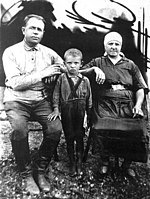 ](Gorbachev and his Ukrainian maternal grandparents, late 1930s
The Soviet Union was a one-party state governed by the Communist Party, and during Gorbachev's childhood was under the leadership of Joseph Stalin. Stalin had initiated a project of mass rural collectivization which, in keeping with his Marxist–Leninist ideas, he believed would help convert the country into a socialist society.[13] Gorbachev's maternal grandfather joined the Communist Party and helped form the village's first kolkhoz (collective farm) in 1929, becoming its chair.[14] This farm was 19 kilometres (12 mi) outside Privolnoye village and when he was three years old, Gorbachev left his parental home and moved into the kolkhoz with his maternal grandparents.[15]
The country was then experiencing the famine of 1930–1933, in which two of Gorbachev's paternal uncles and an aunt died.[16] This was followed by the Great Purge, in which individuals accused of being "enemies of the people", including those sympathetic to rival interpretations of Marxism like Trotskyism, were arrested and interned in labor camps, if not executed. Both of Gorbachev's grandfathers were arrested (his maternal in 1934 and his paternal in 1937) and spent time in Gulag labor camps before being released.[17] After his December 1938 release, Gorbachev's maternal grandfather discussed having been tortured by the secret police, an account that influenced the young boy.[18]
Following on from the outbreak of the Second World War in 1939, in June 1941 the German Army invaded the Soviet Union. German forces occupied Privolnoye for four and a half months in 1942.[19] Gorbachev's father had joined the Red Army and fought on the frontlines; he was wrongly declared dead during the conflict and fought in the Battle of Kursk before returning to his family, injured.[20] After Germany was defeated, Gorbachev's parents had their second son, Aleksandr, in 1947; he and Mikhail would be their only children.[11]
The village school was closed during much of the war but re-opened in autumn 1944.[21] Gorbachev did not want to return but when he did he excelled academically.[22] He read voraciously, moving from the Western novels of Thomas Mayne Reid to the works of Vissarion Belinsky, Alexander Pushkin, Nikolai Gogol, and Mikhail Lermontov.[23] In 1946, he joined the Komsomol, the Soviet political youth organization, becoming leader of his local group and then being elected to the Komsomol committee for the district.[24] From primary school he moved to the high school in Molotovskoye; he stayed there during the week while walking the 19 km (12 mi) home during weekends.[25] As well as being a member of the school's drama society,[26] he organized sporting and social activities and led the school's morning exercise class.[27] Over the course of five consecutive summers from 1946 onward he returned home to assist his father in operating a combine harvester, during which they sometimes worked 20-hour days.[28] In 1948, they harvested over 8,000 centners of grain, a feat for which Sergey was awarded the Order of Lenin and his son the Order of the Red Banner of Labour.[29]
...
Unraveling of the USSR
In the Revolutions of 1989, most of the Marxist–Leninist states of Central and Eastern Europe held multi-party elections resulting in regime change.[340] In most countries, like Poland and Hungary, this was achieved peacefully, but in Romania, the revolution turned violent, and led to Ceaușescu's overthrow and execution.[340] Gorbachev was too preoccupied with domestic problems to pay much attention to these events.[341] He believed that democratic elections would not lead Eastern European countries into abandoning their commitment to socialism.[342] In 1989, he visited East Germany for the fortieth anniversary of its founding;[343] shortly after, in November, the East German government allowed its citizens to cross the Berlin Wall, a decision Gorbachev praised. Over the following years, much of the wall was demolished.[344] Neither Gorbachev nor Thatcher or Mitterrand wanted a swift reunification of Germany, aware that it would likely become the dominant European power. Gorbachev wanted a gradual process of German integration but Kohl began calling for rapid reunification.[345] With German reunification in 1990, many observers declared the Cold War over.[346]
1990–1991: presidency of the Soviet Union
 Gorbachev addressing the United Nations General Assembly in 1988. During the speech, he dramatically announced deep unilateral cuts in Soviet military forces in Eastern Europe.
In February 1990, both liberalisers and Marxist–Leninist hardliners intensified their attacks on Gorbachev.[347] A liberalizer march took place in Moscow criticizing Communist Party rule,[348] while at a Central Committee meeting, the hardliner Vladimir Brovikov accused Gorbachev of reducing the country to "anarchy" and "ruin" and of pursuing Western approval at the expense of the Soviet Union and the Marxist–Leninist cause.[349] Gorbachev was aware that the Central Committee could still oust him as general secretary, and so decided to reformulate the role of head of government to a presidency from which he could not be removed.[350] He decided that the presidential election should be held by the Congress of People's Deputies. He chose this over a public vote because he thought the latter would escalate tensions and feared that he might lose it;[351] a spring 1990 poll nevertheless still showed him as the most popular politician in the country.[352]
In March, the Congress of People's Deputies held the first (and only) Soviet presidential election, in which Gorbachev was the only candidate. He secured 1,329 in favor to 495 against; 313 votes were invalid or absent. He therefore became the first executive President of the Soviet Union.[353] A new 18-member Presidential Council de facto replaced the Politburo.[354] At the same Congress meeting, he presented the idea of repealing Article 6 of the Soviet constitution, which had ratified the Communist Party as the "ruling party" of the Soviet Union. The Congress passed the reform, undermining the de jure nature of the one-party state.[355]
In the 1990 elections for the Russian Supreme Soviet, the Communist Party faced challengers from an alliance of liberalisers known as "Democratic Russia"; the latter did particularly well in urban centers.[356] Yeltsin was elected the parliament's chair, something Gorbachev was unhappy about.[357] That year, opinion polls showed Yeltsin overtaking Gorbachev as the most popular politician in the Soviet Union.[352] Gorbachev struggled to understand Yeltsin's growing popularity, commenting: "he drinks like a fish ... he's inarticulate, he comes up with the devil knows what, he's like a worn-out record".[358] The Russian Supreme Soviet was now out of Gorbachev's control;[358] in June 1990, it declared that in the Russian Republic, its laws took precedence over those of the Soviet central government.[359] Amid a growth in Russian nationalist sentiment, Gorbachev had reluctantly allowed the formation of a Communist Party of the Russian Soviet Federative Socialist Republic as a branch of the larger Soviet Communist Party. Gorbachev attended its first congress in June, but soon found it dominated by hardliners who opposed his reformist stance.[360]
German reunification and the Gulf War
In January 1990, Gorbachev privately agreed to permit East German reunification with West Germany, but rejected the idea that a unified Germany could retain West Germany's NATO membership.[361] His compromise that Germany might retain both NATO and Warsaw Pact memberships did not attract support.[362] On 9 February 1990 in a phone conversation with James Baker, then the US secretary of state, he set out his position that "a broadening of the NATO zone is not acceptable" to which Baker agreed. Scholars are puzzled why Gorbachev never pursued a written pledge.[363] In May 1990, he visited the US for talks with President Bush;[364] there, he agreed that an independent Germany would have the right to choose its international alliances.[362] Ultimately he acquiesced to the reunification on the condition that NATO troops not be posted to the territory of Eastern Germany.[365] There remains some confusion over whether US secretary of state James Baker led Gorbachev to believe that NATO would not expand into other countries in Eastern Europe as well. There was no oral or written US promise that explicitly said so. Gorbachev himself has stated that he was only made such a promise regarding East Germany and that it was kept.[366][367] In July, Kohl visited Moscow and Gorbachev informed him that the Soviets would not oppose a reunified Germany being part of NATO.[368] Domestically, Gorbachev's critics accused him of betraying the national interest;[369] more broadly, they were angry that Gorbachev had allowed the Eastern Bloc to move away from direct Soviet influence.[370]
 In September 1990, Gorbachev met repeatedly with US president George Bush at the Helsinki Summit.
In August 1990, Saddam Hussein's Iraqi government invaded Kuwait; Gorbachev endorsed President Bush's condemnation of it.[371] This brought criticism from many in the Soviet state apparatus, who saw Hussein as a key ally in the Persian Gulf and feared for the safety of the 9,000 Soviet citizens in Iraq, although Gorbachev argued that the Iraqis were the clear aggressors in the situation.[372] In November the Soviets endorsed a UN Resolution permitting force to be used in expelling the Iraqi Army from Kuwait.[373] Gorbachev later called it a "watershed" in world politics, "the first time the superpowers acted together in a regional crisis".[374] However, when the US announced plans for a ground invasion, Gorbachev opposed it, urging instead a peaceful solution.[375] In October 1990, Gorbachev was awarded the Nobel Peace Prize; he was flattered but acknowledged "mixed feelings" about the accolade.[376] Polls indicated that 90% of Soviet citizens disapproved of the award, which was widely seen as a Western and anti-Soviet accolade.[377]
With the Soviet budget deficit climbing and no domestic money markets to provide the state with loans, Gorbachev looked elsewhere.[378] Throughout 1991, Gorbachev requested sizable loans from Western countries and Japan, hoping to keep the Soviet economy afloat and ensure the success of perestroika.[379] Although the Soviet Union had been excluded from the G7, Gorbachev secured an invitation to its London summit in July 1991.[380] There, he continued to call for financial assistance; Mitterrand and Kohl backed him,[381] while Thatcher—no longer in office—also urged Western leaders to agree.[382] Most G7 members were reluctant, instead offering technical assistance and proposing the Soviets receive "special associate" status—rather than full membership—of the World Bank and International Monetary Fund.[383] Gorbachev was frustrated that the US would spend $100 billion on the Gulf War but would not offer his country loans.[384] Other countries were more forthcoming; West Germany had given the Soviets DM60 billion by mid-1991.[385] Bush visited Moscow in late July, when he and Gorbachev concluded ten years of negotiations by signing the START I treaty, a bilateral agreement on the reduction and limitation of strategic offensive arms.[386]
August coup and government crises
Further information: 1991 Soviet coup d'état attempt
[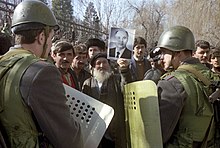 ](https://en.wikipedia.org/wiki/File:RIAN_archive_699872_Dushanbe_riots,_February_1990.jpg)Anti-Armenian and anti-government Dushanbe riots in Soviet Tajikistan, 1990
At the 28th Communist Party Congress in July 1990, hardliners criticized the reformists but Gorbachev was re-elected party leader with the support of three-quarters of delegates and his choice of deputy general secretary, Vladimir Ivashko, was also elected.[387] Seeking compromise with the liberalizers, Gorbachev assembled a team of both his own and Yeltsin's advisers to come up with an economic reform package: the result was the "500 Days" programme. This called for further decentralization and some privatization.[388] Gorbachev described the plan as "modern socialism" rather than a return to capitalism but had many doubts about it.[389] In September, Yeltsin presented the plan to the Russian Supreme Soviet, which backed it.[390] Many in the Communist Party and state apparatus warned against it, arguing that it would create marketplace chaos, rampant inflation, and unprecedented levels of unemployment.[391] The 500 Days plan was abandoned.[392] At this, Yeltsin railed against Gorbachev in an October speech, claiming that Russia would no longer accept a subordinate position to the Soviet government.[393]
By mid-November 1990, much of the press was calling for Gorbachev to resign and predicting civil war.[394] Hardliners were urging Gorbachev to disband the presidential council and arrest vocal liberals in the media.[395] In November, he addressed the Supreme Soviet where he announced an eight-point program, which included governmental reforms, among them the abolition of the presidential council.[396] By this point, Gorbachev was isolated from many of his former close allies and aides.[397] Yakovlev had moved out of his inner circle and Shevardnadze had resigned.[398] His support among the intelligentsia was declining,[399] and by the end of 1990 his approval ratings had plummeted.[400]
Amid growing dissent in the Baltics, especially Lithuania, in January 1991 Gorbachev demanded that the Lithuanian Supreme Council rescind its pro-independence reforms.[401] Soviet troops occupied several Vilnius buildings and attacked protesters,[402] 15 of whom were killed.[403] Gorbachev was widely blamed by liberalizers, with Yeltsin calling for his resignation.[404] Gorbachev denied sanctioning the military operation, although some in the military claimed that he had; the truth of the matter was never clearly established.[405] Fearing more civil disturbances, that month Gorbachev banned demonstrations and ordered troops to patrol Soviet cities alongside the police. This further alienated the liberalizers but was not enough to win over hardliners.[406] Wanting to preserve the Union, in April Gorbachev and the leaders of nine Soviet republics jointly pledged to prepare a treaty that would renew the federation under a new constitution; but six of the republics—Estonia, Latvia, Lithuania, Moldova, Georgia, and Armenia—did not endorse this.[407] A referendum on the issue brought 76.4% in favor of continued federation but the six rebellious republics had not taken part.[408] Negotiations took place to decide what form the new constitution would take, again bringing together Gorbachev and Yeltsin in discussion; it was planned to be formally signed in August.[409]
[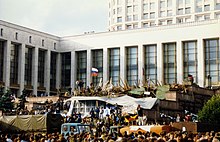 ](https://en.wikipedia.org/wiki/File:August_1991_coup_-awaiting_the_counterattack_outside_the_White_House_Moscow_-panoramio.jpg)Tens of thousands of anti-coup protesters surrounding the White House, Moscow
In August, Gorbachev and his family holidayed at their dacha, "Zarya" ('Dawn') in Foros, Crimea.[410] Two weeks into his holiday, a group of senior Communist Party figures—the "Gang of Eight"—calling themselves the State Committee on the State of Emergency launched a coup d'état to seize control of the Soviet Union.[411] The phone lines to his dacha were cut and a group arrived, including Boldin, Shenin, Baklanov, and General Varennikov, informing him of the take-over.[412] The coup leaders demanded that Gorbachev formally declare a state of emergency in the country, but he refused.[413] Gorbachev and his family were kept under house arrest in their dacha.[414] The coup plotters publicly announced that Gorbachev was ill and thus Vice President Yanayev would take charge of the country.[415]
Yeltsin, now President of the Russian Soviet Federative Socialist Republic, went inside the Moscow White House. Tens of thousands of protesters massed outside it to prevent troops storming the building to arrest him.[416] Gorbachev feared that the coup plotters would order him killed, so had his guards barricade his dacha.[417] However, the coup's leaders realized that they lacked sufficient support and ended their efforts. On 21 August, Vladimir Kryuchkov, Dmitry Yazov, Oleg Baklanov, Anatoly Lukyanov, and Vladimir Ivashko arrived at Gorbachev's dacha to inform him that they were doing so.[417]
That evening, Gorbachev returned to Moscow, where he thanked Yeltsin and the protesters for helping to undermine the coup.[418] At a subsequent press conference, he pledged to reform the Soviet Communist Party.[419] Two days later, he resigned as its general secretary and called on the Central Committee to dissolve.[420][421] Several members of the coup committed suicide; others were fired.[422] Gorbachev attended a session of the Russian Supreme Soviet on 23 August, where Yeltsin aggressively criticized him for having appointed and promoted many of the coup members to start with.[423]
Final days and collapse
Main article: Dissolution of the Soviet Union
After the coup, the Supreme Soviet indefinitely suspended all Communist Party activity, effectively ending communist rule in the Soviet Union.[424][425] From then on, the country collapsed with dramatic speed.
 Leaders of the Soviet Republics sign the Belovezha Accords, which eliminated the USSR and established the Commonwealth of Independent States, 1991.
On 30 October, Gorbachev attended a conference in Madrid trying to revive the Israeli–Palestinian peace process. The event was co-sponsored by the US and Soviet Union, one of the first examples of such cooperation between the two countries. There, he again met with Bush.[426] En route home, he traveled to France where he stayed with Mitterrand at the latter's home near Bayonne.[427]
To keep unity within the country, Gorbachev continued to pursue plans for a new union treaty but found increasing opposition to the idea of a continued federal state as the leaders of various Soviet republics bowed to growing nationalist pressure.[428] Yeltsin stated that he would veto any idea of a unified state, instead favoring a confederation with little central authority.[429] Only the leaders of Kazakhstan and Kirghizia supported Gorbachev's approach.[430] The referendum in Ukraine on 1 December with a 90% turnout for secession from the Union was a fatal blow; Gorbachev had expected Ukrainians to reject independence.[431]
 Changes in national boundaries after the end of the Cold War and the dissolution of the Soviet Union in 1991
Without Gorbachev's knowledge, Yeltsin met with Ukrainian president Leonid Kravchuk and Belarusian president Stanislav Shushkevich in Belovezha Forest, near Brest, Belarus, on 8 December and signed the Belavezha Accords, which declared the Soviet Union had ceased to exist and formed the Commonwealth of Independent States (CIS) as its successor.[432] Gorbachev only learned of this development when Shushkevich phoned him; Gorbachev was furious.[433] He desperately looked for an opportunity to preserve the Soviet Union, hoping in vain that the media and intelligentsia might rally against the idea of its dissolution.[434] Ukrainian, Belarusian, and Russian Supreme Soviets then ratified the establishment of the CIS.[435] On 9 December, Gorbachev issued a statement calling the CIS agreement "illegal and dangerous".[436][437] On 20 December, the leaders of 11 of the 12 remaining republics—all except Georgia—met in Kazakhstan and signed the Alma-Ata Protocol, agreeing to dismantle the Soviet Union and formally establish the CIS. They also provisionally accepted Gorbachev's resignation as president of what remained of the Soviet Union. Accepting the fait accompli of the Soviet Union's dissolution, Gorbachev revealed that he would resign as soon as he saw that the CIS was a reality.[438][439]
Gorbachev reached a deal with Yeltsin that called for Gorbachev to formally announce his resignation as Soviet president and Commander-in-Chief on 25 December, before vacating the Kremlin by 29 December.[440] Yakovlev, Chernyaev and Shevardnadze joined Gorbachev to help him write a resignation speech.[438] Gorbachev then gave his speech in the Kremlin in front of television cameras, allowing for international broadcast.[441] In it, he announced, "I hereby discontinue my activities at the post of President of the Union of Soviet Socialist Republics." He expressed regret for the breakup of the Soviet Union but cited what he saw as the achievements of his administration: political and religious freedom, the end of totalitarianism, the introduction of democracy and a market economy, and an end to the arms race and Cold War.[442] Gorbachev was the third out of eight Soviet leaders, after Malenkov and Khrushchev, not to die in office.[443][444] The following day, 26 December, the Soviet of the Republics, the upper house of the Supreme Soviet of the Soviet Union, formally voted the country out of existence.[445] As of 31 December 1991, all Soviet institutions that had not been taken over by Russia ceased to function.[446][447]
Post-USSR life
1991–1999: initial years
 Gorbachev visiting Reagan, at Rancho del Cielo in 1992[
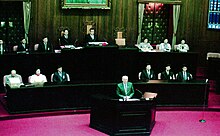 ](https://en.wikipedia.org/wiki/File:Mikhail_Gorbachev_speech_at_Legislative_Yuan_%281994%29_02.jpg)Gorbachev giving a speech at the Legislative Yuan in Taiwan, 1994
Out of office, Gorbachev had more time to spend with his wife and family.[448] He and Raisa initially lived in their dilapidated dacha on Rublevskoe Shosse, and were also allowed to privatize their smaller apartment on Kosygin Street.[448] He focused on establishing his International Foundation for Socio-Economic and Political Studies, or "Gorbachev Foundation", launched in March 1992;[449] Yakovlev and Revenko were its first vice presidents.[450] Its initial tasks were in analyzing and publishing material on the history of perestroika, as well as defending the policy from what it called "slander and falsifications". The foundation also tasked itself with monitoring and critiquing life in post-Soviet Russia, presenting alternative development forms to those pursued by Yeltsin.[450]
To finance his foundation, Gorbachev began lecturing internationally, charging large fees to do so.[450] On a visit to Japan, he was well received and given multiple honorary degrees.[451] In 1992, he toured the US in a Forbes private jet to raise money for his foundation. During the trip he met up with the Reagans for a social visit.[451] From there he went to Spain, where he attended the Expo '92 world fair in Seville and met with Prime Minister Felipe González, who had become a friend of his.[452] He further visited Israel and Germany, where he was received warmly by many politicians who praised his role in facilitating German reunification.[453] To supplement his lecture fees and book sales, Gorbachev appeared in commercials such as a television advertisement for Pizza Hut, another for the ÖBB[454] and photograph advertisements for Apple Computer[455] and Louis Vuitton, enabling him to keep the foundation afloat.[456][457] With his wife's assistance, Gorbachev worked on his memoirs, which were published in Russian in 1995 and in English the following year.[458] He also began writing a monthly syndicated column for The New York Times.[459]
In 1993, Gorbachev launched Green Cross International, which focused on encouraging sustainable futures, and then the World Political Forum.[460] In 1995, he initiated the World Summit of Nobel Peace Laureates.[461]
| External video |
|---|
 *Booknotes* interview with Gorbachev on his memoirs, 24 November 1996, C-SPAN |
Gorbachev had promised to refrain from criticizing Yeltsin while the latter pursued democratic reforms, but soon the two men were publicly criticizing each other again.[462] After Yeltsin's decision to lift price caps generated massive inflation and plunged many Russians into poverty, Gorbachev openly criticized him, comparing the reform to Stalin's policy of forced collectivization.[462] After pro-Yeltsin parties did poorly in the 1993 legislative election, Gorbachev called on him to resign.[463] In 1995, his foundation held a conference on "The Intelligentsia and Perestroika". It was there that Gorbachev proposed to the Duma a law that would reduce many of the presidential powers established by Yeltsin's 1993 constitution.[464] Gorbachev continued to defend perestroika but acknowledged that he had made tactical errors as Soviet leader.[460] While he still believed that Russia was undergoing a process of democratization, he concluded that it would take decades rather than years, as he had previously thought.[465]
 Gorbachev with Argentine president Carlos Menem in 1999
In contrast to her husband's political activities, Raisa had focused on campaigning for children's charities.[466] In 1997, she founded a sub-division of the Gorbachev Foundation known as Raisa Maksimovna's Club to focus on improving women's welfare in Russia.[467] The Foundation had initially been housed in the former Social Science Institute building, but Yeltsin introduced limits to the number of rooms it could use there;[468] the American philanthropist Ted Turner then donated over $1 million to enable the foundation to build new premises on the Leningradsky Prospekt.[469] In 1999, Gorbachev made his first visit to Australia, where he gave a speech to the country's parliament.[470] Shortly after, in July, Raisa was diagnosed with leukemia. With the assistance of German chancellor Gerhard Schröder, she was transferred to a cancer center in Münster, Germany, and there underwent chemotherapy.[471] In September she fell into a coma and died.[223] After Raisa's passing, Gorbachev's daughter Irina and his two granddaughters moved into his Moscow home to live with him.[472] When questioned by journalists, he said that he would never remarry.[459]
 Gorbachev, daughter Irina and his wife's sister Lyudmila at the funeral of Raisa, 1999
1996 presidential campaign
Main article: Mikhail Gorbachev 1996 presidential campaign
The Russian presidential elections were scheduled for June 1996, and although his wife and most of his friends urged him not to run, Gorbachev decided to do so.[473] He hated the idea that the election would result in a run-off between Yeltsin and Gennady Zyuganov, the Communist Party of the Russian Federation candidate whom Yeltsin saw as a Stalinist hardliner. He never expected to win outright but thought a centrist bloc could be formed around either himself or one of the other candidates with similar views, such as Grigory Yavlinsky, Svyatoslav Fyodorov, or Alexander Lebed.[474] After securing the necessary one million signatures of nomination, he announced his candidacy in March.[475] Launching his campaign, he traveled across Russia giving rallies in twenty cities.[475] He repeatedly faced anti-Gorbachev protesters, while some pro-Yeltsin local officials tried to hamper his campaign by banning local media from covering it or by refusing him access to venues.[476] In the election, Gorbachev came seventh with approximately 386,000 votes, or around 0.5% of the total.[477] Yeltsin and Zyuganov went through to the second round, where the former was victorious.[477]
1999–2008: promoting social democracy in Putin's Russia
 Gorbachev attended the inauguration of Vladimir Putin in May 2000.
In December 1999, Yeltsin resigned and was succeeded by his deputy, Vladimir Putin, who then won the March 2000 presidential election.[478] Gorbachev attended Putin's inauguration ceremony in May, the first time he had entered the Kremlin since 1991.[479] Gorbachev initially welcomed Putin's rise, seeing him as an anti-Yeltsin figure.[460] Although he spoke out against some of the Putin government's actions, Gorbachev also had praise for the new government; in 2002, he said: "I've been in the same skin. That's what allows me to say that what [Putin] has done is in the interest of the majority."[480] At the time, he believed Putin to be a committed democrat who nevertheless had to use "a certain dose of authoritarianism" to stabilize the economy and rebuild the state after the Yeltsin era.[479] At Putin's request, Gorbachev became co-chair of the "Petersburg Dialogue" project between high-ranking Russians and Germans.[478]
In 2000, Gorbachev helped form the Russian United Social Democratic Party.[481] In June 2002, he participated in a meeting with Putin, who praised the venture, suggesting that a center-left party could be good for Russia and that he would be open to working with it.[480] In 2003, Gorbachev's party merged with the Social Democratic Party to form the Social Democratic Party of Russia[481]—which, however, faced much internal division and failed to gain traction with voters.[481] Gorbachev resigned as party leader in May 2004 following a disagreement with the party's chairman over the direction taken in the 2003 election campaign. The party was later banned in 2007 by the Supreme Court of the Russian Federation due to its failure to establish local offices with at least 500 members in the majority of Russian regions, which is required by Russian law for a political organization to be listed as a party.[482] Later that year, Gorbachev founded a new movement, the Union of Social Democrats. Stating that it would not contest the forthcoming elections, Gorbachev declared: "We are fighting for power, but only for power over people's minds".[483]
Gorbachev was critical of US hostility to Putin, arguing that the US government "doesn't want Russia to rise" again as a global power and wants "to continue as the sole superpower in charge of the world".[484] More broadly, Gorbachev was critical of US policy following the Cold War, arguing that the West had attempted to "turn [Russia] into some kind of backwater".[485] He rejected the idea—expressed by Bush—that the US had "won" the Cold War, arguing that both sides had cooperated to end the conflict.[485] He declared that since the fall of the Soviet Union, the US, rather than cooperating with Russia, had conspired to build a "new empire headed by themselves".[486] He was critical of how the US had expanded NATO right up to Russia's borders despite their initial assurances that they would not do so, citing this as evidence that the US government could not be trusted.[485][487] He spoke out against the 1999 NATO bombing of Yugoslavia because it lacked UN backing, as well as the 2003 invasion of Iraq led by the US.[485] In June 2004, Gorbachev nevertheless attended Reagan's state funeral,[488] and in 2007 visited New Orleans to see the damage caused by Hurricane Katrina.[489]
2008–2022: growing criticism of Putin and foreign policy remarks
Barred by the constitution from serving more than two consecutive terms as president, Putin stood down in 2008 and was succeeded by his chosen successor, Dmitry Medvedev, who reached out to Gorbachev in ways that Putin had not.[484] In September 2008, Gorbachev and business oligarch Alexander Lebedev announced they would form the Independent Democratic Party of Russia,[490] and in May 2009 Gorbachev announced that the launch was imminent.[491] After the outbreak of the Russo-Georgian War between Russia and South Ossetian separatists on one side and Georgia on the other, Gorbachev spoke out against US support for Georgian president Mikheil Saakashvili and for moving to bring the Caucasus into the sphere of its national interest.[492][493] Gorbachev nevertheless remained critical of Russia's government and criticized the 2011 parliamentary elections as being rigged in favor of the governing party, United Russia, and called for them to be re-held.[494] After protests broke out in Moscow over the election, Gorbachev praised the protesters.[494]
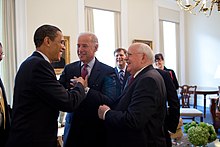 ](
Gorbachev (right) being introduced to US president Barack Obama by US vice president Joe Biden, March 2009. US ambassador to Russia Michael McFaul is pictured in the background.
In 2009, Gorbachev released Songs for Raisa, an album of Russian romantic ballads, sung by him and accompanied by musician Andrei Makarevich, to raise money for a charity devoted to his late wife.[495] That year, he also met with US president Barack Obama in efforts to "reset" strained US–Russian relations,[496] and attended an event in Berlin commemorating the twentieth anniversary of the fall of the Berlin Wall.[497] In 2011, an eightieth birthday gala for him was held at London's Royal Albert Hall, featuring tributes from Shimon Peres, Lech Wałęsa, Michel Rocard, and Arnold Schwarzenegger. Proceeds from the event went to the Raisa Gorbachev Foundation.[498] That year, Medvedev awarded him the Order of St Andrew the Apostle the First-Called.[494]
After Putin announced his intention to run for president in the 2012 election, Gorbachev was opposed to the idea.[499][500][501] He complained that Putin's new measures had "tightened the screws" on Russia and that the president was trying to "completely subordinate society", adding that United Russia now "embodied the worst bureaucratic features of the Soviet Communist party".[499]
In 2015, Gorbachev ceased his frequent international traveling.[502] He continued to speak out on issues affecting Russia and the world. In 2014, he defended the Crimean status referendum and Russia's annexation of Crimea that began the Russo-Ukrainian War.[485] In his judgment, while Crimea was transferred from Russia to Ukraine in 1954, when both were part of the Soviet Union, the Crimean people had not been asked at the time, whereas in the 2014 referendum they had.[503] After sanctions were placed on Russia as a result of the annexation, Gorbachev spoke out against them.[504] His comments led to Ukraine banning him from entering the country for five years.[505]
Russia can succeed only through democracy. Russia is ready for political competition, a real multiparty system, fair elections and regular rotation of government. This should define the role and responsibility of the president.
– Gorbachev, 2017[506]
At a November 2014 event marking 25 years since the fall of the Berlin Wall, Gorbachev warned that the ongoing war in Donbas had brought the world to the brink of a new Cold War, and he accused Western powers, particularly the US, of adopting an attitude of "triumphalism" towards Russia.[507][508] In December 2014, he said that both sides in the war in Donbas "have been violating the terms of the ceasefire; both sides are guilty of using dangerous types of weapons and violating human rights",[509] adding that Minsk agreements "form the basis for the settlement" of the conflict.[510]
In 2016, he said that "Politicians who think that problems and disputes can be solved by using military force—even as a last resort—should be rejected by society, they should clear the political stage."[511] In July 2016, Gorbachev criticized NATO for deploying more troops to Eastern Europe amid escalating tensions between the military alliance and Russia.[512] In June 2018, he welcomed the Russia–United States summit in Helsinki between Putin and US president Donald Trump,[513] although in October criticized Trump's threat to withdraw from the 1987 Intermediate-Range Nuclear Forces Treaty, saying the move "is not the work of a great mind". He added: "all agreements aimed at nuclear disarmament and the limitation of nuclear weapons must be preserved, for the sake of life on Earth".[514]
Following the death of former president George H. W. Bush in 2018, a critical partner and friend of his time in office, Gorbachev stated that the work they had both accomplished led directly to the end of the Cold War and the nuclear arms race, and that he "deeply appreciated the attention, kindness and simplicity typical of George, Barbara and their large, friendly family".[515]
After the January 6 United States Capitol attack, Gorbachev declared, "The storming of the capitol was clearly planned in advance, and it's obvious by whom." He did not clarify to whom he was referring. Gorbachev also stated that the attack "called into question the future fate of the United States as a nation".[516]
In an interview with Russian news agency TASS on 20 January 2021, Gorbachev said that relations between the United States and Russia are of "great concern", and called on US president Joe Biden to begin talks with the Kremlin to make the two countries' "intentions and actions clearer" and "in order to normalize relations".[517] On 24 December 2021, Gorbachev said that the United States "grew arrogant and self-confident" after the collapse of the Soviet Union, resulting in "a new empire. Hence the idea of NATO expansion". He also endorsed the upcoming security talks between the United States and Russia, saying, "I hope there will be a result."[518]
Gorbachev made no personal comment publicly on the 2022 Russian invasion of Ukraine. Although, on 26 February, his Gorbachev Foundation stated that "we affirm the need for an early cessation of hostilities and immediate start of peace negotiations. There is nothing more precious in the world than human lives."[519] At the end of July 2022, Gorbachev's close friend, journalist Alexei Venediktov, said that Gorbachev was very upset when he found out that Putin had launched an invasion of Ukraine. According to Venediktov, Gorbachev believed that Putin "destroyed his life's work".[520] Gorbachev's interpreter, Pavel Palazhchenko, also stated that Gorbachev was psychologically traumatized by the war before his death.[521][522]
Political ideology
...