Kokoschka
Name: Oscar Kokoschka
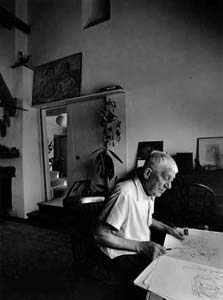
Achievements: German Expressionist artist whose work was banned by the Nazis for being “degenerate.”
Born: March 1, 1886; Pöchlarn, Lower Austria
Died: February 22, 1980; Montreux (Aged 93)
Field & Discipline: Art; Artist
Language: German
Father: Gustav (from a well known family of Prague goldsmiths whose family trade became a casualty of the Industrial Revolution)
Mother: Maria Romana (from a poor family of ten children who hailed from the mountain region of Styria and claimed to have second sight)
Siblings: two brothers; Bertha Theresia
Spouse: Olda Palkovská
Children: None
Education: Kunstgewerbeschule, or Vienna School of Arts and Crafts (1904-9)
Major Work:
Art
“Portrait of Karl Kraus” (Vienna, 1909)
“Portrait of Adolf Loos” (Vienna, 1909)
“Portrait of Auguste Forel, scientist” (1910)
“Still-life with Tortoise, Lamb and Hyacinth” (1910)
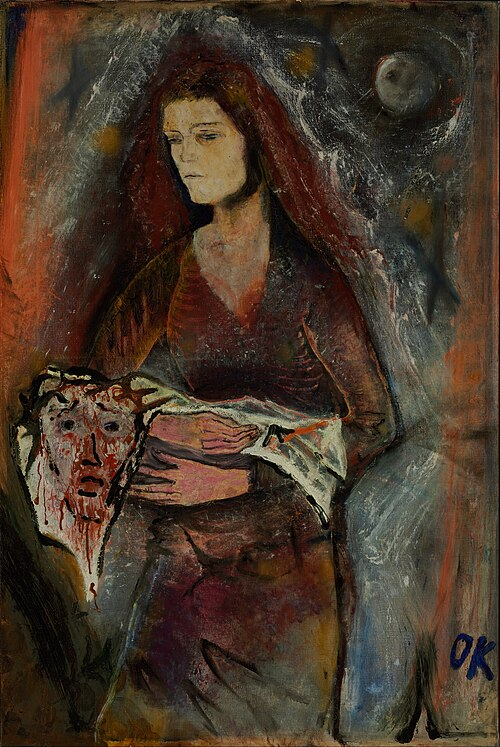
Veronica's Veil. 1911, (120,6 cm x 80,7 cm), Museum of Fine Arts, Budapest
Illustrations for the periodical, Der Sturm
“The Tempest, or Bride of the Wind” (1913)
“Knight Errant” (1914-5)
“Woman in Blue” (1919)
“Variationen über ein Thema” (Vienna, 1921)
“Large Thames View I” (1926)
“Schloss Wilhelminenberg with a View of Vienna” (1931)
“Portrait of the president, Tomás G. Masaryk” (1935-6)
“Self-portrait of a “Degenerate Artist“ (1937)
“Help the Basque Children” (1937)
“La Pasionaria” (1937)
“What We Are Fighting for” (1943)
“Saga of Prometheus” (1950)
“Thermopylae” (1954)
“Bekenntnis zu Hellas” (lithograph, London, 1961, published 1964)
“Die Odyssee” (lithograph, London, 1963-5)
“Apulia” (London, 1964)
“Marrakesch” (London, 1966)
“Saul und David” (London, 1969)
“Penthesilea” (Frankfurt am Main, 1970)
“Handzeichnungen 1906-1969” (New York, 1971)
“The Women of Troy” (London, 1973)
“Pan” (Hamburg, 1978)
Writings
“Mörder Hoffnung der Frauen, Murderer, Hope of Women” (play, Vienna, 1907-9)
“Die träumenden Knaben, or The Dreaming Youths” (Vienna, 1907-8)
“Sphinx und Strohamann, or The Sphinx and the Scarecrow” (1907, under the title "Hiob" in 1917)
“Der gefesselte Kolumbus” (Berlin, 1916)
“Mörder hoffnung der Frauen, or Murderer, Hope of Women” (Berlin, 1916)
“Der brennende Dornbusch” (Leipzig, 1917)
“Hiob” (Berlin, 1917)
“Orpheus und Eurydice” (Vienna, 1925)
“Comenius” (play, written 1935-72, filmed for television 1974)
“What We Are Fighting for” (1943; Zurich, Ksthaus)
“Ann Eliza Reed” (Hamburg, 1952)
“Thermopylae: Ein Triptychon” (Winterthur, 1955)
“Spur im Treibsand: Geschichten” (Zurich, 1956)
“A Sea Ringed with Visions” (London, 1962)
“Mein Leben” (Munich, 1971; Eng. trans., London, 1974)
“H. Spielmann, ed.: Oskar Kokoschka: Das schriftliche Werk, 4 vols” (Hamburg, 1973-6)
“Olda Kokoschka and H. Spielmann, eds: Oskar Kokoschka: Briefe, 4 vols” (Düsseldorf, 1984-8)
“Olda Kokoschka and A. Marnau, eds: Oskar Kokoschka: Letters 1905-1976” (London, 1992)
Set Design
“Mozart's Die Zauberflöte at the Salzburg Festival” (1955)
“Plays by Ferdinand Raimund at the Burgtheater in Vienna” (1960-62)
“Verdi's Un ballo in maschera in Florence” (1963)
“Opera house in Geneva” (1965)
Life & Times:
As a child, Kokoschka was given a picture book by [was influenced by] Komensky*. The ideas on Western civilization and thought contained within the book remained the basis of his ethical principles throughout his life.
A teacher who was impressed by his drawings recommended Kokoschka for a scholarship at the Kunstgewerbeschule in Vienna (1904-9), where he pioneered the use of life models in motion. Vienna was the center of Jugendstil (Art Nouveau) and Kokoschka's earliest work was influenced by the Secessionist style, whose leader Gustav Klimt he greatly admired and to whom he dedicated Die Träumenden Knaben (1907-8), a lyric text with eight color lithographs. In his later work, he broke away from Jugendstil to follow his own vision.
At a very young age, Oskar Kokoschka had realized that the eyes can reach much farther than the hands, and this belief led him to develop an approach to art that made visible the inner essence of his subjects, whether in portraits or landscapes.
Like many artists of his generation, Kokoschka also expressed himself through writings, music, and theater. The performances of his play Mörder Hoffnung der Frauen (1907-9), which depicts the battle of the sexes, caused a public outcry, as did his paintings shown at the Kunstschau exhibitions organized by Klimt in 1908 and 1909. These controversies led to his dismissal from the School of Arts and Crafts.
Through architect [a pal of] Loos*, Kokoschka received a series of portrait commissions, including magazine editor Karl Kraus (1909), poet Peter Altenberg (1909), Adolf Loos (1909) and Loos's companion Bessie Bruce (1910). The insight Kokoschka had into his sitters' personalities manifested itself in these paintings. Despite being branded a madman by critics, Kokoschka had a few supporters, such as Herwarth Walden, who engaged Kokoschka to provide ink illustrations for his periodical, Der Sturm.
In 1912 Kokoschka began an intense three-year love affair with [affair with] Alma Mahler*, nee Schindler, stepdaughter of Carl Moll, the widow of [knew] composer Gustav Mahler* and subsequently the wife of [knew] architect Gropius* and the poet and novelist Franz Werfel. Of the many works relating to Alma, the best known is: “The Tempest, or Bride of the Wind” (1913). Alma twice aborted his child and later severed their relationship. “Knight Errant,” which reflects his loneliness after the breakup, was Kokoschka's last painting before he volunteered for service in World War I.
In 1915, while serving on the Ukrainian front, Kokoschka suffered lung and head injuries. His lung healed after a few months, but his head injuries affected his equilibrium for the rest of his life. In 1916 he went to Dresden and attempted to overcome the pain of his unhappy affair with Alma.
He ordered a life-size effigy from the Munich doll-maker Hermine Moos, used it as a model for “Woman in Blue” (1919), and told the housemaid to spread rumors around town about the mysterious “silent woman”: for example, that he took her for carriage rides on sunny days and rented a box at the opera to show her off. As a finale, Kokoschka held a party during which the doll was paraded around and doused in red wine.
In 1919 Kokoschka was appointed a professor at the Kunstakademie in Dresden. He left Dresden in 1923 and spent the following decade traveling through Europe, from Britain to North Africa and the Near East. During this period he focused on townscapes, which were influenced by the work of Albrecht Altdorfer.
In the early 1930s Kokoschka returned to Vienna, where he painted pictures of the surrounding district, including Schloss Wilhelminenberg with a View of Vienna (1931), which was commissioned by city authorities.
After the establishment of an authoritarian corporate state in Austria, Kokoschka moved to Prague in 1935 and, at the suggestion of President [knew] Tomás Masaryk*, became a Czech citizen. There he met his future wife, Olda Palkovská. The removal of his pictures from German museums led him to paint Self-portrait of a “Degenerate Artist” (1937). He also produced several politically charged works in response to the Spanish Civil War of 1936-9, such as “Help the Basque Children” (1937). When the Nazis seized Czechoslovakia in 1938, Kokoschka and Olga left for London. There he continued commenting on the war through works such as “What We Are Fighting For” (1943).
Kokoschka became a British citizen in 1947. After the war he spent a few more years traveling through Europe and the USA before settling on Lake Geneva in Switzerland in 1953, where he painted portraits of the famous and turned to classical subjects in lithographs such as Bekenntnis zu Hellas (1961), Apulia (1963) and Die Odyssee (1963-5). He also designed stage sets and costumes for several plays, such as Mozart's Die Zauberflöte at the Salzburg Festival (1955).
From 1953 to 1963 he founded and directed the popular School of Seeing at the Internationale Sommerakademie für Bildende Kunst in Salzburg. He was recognized by several exhibitions and publications and received several high honors. The Oskar Kokoschka Documentary Archive was set up in 1973 in the house where Kokoschka was born. In 1975 he resumed his Austrian citizenship.
In 1988, eight years after his death, a commemorative foundation was established at the Musée Jenisch in Vevey, Switzerland.
Extra Connections:
He was acquainted with [knew] composer Arnold Schoenberg*.
He met [met] Joyce*,[met] Czechoslovakian politician Beneš*, [met] Toscanini*, and [met] T.S. Eliot*.
He painted [painted] Pound*
Assessment: Among his prodigious body of work, consisting of 485 oil paintings, about 5000 drawings, various watercolors, and 567 prints, mostly of portraits and cityscapes, German Expressionist artist Kokoschka is best known for The Tempest, or Bride of the Wind and for being banned by the Nazis for being a “degenerate” artist.
Oneliner: Oskar Kokoschka, German Expressionist artist
Bibliography:
- Briggs, A. (ed.) (1992). A Dictionary of Twentieth-Century World Biography. Oxford: Oxford University Press.
- Kokoschka, O. (1974). My Life, trans. by D. Britt. New York: Macmillan.
- Lachnit, E. “Kokoschka, Oskar,” The Grove Dictionary of Art Online, ed. L. Macy, [http://www.groveart.com]
- Lavallée, M. “Art Nouveau,” The Grove Dictionary of Art Online, ed. L. Macy, [http://www.groveart.com]
- Project AEIOU, [http://www.aeiou.at/aeiou.encyclop.k/k545050.htm]
- McGraw-Hill Encyclopedia of World Biography (vol. 6) (1973). New York: McGraw-Hill.
- Wintle, J. (ed.) (1981). Makers of Modern Culture. New York: Facts On File, Inc.