Joyce, J
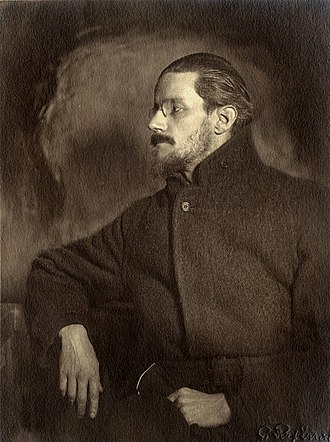
Name: James Joyce
Achievements: “Stream of consciousness” novels.
Nickname/Alias: None.
Born: 2nd February 1882, in Dublin, Ireland.
Died: 13th January 1941, in Zurich, Switzerland. Aged 59.
Writer.
Field & Discipline: Literature.
Language: English.
Father: John Stanislaus Joyce and Mary Jane Murray.
Siblings: 3 brothers, 6 sisters.
Spouse: Nora Barnacle.
Children: George and Lucia.
Education: Clongowes Wood College; Belvedere College, Dublin; University College, Dublin University.
Major Work:
“Portrait of the Artist as a Young Man” (1916)
“Ulysses” (1922)
“Finnegan’s Wake” (1939)
Life & Times:
Joyce graduated in 1902 and began to mix in Dublin’s literary circles, where he met the poet [encouraged by] Yeats*, who was impressed by his vitality and originality, and the fact that Joyce had an amusing awkwardness and lack of reverence for older writers.
After thinking briefly about a career in medicine, Joyce went to Paris, where he wrote book reviews and practised writing fiction. Back in Ireland in April 1903, he took several different jobs and moved around, at one time living in the Martello Tower at Sandycove, which is now the Joyce Museum.
In 1904, he began to write stories with an Irish background for a farming magazine, “The Irish Homestead.” After three of his stories had been printed, “The Sisters,” “Eveline” and “After the Race,” all written under the pseudonym Stephen Dedalus, the editor decided that Joyce’s work wasn’t suitable for a farming magazine.
At the same time, Joyce was working on a largely autobiographical novel, “Stephen Hero” and he had met and fallen in love with Nora Barnacle. He met her on June 16, 1904, which was the date he later used in his novel “Ulysses” as the day on which the whole action of the book takes place.
Having rejected Catholicism, as a matter of personal principle, Joyce wouldn’t marry, but he and Nora left Ireland, as a couple, for the European continent in October 1904.
After working as a teacher at the Berlitz language school in Pola in the Austro-Hungarian Empire, they moved to Trieste in 1905, where they were joined by Joyce's brother, Stanislaus. In 1906-7 Joyce earned money working in a bank in Rome, while he worked on his novel and wrote some short stories.
At this time, Joyce fell under the influence of new movements in European literature, including the Symbolists and the Realists and he re-wrote “Stephen Hero” in a much shorter form.
In 1909, Joyce took his collected stories to Ireland, in an attempt to get them published, at the same time working on a plan to set up a chain of cinemas. Neither scheme was successful, so he went back to Trieste.
A few years later, in 1913, Joyce received an unexpected letter from [encouraged by] Ezra Pound*, the American poet who was active in London and had heard of Joyce from Yeats. With the backing of Pound, Joyce was able to publish “The Dubliners” in 1914.
Italy joined World War I in 1915 and, although Stanislaus was interned by the Italians, Joyce and his family were allowed to go to Switzerland. They settled in Zurich, where he gave English lessons and worked on “Ulysses,” which he originally planned to write as a short story.
At this time, Joyce was beginning to suffer from glaucoma and he was worried about the mental state of his daughter Lucia, who was later diagnosed as schizophrenic. His living standard was slightly improved when Yeats and Pound persuaded the Royal Literary Fund to make Joyce a small grant.
A contact in Zurich introduced Joyce to an American philanthropist, Edith McCormick, [funded by daughter of] Rockefeller* Snr.’s daughter, who was in Zurich under the care of the analyst Carl Jung and who gave Joyce a monthly allowance.
Around the same time, the re-write of “Stephen Hero” appeared, serialized, in a magazine called “The Egoist,” under the title “A Portrait of the Artist as a Young Man.” Through Pound, Joyce had met Harriet Shaw Weaver, the editor, and, through her efforts, the book was published in the US and England, in 1916.
Reviews were good and in 1918, an American journal, “Little Review” began to publish extracts from “Ulysses,” but they eventually stopped at the end of 1920, when the book was banned for obscenity. Joyce had returned to Trieste in 1918 and, in 1920, he accepted an invitation to from Pound to visit Paris.
Two years later, Sylvia Beach, the English owner of the bookstore, “Shakespeare and Company,” published “Ulysses” in France, although it would not be published in England until 1936. Joyce had written the novel as a modern version of Homer’s “Odyssey” and the three main characters, Leopold Bloom, his wife Molly and Stephen Dedalus, depicted with great humanity, are Joyce's versions of Telemachus, Ulysses and Penelope.
With the whole of the story taking place on June 16th in Dublin, Joyce used the stream-of-consciousness technique, in which the true thoughts and feelings of his characters are written in minute detail, alongside their rational external speech.
“Ulysses,” which was to have a great impact on future writers, was a sensation in literary circles, hated by some, loved by others. Virginia [influenced] Woolf* hated it and argued with [influenced] T S Eliot*, who loved it, but she admired Joyce’s stream-of-consciousness approach and experimented with it herself.
In Paris, [influenced] Ernest Hemingway (https://app.thebrain.com/brain/f3e16344-7cd9-4fa3-ae1d-59876e128474/41c05678-d126-56d1-805b-4295956033f1)* loved it but [influenced] Stein* hated it, mainly because she had already started experimental writing and was jealous of Joyce for getting there first.
In 1931, Joyce worked on “Finnegan’s Wake” which, like all his work, he wrote and rewrote. The story, about an Irish bar owner and his family, and a celebration of Dublin and the River Liffey, was another experimental work.
Joyce experimented with language, used foreign words and introduced characters from history and literature, without reference to chronological order. Published in 1939, it was met with puzzled hostility.
The following year, when France was invaded by Germany, Joyce went back to live in Zurich in Switzerland.
Extra Connections:
Met film director [met] Eisenstein*.
[published by] Ford Madox Ford* published his work.
Samuel Beckett* ?
He influenced [influenced] William Carlos Williams* and [influenced] Perelman*
He met [met] W Archer*
His portrait was drawn by [portrait drawn by] John*
He met [met] Kokoschka*
Assessment: Joyce's work still generates controversy because of the experimental nature of his writing.
Oneliner: James Joyce, “stream of consciousness” writer
Bibliography:
- Gilbert, S., The Letters of James Joyce, vol 1, 1957.
- Ellmann, R., The Letters of James Joyce, vols 2 and 3, 1966.
- Ellmann, R., James Joyce, Oxford University Press, New York, 1959, (2nd edition, 1982).
- Burgess, A., Joysprick: An Introduction to the Language of James Joyce, 1975.