De Graaf
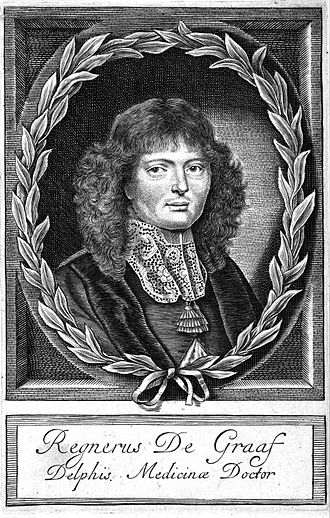
Name: Regnier de Graaf
Achievements: Discovered the follicles of the ovary
Born: July 30, 1641; Schoonhoven, Netherlands
Died: August 17, 1673; Delft, Netherlands (Aged 32)
Field & Discipline: Science; Medicine; Physiology
Language: Dutch
Education: University of Utrecht; University of Leiden
Major Work:
“De mulierum organis generationi inservientibus tractatus novus” (1672)
Life & Times:
At the University of Leyden De Graaf formed a close friendship with a fellow student, the naturalist [a pal of] Swammerdam*.
As early as 1664, while still a student, De Graaf was the first to obtain specimens of pancreatic juice by developing the method of the pancreatic fistula. To perform this groundbreaking operation, De Graaf inserted a plug of soft wood into the narrow end of a wild-duck quill, attached to which was a thread passing down the quill and hanging from its broad end.
He then opened the abdomen of a dog and then ligatured the duodenum above and below the entrances of the bile duct and the pancreatic duct. Next he inserted the narrow end of the quill into the pancreatic duct, and attached a small flask to its broad end, while the thread was brought out through a hole in the stopper of the flask. After closing the abdomen, De Graaf pulled the thread, and pancreatic juice began to drip from the quill into the flask.
This was a considerable technical advance, and de Graaf's dissertation on pancreatic juice, “De succi pancreatici natura et usu exercitatio anatomico medica”, published in Leiden in 1664, was immediately translated into French and reprinted many times. However, de Graaf's examination of the pancreatic juice proved disappointing, as he thought that the juice effervesced with the bile to remove viscid mucus (that might hinder absorption) from the wall of the stomach. He also thought that the juice might in some way separate the useful from the useless parts of the food.
During 1664-65 De Graaf spent some studying in Paris, France and then graduated in medicine at Angers in 1665. In 1667 he established himself as a well-known medical practitioner at Delft in the Netherlands.
During these years at Delft he mixed with the scientific and artistic elite, becoming particularly friendly with the microscopist [a pal of] Leeuwenhoek*, whom he introduced to the Royal Society of London by letter in 1673.
During the late 1660s De Graaf - like many of his famous contemporaries - became engrossed in the problem of reproduction and generation, and in 1668 he published a treatise on the male reproductive organs. This was followed by his most important work (1672), a treatise on the female reproductive organs which was much in advance of its time and constituted an important step in the history of biology.
After examining and dissecting the ovaries of numerous mammals, including human ones, De Graaf succeeded in isolating the ovarian vesicles with their envelopes. He also examined the ovary of a cow before and after mating, observing how its structure hanged, and followed rabbit pregnancy from mating until birth.
In this work De Graaf was able to give an accurate and concrete description of the anatomy and physiology of the female mammalian reproductive organs, adopted the name "ovary" for the female mammalian gonad, and described the ovarian follicle that contains an ovum undergoing maturation and which is named the Graafian follicle.
His work on the physiology of the ovary was greatly praised by such prominent scientists as [praised by] Boerhaave* in the 18th and [technique used by] Bernard* in the 19th centuries, and played a fundamental role in the development of modern sexual endocrinology.
Extra Connections: His theories were confirmed by [theory confirmed by] Cruikshank*
Assessment: A major contributor to reproductive physiology.
Oneliner: Regnier de Graaf, pioneer of reproductive physiology
Bibliography:
- Dictionary of Scientific Biography.
- Bayliss, W.M., Principles of General Physiology, London, 1924.
- Encyclopedia Britannica.
Father: Unknown
Mother; Unknown
Siblings: Unknown
Spouse: None
Children: None