Pershing
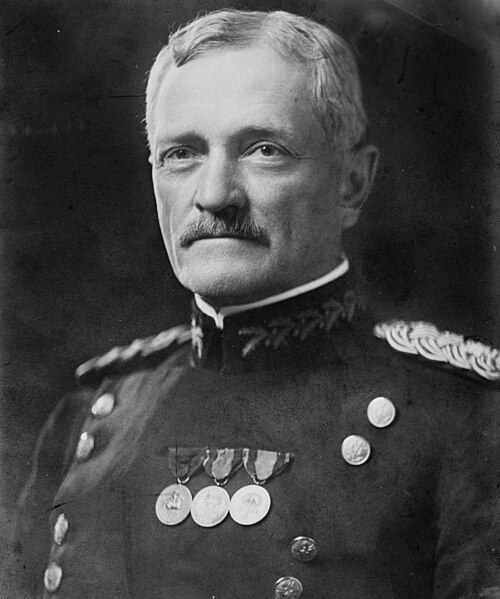
Nickname/Alias: “Black Jack”
Achievements: Improved US army training to better suit the times.
Born: September 13, 1860; near Laclede, Missouri
Died: July 15, 1948; Walter Reed Army Medical Center, Washington D.C. (Aged 87)
Field & Discipline: Military; Army General Staff; General
Language: English
Father: Father, John Fletcher Pershing
Mother: Ann Elizabeth Thompson
Siblings: James; Mae; Grace; Elizabeth; 4 others
Spouse: 1) Helen Frances Warren; 2) Micheline Resco
Children: Helen Elizabeth; Anne; Francis Warren; Mary Margaret
Education: State Normal School at Kirksville, Missouri; West Point Military Academy; University of Nebraska (Law)
Major Work:
“My Experiences in the World War” (1931, 2 Volumes, Frederick A. Stokes Co.)
Life & Times:
Out of seventeen applicants to West Point, Pershing was chosen to represent his state, and in 1882 he passed the entrance examination easily. Given the highest student honors, Pershing was chosen to lead the cadets when they paid tribute to Ulysses S. Grant’s funeral procession in 1885. In 1886, the year he graduated, he was elected president of his class.
In October, only four months after leaving the academy, he was posted to Fort Bayard, New Mexico as a 2nd Lieutenant in the 6th Cavalry Regiment. The 6th was soon ordered to hunt down a renegade Apache group led by Chief Magnus and Pershing was introduced to the realities of warfare.
Very quickly, the young officer grasped the concepts of mobile operations and he studied the hit-and-run tactics of the Native Americans. He learned also to study his opponent’s culture in order to better understand them. In 1890 while putting down the Sioux Ghost Dance rebellion, Pershing briefly commanded a troop of Oglala Indian Scouts and learned more about the problems faced by cavalry units operating in hostile territory.
Later that year Pershing was reassigned to be the Professor of Military Science and Tactics at the University of Nebraska. Seizing the opportunity to achieve a lifelong goal he studied law and graduated with his LL.B. in 1893.
Deciding the best opportunities lay in the army, he reenlisted in 1895. Posted to the 10th Cavalry, an African-American unit (Buffalo Soldiers) commanded by white officers.
In 1897, Pershing was appointed to the West Point tactical staff as an instructor, where he was assigned to Cadet Company A. Because of his strictness and rigidity, Pershing was unpopular with the cadets, who took to calling him a ruder nickname, later softened to "Black Jack" because of his service with the 10th Cavalry.
When the Spanish-American War finally erupted Pershing’s men were included in the battle group that invaded Cuba. The 10th supported the charge up San Juan Hill by [fought with] Theodore Roosevelt’s* Rough Riders, though subsequent duty in Cuba was uneventful.
He then he held various administrative positions within the army until 1899 when the indigenous Moro people of the Philippines rose against the U.S. presence. Pershing correctly decided that negotiations would work better than force.
In 1903 he was ordered to Washington and shortly afterwards met his future wife, Helen Francis Warren the daughter of a prominent Wyoming Senator. In 1905 Pershing was assigned to monitor and report on the fighting in the Russo-Japanese War and traveled to Manchuria with Gen. Arthur MacArthur.
Somewhat surprised by what he saw, the experienced soldier in him recognized the new style of warfare employed in the 20th century. In 1908 the Pershing family returned to the U.S. via the extended scenic tour of Western Europe including Russia, Germany, France and Britain. After a brief stay Pershing returned to the Philippines. The Moro rebellion had flared up once again. An overwhelming victory caused Pershing’s services to no longer be needed in the Philippines so in 1913 he and the family returned to America.
Assigned to command the 8th Brigade based at the Presidio in San Francisco, the unit was called to duty at Fort Bliss, New Mexico, to counter the cross-border incursions by Mexican bandits. The main antagonist in the region was the self-styled freedom fighter [ fought against] Villa*, who actually went to greet the new commander of the 8th.
On August 27th 1915 a fire took the lives of his wife and three daughters, sparing only his young son. In March 1916 “Pancho” Villa and his men raided the border town of Columbus, New Mexico causing American casualties and Pershing was ordered to command the “Punitive Expedition” detailed to track the bandit down. Pershing’s men pushed 350 miles into hostile territory defeating small bands of Villa’s men as they went.
In 1917 and Pershing was given command of the American Expeditionary Force. The initial command group made up of 200 men left for France on May 28th 1917 followed by small units of the U.S. 1st Infantry Division.
The Allied Commander-in-Chief, French General [had row with] Foch* wanted Pershing to turn his men over to British and French command, but Pershing refused. By early 1918 there were about 250,000 Americans in France. On March 21st 1918 the Germans opened a massive assault against the Allied lines using poison gas and specially trained shock troops. The Allies wavered and Foch again appealed to Pershing to release the Americans but again Pershing refused.
It wasn’t until June 1st, when the Germans were only 37 miles from Paris, that the general finally allowed a small scale operation under his direct command to be mounted at Chateau Thierry and Belleau Wood, both of which the Americans took and held.
By the end of June one million men were in the A.E.F. and Pershing was ready to join full-scale operations. American forces were given the assignment of breaking through the heavily fortified lines around St Mihiel.
Some 500,000 troops, 1500 aircraft and a small number of tanks, under the command of George Patton, attacked the Germans and within 36 hours had broken through. Marshal Foch eager to continue the rout, ordered Pershing to advance up both banks of the Meuse. Two weeks of heavy fighting were needed to overcome the Germans. Although Pershing’s personal feelings favored an unconditional surrender, the politicians made a brokered peace and the war was over at 11 a.m. November 11th 1918.
On September 13th 1924 Pershing’s military service came to an end but he still retained several offices in government buildings from which he could carry on with his various projects.
In December 1940 President Franklin D. Roosevelt asked Pershing if he would be the U.S. Ambassador to Vichy France, but he had to refuse because of poor health.
In 1946 “Black Jack” secretly married his wartime French mistress.
Assessment: Remembered for his long and distinguished military career culminating with his appointment to construct and command the American Expeditionary Force in France during World War I.
Oneliner: “Black Jack” Pershing, US Army General
Extra Connections:
Gangster Al Capone claimed he got a medal from Pershing to his pseudonym JV Hart.
Bibliography:
- Smith, Gene, Until the Last Trumpet Sounds, John Wiley & Sons, 1998.
- Smythe, Donald, Pershing; General of the Armies, Indiana University Press, 1986.
- Eggenberger, David, An Encyclopedia of Battles, Dover Publications, 1985.
- Arlington National Cemetery Website (www.arlingtoncemetery.com).
- West Point Military Academy Website (www.usma.edu).