Gilchrist P
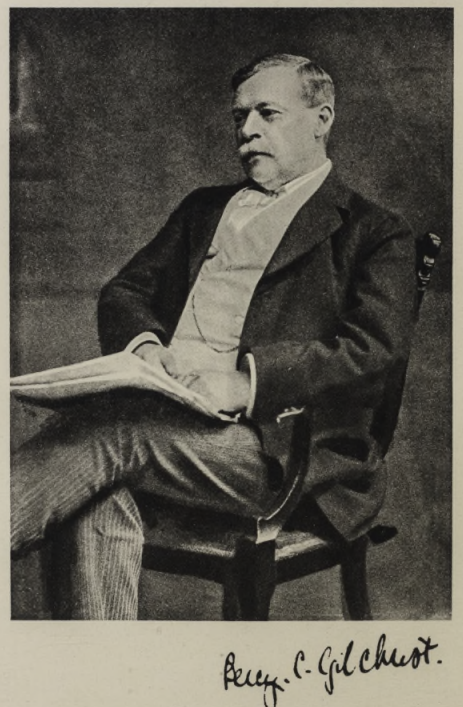
Full Name: Percy Carlyle Gilchrist
Achievements: Developed furnace liners that removed phosphorus.
Born: December 27, 1851; Lyme Regis, Dorset, England.
Died: December 15, 1935; Pinner, Middlesex, England (Aged 84)
Field & Discipline: Industry; Metallurgist
Language: English
Father: Alexander Gilchrist
Mother: Anne Burrows
Siblings: Herbert Harlakenden Gilchrist (painter) and two sisters
Spouse: Nora Fitzmaurice
Children: One son and one daughter
Education: Felsted School, Essex; Royal School of Mines, London
Life & Times:
Around 1855, Gilchrist’s parents moved to Chelsea in London and became close friends with their neighbour, writer [neighbor was] Carlyle*. Gilchrist studied metallurgy and analytic chemistry at the Royal School of Mines in London, where he won the Murchison Medal.
Around 1874, he worked as a chemist at an ironworks in Cwm Avon in Glamorgan, Wales, before being taken on by Edward Martin, manager of the Blaenavon ironworks in Monmouthshire, in a similar job. His cousin, Sidney Gilchrist Thomas, contacted him with an idea about how to deal with the problem of phosphorus in steelmaking. He had been told that if anybody could come up with a process to eliminate the problems caused by phosphorus in the Bessemer steel process, they would make a lot of money.
[improved process of] Bessemer* had discovered a low-cost means of steel production but development was being held up by the [solved problem of] phosphoric ores* used in the steelmaking process. Too much phosphorus in the steel made it brittle and Thomas wanted Gilchrist to help him work on solving the problem.
Reluctantly, Gilchrist agreed to use the laboratories of the Blaenavon works, first explaining the idea to Martin, because it would be impossible to do the work behind his back. Martin was interested and helpful and he paid for the development of Thomas's idea and the patents, on dephosphorisation, taken out in 1877 and 1878.
In 1878, Thomas presented a paper on the subject to the Iron and Steel Institute at a meeting in Paris. E. Windsor Richards, the manager at the steelmakers Bolckow, Vaughan & Company in the north of England, was at the meeting and then met Thomas on a visit to the Le Creusot works. Bolkow, Vaughan had built a pioneering steel plant in 1875, to make steel by the Bessemer process but, as the local Cleveland iron ores were high in phosphorus, they had to import foreign hematite ores.
If Thomas' invention could be made to work, they would be free of the expense of importing ore, so they offered the cousins a development package. Gilchrist moved to the north and worked with Thomas and the Bolkow, Vaughan staff to perfect the dephosphorisation process and, in 1879, they successfully removed the phosphorus from local ore and produced good steel.
The problem with the Bessemer process was that it used a blast of air to oxidise most of the waste products in iron, but it didn’t remove the phosphorous. Thomas and Gilchrist discovered the chemical conditions necessary to fix, in a stable form, the phosphoric acid produced by the oxidation of the phosporus in iron ore.
The chemical key was lime, so they exchanged the siliceous lining of the Bessemer converter with a lining made of burned limestone. The phosphoric acid combined with the lime to produce phosphate of lime, which was then deposited as slag. A side benefit was that the phosphorus-rich slag was an agricultural fertilizer.
In 1881, Thomas and Gilchrist set up their own steel works in Middlesborough, where Gilchrist managed the practical work and Thomas dealt with the marketing and business side. Thomas became ill in 1882 and died three years later and Gilchrist took over as managing director of the company set up by the patentees.
For many years, he was active in the steel industry, promoting improvements in steel-making using both the Bessemer convertor and open-hearth furnaces.
Extra Connections: [influenced by] Liebig, Justus* pioneered the study of phosphoric compounds.
He or his family had him admitted to well-appointed private asylum, Holloway Sanatorium from 5 March 1899 for just under one year, then discharged into single care.[4] Noted are "eccentricities" and his role as an inventor.
He was elected vice-president of the Iron and Steel Institute and in 1891 a Fellow of the Royal Society.[5]
Assessment: Thomas and Gilchrist's discovery of how to dephosphorize iron ore opened up the development of steelmaking and was of great importance in the European areas rich in phosphoric ores.
Oneliner: Percy Gilchrist, who improved steel-making
Bibliography:
- Jeremy, David J, ed., Dictionary of Business Biography, Butterworths, London, 1984.
- Dictionary of National Biography, Oxford University Press.
- FRS Obituary