Liebig, Justus
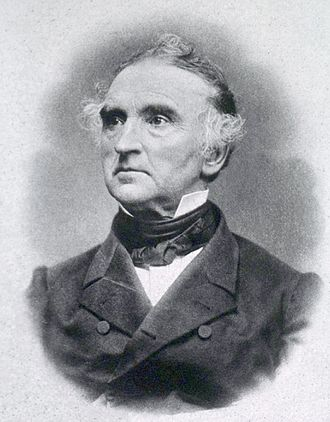
Name: Freiherr (baron) Justus von Liebig
Achievements: German organic chemist, pioneer in the training of chemists and in agricultural chemistry, who was one of the greatest influences on 19th-century chemistry.
Born: May 12, 1803; Darmstadt, Hesse, Germany
Died: April 18, 1873; Munich, Germany (Aged 69)
Field & Discipline: Science; Organic Chemistry; Chemist
Language: German
Father: Johann Georg Liebig
Mother: Maria Karoline Moserin
Siblings: One elder, seven younger siblings
Spouse: Henriette Moldenhauer (m. 1826)
Children: Georg; Hermann; Agnes; Johanna; Marie
Education: University of Bonn (1820-21); University of Erlangen (1821-22);
University of Paris (1822-24)
Major Work:
“Organic Chemistry” (1840-43)
Life & Times:
In 1820 Liebig's parents sent him to the University of Bonn to study under the leading chemist of the day, Karl Wilhelm Gottlob Kastner. When Kastner moved to the University of Erlangen, Liebig accompanied him and received his doctorate there in 1822, aged only 19.
On his return to Darmstadt, armed with a letter of recommendation from Kastner to the Hessian government, he received a grant to study in Paris, where he met the young chemist [met] Runge*, attended the lectures of [lectured by] Gay-Lussac*, [lectured by] Thenard and Pierre Louis Dulong, and continued his investigations of the fulminates (begun in Erlangen), which were so successful that Gay-Lussac presented his results to the Paris “Academie” in July 1823.
During this meeting, [a fan was] Alexander von Humboldt* was so impressed by the work of the young chemist that he persuaded Gay-Lussac to accept Liebig as an assistant in his private laboratory at the Arsenal (summer 1823-early 1824).
Again on the recommendation of Humboldt, in 1824 Louis I of Hesse appointed Liebig extraordinary professor of chemistry at the small University of Giessen, near Frankfurt, where he became professor two years later and stayed for the next 28 years.
At Giessen, Liebig first devoted himself to the establishment of a teaching laboratory based on his experiences with Gay-Lussac, where students could learn the methods of qualitative analysis as the basis for an entirely systematic approach to chemical research. Here Liebig not only created an entirely new series of courses in chemistry, but also invented appliances for analysis by combustion and popularized the “Liebig’s condenser” (still used in many laboratory distillations).
The laboratory, the first institution of its kind, and the instruction given by Liebig soon became the model for the training of chemists throughout Germany, and over the following decades Giessen produced a large number of well-qualified chemists who would form the backbone of Germany's successful industrial chemical industry. Inevitably, before long Liebig's laboratory began attracting students from all over Europe, including such notables as [taught] Hofmann*, [taught] Bunsen, [taught] Kekule*, [taught] Meissner*, [taught] Sobrero*, and [taught] Lyon Playfair*.
In 1825, Liebig began working with his students and assistants on investigations into the preparation of known inorganic substances. A year later he read a paper by another German chemist, [influenced by] Wohler*, containing an analysis of silver cyanate in which he had assigned the identical formula given a few years earlier by Liebig and Gay-Lussac to silver fulminate.
Fascinated by this unusual result, Liebig confirmed Wohler's discovery, thereby establishing the important new idea that two chemical compounds with entirely different properties could have the same elementary compositions, and stimulating [influenced] Berzelius'* work that led to the concept of isomers.
During the late 1820s, Liebig then began a long collaboration with Wohler, first investigating the isomerism of cyanic acids, and in 1832 examining oil of bitter almonds (benzaldehyde phenylmethanal), which led to their discovery of the benzoyl radical.
They also showed that benzaldehyde can be converted to benzoic acid and other related compounds - e.g. benzyl alcohol and benzoyl chloride - and through these experiments
deduced that this chemical (i.e. benzoyl) group could persist unchanged through such a great variety of reactions because of the stability given it by the benzene ring.
The benzoyl group was named by Liebig and Wohler a "compound radical,” an entirely novel idea in organic chemistry which aroused much bitter dispute from the chemists Berzelius and [argument with] JBA Dumas*, particularly as Liebig and Wohler were unable to find other such radicals to support their theory.
Nevertheless, the radical theory marked the first attempt to introduce a degree of systematization into the confused field of organic chemistry, and Liebig continued this systematization by the development of certain other methods of organic analysis, most notably his simple method for analytically determining carbon, hydrogen and halogens in organic compounds.
Meanwhile, during the early 1830s, with the aid of a sample of "ether-like" fluid sent to him by the chemist [collaborated with] Dobereiner*, Liebig also became the first to synthesize chloroform (1831) and the sedative-hypnotic drug chloral hydrate (1832), and in 1832 founded the journal “Annalen der Pharmacie,” which in 1840 was renamed “Annalen der Chemie” and became (and remains) one of the major international chemical journals (publishing, for example, important works by the Italian chemist [published] Avogadro*).
From 1838, Liebig interests began to move away from pure organic chemistry to the chemistry of plants and animals - i.e. what is now known as biochemistry. During the next two years, he made extensive studies of fermentation and sepsis (although his persistent adherence to the mistaken view - shared with Berzelius - that neither yeast nor sepsis were living substances would bring him into direct conflict with the ideas of [conflicted with] Pasteur*, [conflicted with] Billroth*, and, later, Joseph [conflicted with] Lister*) and of various body fluids and urine (following on from the work of, among others, the English chemist [work related to] Wollaston*).
He also made a large number of investigations and analyses of the nitrogenous products of the animal organism, which he recorded in his important work “Animal Chemistry” (1842).
These studies led Liebig to consider the nutritional value of certain foods for the animal organism and, convinced that fats were the major source of dietary energy, he calculated the calorific value of a large number of foods, devised recipes for broth for the sick, rye bread, baking powder and malt soup, and even developed a beef extract - long marketed as “Liebig extract of beef” - which became an important nutritional supplement for the poor.
Through these investigations, Liebig also became greatly interested in the application of chemical knowledge to agricultural problems, and in 1840 he published perhaps his most famous work, “Die organische Chemie in ihrer Anwendung auf Agrikulturchemie und Physiologie” (“Organic Chemistry in Its Application to Agriculture and Physiology,” 1843), starting the systematic development of the agricultural sciences.
In particular, he rejected the prevalent theory that humus supplied plants with food, and showed instead that plants absorb minerals and water from the soil and carbon from carbon dioxide in the air.
He also believed that ammonia in rain water passed into the soil and provided plants with their only source of nitrogen, and although this idea would prove incorrect it was directly responsible for his advocation of the use of artificial mineral fertilizers in agriculture (in place of animal manure), in order to supply certain essential elements - in particular potassium and phosphoric acid, which he obtained from [investigated] phosphoric ore* - that might become depleted in the soil (although his original formulation omitted essential nitrogen compounds).
Soil treated with such artificial fertilizers were shown to produce higher yields, and almost immediately his ideas were therefore adopted by certain progressive agriculturalists across Europe, most notably [influenced] Lawes*, who set up a factory in London for the manufacture of “super-phosphates” in 1842.
Liebig's scientific approach to agriculture also led to the development of a system of agricultural education across Europe and North America, comprising secondary and post-secondary instruction, in which the old empirically-based training centres were replaced by agricultural schools which taught agricultural and the natural sciences using Liebig's methods and textbooks, including a further work, “Agricultural Chemistry” (1855).
As a result of his international renown, in 1845 Liebig was made a baron, and in 1852 he was appointed professor of chemistry at the University of Munich, where he remained until his death.
At Munich, Liebig spent less time in the laboratory, although he continued to improve certain items of experimental equipment - in 1856 inventing a process for forming a mirror-like layer of silver on polished glass (used by [work related to] Steinheil* as a new method for making reflectors for telescopes), and in 1858 collaborating with [collaborated with] Geissler* on the experimental use of "Geissler tubes.”
However, he increasingly lost interest in experimental work, refusing to accept any new students and devoting himself to writing and to frequent controversies with other (generally younger) scientists.
From this point, now regarded as the final authority in chemical matters, Liebig became increasingly rigid and dogmatic in his views, and developed a reputation as a merciless and often arrogant opponent, only admitting an error when the matter was no longer in the public eye.
He died, aged 69, in Munich in 1875, and was succeeded as professor of chemistry at the University of Munich by [succeeded by] Baeyer*. The university at Giessen now bears Liebig's name, and his famous laboratory has been preserved as a museum.
Extra Connections: He influenced [influenced] Jefferson*; [influenced] Ludwig*, [influenced] Gilchrist*, [influenced] Muspratt*, and [influenced] Schleiden*
Assessment: One of the most illustrious scientists of his age.
Oneliner: Justus von Liebig, discoverer of fertilizer
Bibliography:
- Abbot, David (ed.), The Biographical Dictionary of Chemists' London: Blond Educational: London, 1983.
- Dictionary of Scientific Biography.
- Encyclopedia Britannica.
- Haber, F., "Justus von Liebig" in Great Chemists'(ed. Edouard Farber), New York & London: Interscience Publishers, 1961.
- Moulton, F.R. (ed.), Liebig and After Liebig, Washington, D.C: American Association for the Advancement of Science, 1942.