Goddard, Robert
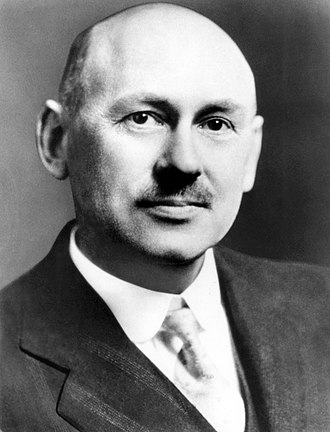
Full Name: Robert Hutchings Goddard
Achievements: The father of modern rocketry
Born: October 5, 1882; Worcester, Massachusetts
Died: August 10, 1945; Baltimore, Maryland (Aged 61)
Field & Discipline: Engineering; Astronautics; Physics
Language: English
Father: Nahum Danford Goddard
Mother: Fannie Hoyt
Siblings: None
Spouse: Esther Christine Kisk
Children: None
Education: Boston High School; South High School, Worcester, Massachusetts;
Worcester Polytechnic Institute; Clark University, Worcester, Massachusetts
Major Work:
"A Method of Attaining Extreme Altitudes"
Life & Times:
When he was 16, Goddard’s imagination was fired by [inspired by] H.G. Wells’* science-fiction novel "War of the Worlds". On October 19, 1899, a day that became his "Anniversary Day," he climbed a tree in his backyard and, as he wrote in his diary, "imagined how wonderful it would be to make some device which had even the possibility of ascending to Mars."
Goddard accomplished an important portion of his work on rocketry at Clark University. In 1909 he began to make detailed studies and calculations of liquid-propellant engines, coming to the conclusion (like Russian aerospace engineer [paralleled work of] Tsiolkovsky*) that liquid hydrogen and liquid oxygen would be an ideal combination for a propellant.
During a year at Princeton, Goddard continued to study rocket propulsion, believing his work would lead to space exploration and discovery. His experiments and theories resulted in a succession of patents in 1914, covering combustion chambers, nozzles, propellant feed systems, and multistage rockets.
As the First World War approached, Goddard was testing simple powder rockets, some of which reached altitudes up to 500 feet. In 1916, he applied to the Smithsonian Institution, and in early 1917, got a grant of $5000. He postponed his new experiments to go to California to work on military rockets, including a forerunner of the Second World War bazooka.
Goddard's first monograph was published by the Smithsonian in 1920, and caused a sensation. "A Method of Attaining Extreme Altitude" was a treatise on the basics of rocketry that is now considered a classic of space-science literature. It described Goddard's early experiments; discussed the concept of multi-stage rockets; and included computations showing that a rocket equipped with an efficient engine and appropriate propellants can travel to great heights.
He added notes about the possible use of hydrogen and oxygen as propellants, and the probability of collision with meteors. The last section of the book, "Calculation of Minimum Mass Required to Raise One Pound to an 'Infinite' Altitude", speculated, almost as an afterthought, that it would one day be possible to send a rocket to the
moon.
Newspapers seized on the "moon" statement and turned the quiet professor from Massachusetts into the crazy "Moon Man". Reporters from all over the country flocked to his door. Most were out to make a fool of Goddard, and it made him suspicious of publicity for the rest of his life.
However some American scientists (and a larger number of European ones) took Goddard seriously. Inventor [visited] Alexander Graham Bell*, for one, had thought of using rockets to power a hydrofoil boat he was in developing, and he paid Goddard's way to visit him in Washington DC in 1920.
Goddard's money from the Smithsonian was gone by the summer of 1920, but the Institute promised another $3,500. Goddard went to work for the U.S. Navy's Bureau of Ordnance in Maryland, where he spent three years experimenting on rocket depth-charges and rocket-boosted armor-piercing projectiles.
From his small lab in Worcester, he was the first to prove that thrust and consequent propulsion can take place in a vacuum.(1915). He was the first to explore mathematically the ratios of energy and thrust per weight of various fuels, including liquid oxygen and liquid hydrogen (1919).
He was also the first to develop a rocket motor using liquid fuels (liquid oxygen and gasoline), as used in the German [inspired] V-2 missile* 15 years later (1920-25). In a small structure adjoining his laboratory, he proved in a static test in 1925 that a liquid-propelled rocket could operate satisfactorily and lift its own weight.
On March 16, 1926, the world's first flight of a liquid-propelled rocket engine took off from Goddard's Aunt Effie's farm in Auburn, Mass., achieving a brief lift-off. German physicist [sent copy of work to] Oberth*, who had heard of Goddard's monograph and had written him for a copy in 1922, published his space-flight treatise, "Die Rakete zu den Planetenrumen (The Rocket into Planetary Space)" in 1923.
In 1929, following an aborted and noisy flight test that brought considerable notice to the publicity-shy inventor, famous aviator [supported by] Lindbergh*, who had visited Goddard at Worcester, helped raise $50,000 for Goddard's experiments.
From 1930 to the mid-40’s, the Guggenheim Fund for the Promotion of Aeronautics financed his work on a scale that made possible a small shop and crew and experimental flights in the open spaces of the American southwest, at Mescalero Ranch, near Roswell, New Mexico.
Goddard spent most of his remaining days at Roswell. From 1930 until 1941, Goddard worked alone. He became the first to shoot a liquid-fuel rocket faster than the speed of sound (1935). He obtained the first patents for a steering apparatus for the rocket machine. His small rockets, early prototypes of the modern moon-thrusters, achieved altitudes of up to 1.6 kilometers (one mile) above the earth.
During the Second World War Goddard closed his Roswell site and contributed to the war effort by working on a jet-thrust booster for seaplane takeoff for the U.S. Navy at Annapolis, Maryland.
Goddard died of throat cancer in 1945, on the threshold of the age of jets and rockets. Years later, his work was acknowledged by the United States government when a $1 million settlement to his wife and the Guggenheim Foundation was made for the use of his patents.
Extra Connections: He inspired [inspired] von Braun 2*
Assessment: Goddard pioneered modern research into rocketry.
Oneliner: Robert Goddard, pioneer of spaceflight
Bibliography:
- Biographical Dictionary of Scientists: Engineers and Inventors.
- Coil, Suzanne M., Robert Hutchings Goddard: Pioneer of Rocketry and Space Flight, New York & Oxford, UK: Facts on File, 1992.
- Encyclopedia Britannica.
- Von Braun, Wernher and Frederick I. Ordway III, History of Rocketry and Space Travel, London: Thomas Nelson and Sons, 1966.