Oberth
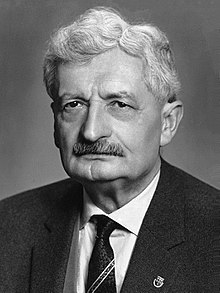
ACHIEVEMENT(S): One of the founders of modern astronautics
DATE AND PLACE OF BIRTH: June 25, 1894, Hermannstadt, Transylvania,
Austria-Hungary (now Sibiu, Romania)
DATE/PLACE/AGE AT DEATH: December 29, 1989, Nurnberg, Germany. Aged 95
DISCIPLINE: Rocket engineer
FIELD: Astronautics
EDUCATION: Schassburg elementary school and Gymnasium; University of Munich
MAJOR WORK: "Die Rakete zu den Planetenrumen” (The Rocket into Interplanetary Space)
LIFE AND TIMES:
At the age of 11, Oberth read the Jules Verne science-fiction books, "From the Earth to the Moon" and " Travel to the Moon", which inspired in him a fascination for space flight. In 1913, at 19, Oberth entered the faculty of medicine at the University of Munich, but also attended lectures in physics and related subjects at a nearby technical institute. His studies were interrupted by the First World War. After leaving the army, Oberth began to work on how to achieve space flight.
In 1918, his proposal for a long-range rocket powered by ethyl alcohol, water, and liquid air, somewhat similar to the V-2, was rejected by the German Ministry of Armaments. The following year he began at the University of Heidelberg, but, in 1922, his doctoral thesis on rocket design and space-flight theory was rejected.
Oberth taught physics and mathematics at a girls' teacher-training school in Schassburg from 1922 to 1923, when the University of Klausenburg offered him a professorship.
In 1923, Oberth published his rejected doctoral thesis as "Die Rakete zu den Planetenrumen” (The Rocket into Interplanetary Space). In it, Oberth set forth the basic principles of space flight and discussed possible solutions to a number of problems. He advocated the use of liquid fuels, such as oxygen and hydrogen (liquid hydrogen and liquid oxygen having first been produced on a large scale by Dewar* in 1898.) He discussed the use of propellants for different stages of rockets, and the employment of successive stages that would disengage as their propellants were used up. He also speculated on the effects of space flight on humans, and proposed the idea of a space station.
The book gained Oberth widespread recognition, and put him in contact with other scientists working in the same field. It was read, for example, by the future German rocket scientist Wernher von Braun*.
In 1922, Oberth came to learn of the work of American physicist Goddard*, and in 1925, of the work of Soviet aerospace engineer Tsiolkovsky*. After corresponding with both, he acknowledged that they had preceded him in deriving the equations associated with space flight.
Oberth's "Wege zur Raumschiffahrt” (Ways to Spaceflight), an expanded version of the early book, won the first annual Robert Esnault-Pelterie-Andr Hirsch Prize, which paid him enough (10,000 francs) to finance his research on liquid-propellant rocket motors. The book anticipated by 30 years the development of electric propulsion and of the ion rocket.
One of the most important consequences of the book was the formation of the German Rocket Society ("Verein fur Raumschiffahrt") in Berlin, in 1927. Its purpose was to raise money for Oberth's rocket experiments. The society also provided practical training for its members, including von Braun, who later became part of the German Army's rocket center and helped develop the V-2 guided missile.
When German film director Fritz Lang made a fantastical movie about space travel: Frau im Mond (Woman on the Moon") he hired Oberth as technical adviser.
Oberth's main contributions to rocketry were his theories and the publicity he generated for space travel during the 20’s. He launched one rocket in 1935, but after 1930, he remained outside the mainstream of rocket development. In 1941 he took a job working under von Braun at the German rocket development centre at Peenemunde, on the Baltic. In 1943, he began work on an anti-aircraft rocket, using a solid propellant and was soon transfered to a firm that dealt in solid fuels, Westfalisch-Anhaltische Sprengstoff A.G., where he worked until the end of the war.
After the Second World War, Oberth moved to Feucht, near Nurnberg, West Germany. In 1948-49, he spent a year in Switzerland as a rocket consultant. In 1950, he was hired by the Italian Navy to develop a solid-propellant anti-aircraft rocket, but the project was discontinued in 1953. In 1954, Oberth published "Menschen im Weltraum” (Men into Space), in which he discussed electric spaceships and a vehicle for traveling on the moon. In 1955, he published "Das Mondauto” (The Moon Car), in which he elaborated on the ideas outlined in the previous book.
In 1955, von Braun got Oberth a job with the U.S. Army Ballistic Missile Agency (ABMA) at Redstone Arsenal in Huntsville, Alabama. Oberth was involved in planning for electrical and thermonuclear propulsion for rockets, guidance devices, and vehicles for the moon.
Oberth is believed to have inspired the Lunar Rover used on the NASA Apollo* 15 flight to the moon. In 1958, Oberth returned to Feucht, where he resided for the rest of his life, spending his retirement engaged in theoretical studies.
In July, 1969, he returned to the United States to watch the launch of Apollo 11.
ASSESSMENT: Oberth is one of the acknowledged Fathers of Space Flight.
EXTRA CONNECTIONS: He was influenced by HG Wells* ; hired by filmmaker Fritz Lang
ONELINER: Hermann Oberth, early spaceflight pioneer
BIBLIOGRAPHY:
EB Gartmann, Heinz,The Men Behind the Space Rockets,London: Wyman & Sons, 1955
Hunley, J.D., "Hermann Oberth", in Notable Twentieth Century Scientists, Vol. 4, New York: Gale Research Inc., 1995
Von Braun, Wernher and Frederick I. Ordway III, History of Rocketry and Space Travel, London: Thomas Nelson and Sons, 1966
Multimedia:
NASA Stole the Rocket Countdown From a 1929 Fritz Lang Film:
http://www.atlasobscura.com/articles/nasa-stole-the-rocket-countdown-from-a-1929-fritz-lang-film-1d569cc0-50ff-4045-b0c9-1f0d72a193db
LANGUAGE: German
PARENTS: Dr. Julius Gotthold Oberth; Valerie Emma Krassner
SIBLINGS: None
SPOUSE: Mathilde Hummel
CHILDREN: Julius; Ilse; Erna; Adolf