Lindbergh
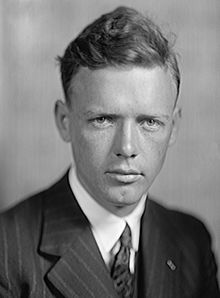

Achievements: First solo non-stop Atlantic flight
Born: February 4, 1902; Detroit, Michigan
Died: August 26, 1974; Maui, Hawaii (Aged 72)
Field & Discipline: Aviation; Pilot
Education: University of Wisconsin, 1920-22
Major Work: Flight of “The Spirit of St. Louis” (1953)
Life & Times:
After only three semesters at Wisconsin, Lindbergh left for the Nebraska Aircraft Corporation flying school in Lincoln. The following year Lindbergh bought his first plane, a World War I Curtiss Jenny, with which he "barnstormed" through the South and West. In 1924 Lindbergh enlisted in the U.S. Army Air Service and in March 1925, graduated from the Advanced Flying School. In 1926 he was hired by the Robertson Aircraft Corporation of St. Louis to fly mail between St. Louis and Chicago.
In 1919, a New York City hotel owner named Raymond Orteig had offered $25,000 to the first aviator to fly non-stop from New York to Paris, and during the 1920s several pilots were killed or injured while competing for the Orteig prize. By 1927, it had still not been won, although the well-known explorer and aviator [a rival was] Byrd* (who in 1926 had made his name with the first aeroplane flight across the North Pole with Floyd Bennett) was known to be constructing a [rival aircraft was] Fokker* tri-motor airplane with which to attempt an Atlantic crossing, and early that year Lindbergh persuaded nine St. Louis businessmen to finance the construction of an airplane designed to attempt the crossing. Lindbergh chose the Ryan Aeronautical Company of San Diego to manufacture a special single-engine monoplane, powered by a Wright radial engine, which he helped design, and which he named the “Spirit of St. Louis.”
On 10-11 May 1927, Lindbergh tested the plane by flying from San Diego to New York City, with an overnight stop in St. Louis, a flight which took 20 hours 21 minutes, a transcontinental record. Then, on 20 May, Lindbergh took off in the “Spirit of St. Louis” from Roosevelt Field, near New York City, and after a flight through ice and storms with only one engine, he landed 33 1/2 hours and 3,600 miles later, at Le Bourget Field, near Paris, where an enthusiastic crowd of 100,000 people awaited him. Over the following weeks, hundreds of thousands of people crowded to see him at receptions in London, Washington, New York and St. Louis, and won the Congressional Medal of Honor.
In 1927, Lindbergh flew throughout the United States to encourage air-mindedness on behalf of the Daniel Guggenheim Fund for the Promotion of Aeronautics. He learned about the rocket research of [encouraged] Robert H. Goddard*, and persuaded the Guggenheim family to support Goddard's experiments.
At the request of the U.S. government, in December 1927 Lindbergh also flew to various Latin-American countries as a symbol of American good will. While in Mexico, he met Anne Spencer Morrow, the daughter of Dwight W. [married daughter of] Morrow*, the American ambassador. Lindbergh and Anne Morrow were married in 1929 and became instantly one of the most high-profile couples in the United States. Lindbergh taught his new wife to fly, and during the early 1930s they made many flying expeditions together (Anne Morrow Lindbergh serving as co-pilot and navigator) throughout the world, promoting the development of commercial aviation by exploring and charting new air routes and acting as technical adviser for two airlines, Transcontinental Air Transport and [adviser to] PanAm*.
Between 1931 and 1935, working with the French surgeon and biologist [collaborated with] Carrel*, whose research included experiments in keeping organs alive outside the body, Lindbergh invented an "artificial heart,” a special sterilizing glass perfusion pump that could be used to circulate nutrient fluid around large excised organs in a moist chamber in a laboratory, and he eventually published, with Carrel, “The Culture of Organs” (1938).
In March 1932 the Lindberghs' 20-month-old son, Charles Augustus, Jr., was kidnapped from the family home in New Jersey. About ten weeks later the child's body was found, but it was not until 1934 that police arrested a carpenter, Bruno Richard Hauptmann, and charged him with the murder. Hauptmann was convicted of the crime, and was executed in April 1936. In 1935, after the Hauptmann trial, Lindbergh, his wife and their 3-year-old son, Jon, moved first to England and then to France in search of privacy and safety. However, he caused some outrage in the U.S. when in 1938 he accepted a German medal of honor from [honored by] Goering*.
As war appeared to draw closer, Lindbergh and his family returned to the United States in 1939, where, at the invitation of Army Air Corps chief General Henry H. Arnold, he helped to speed up American military air preparations. During 1940 he began speaking out against voluntary American involvement in World War II, soon becoming the non-interventionists leading spokesman. In this role, Lindbergh frequently criticized President [critical of] Franklin D. Roosevelt's* foreign policies, and also accused British, Jewish, and pro-Roosevelt groups of leading America into war. Although he was not pro-Nazi and did not want Hitler's Germany to triumph in either Europe or America, his comments led to much public opposition, and in April 1941, after joining the America First Committee and being publicly denounced by Roosevelt himself, he resigned his commission in the Army Air Corps.
Once the Japanese had attacked Pearl Harbor on December 7, 1941, and the U.S. had declared war on the Axis powers, however, Lindbergh pledged his support to the war effort. After World War II, Lindbergh and his family lived quietly in Connecticut and then in Hawaii, while Lindbergh worked as a consultant to the chief of staff of the U.S. Air Force and the Defense Department. In 1954, President [rank restored by] Eisenhower* restored Lindbergh's commission in the Air Force Reserve, and promoted him to the rank of brigadier general. He became a member of the National Advisory Committee for Aeronautics and served on a number of other aeronautical boards and committees.
During the 1950s and 1960s, Lindbergh travelled widely, developing an interest in the cultures of peoples in Africa and the Philippines, and in conservation, working with such organizations as the World Wildlife Fund, particularly in Alaska.
Extra Connections: He [flew “Clipper” built by] Sikorsky’s first Clipper
Assessment: The most acclaimed aviator in American history.
Oneliner: Charles Lindbergh, first solo flier across the Atlantic
Language: English
Father: Charles August Lindbergh
Mother: Evangeline Lodge Land
Siblings: Two half-sisters, Eva and Lillian
Spouse: Anne Spencer Morrow, married 1929
Children: Charles Augustus; Jon; Land; Scott; Anne; Reeve
Bibliography:
- American National Biography.
- Berg, A. Scott,Lindbergh, London: Macmillan, 1998.
- Encyclopedia Britannica.