Blood Typing
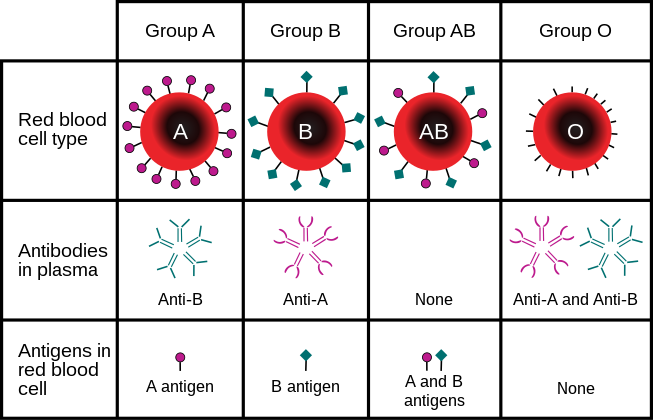
Red blood cell compatibility chart
Details:
The classification of blood by its make-up of red blood cells is called blood-typing. It is necessary for a safe blood transfusion since only certain blood types are compatible and mixing the wrong types can cause illness and death. [discovered by]Landsteiner*, a German pathologist, was responsible for discovering blood typing.
In 1900, while experimenting with mixing blood, he discovered that there are marker proteins, or antigens, on the surfaces of red blood cells. He found two type of antigens and called them A and B. He identified the ABO blood groups, and found that a person’s blood type depends on the antigens present.
Everybody has blood of either type A, type B, type AB, or type O (no antigens present) blood.In 1940, while experimenting with Rhesus monkeys Landsteiner discovered another blood group:- the Rhesus factors, or RH factors. The most important factor is the D antigen, found in 85% of the population. The other 15% are referred to as “RH negative.” A person’s complete blood type is a result of the two blood groups, for example, O negative or AB positive blood.Since Landsteiner’s time more than 400 other antigens in blood have been discovered. Blood types are inherited.
Oneliner: Blood-typing made transfusion possible.
Bibliography:
- The American Medical Association Encyclopedia of Medicine. Clayman, Charles B., M.D. (ed.). Random House: New York, 1989.
A blood type (also known as a blood group) is a classification of blood, based on the presence and absence of antibodies and inherited antigenic substances on the surface of red blood cells (RBCs). These antigens may be proteins, carbohydrates, glycoproteins, or glycolipids, depending on the blood group system. Some of these antigens are also present on the surface of other types of cells of various tissues. Several of these red blood cell surface antigens can stem from one allele (or an alternative version of a gene) and collectively form a blood group system.[1]
Blood types are inherited and represent contributions from both parents of an individual. As of September 2022, a total of 43 human blood group systems are recognized by the International Society of Blood Transfusion (ISBT).[2] The two most important blood group systems are ABO and Rh; they determine someone's blood type (A, B, AB, and O, with + or − denoting RhD status) for suitability in blood transfusion....