Hydraulic Ram
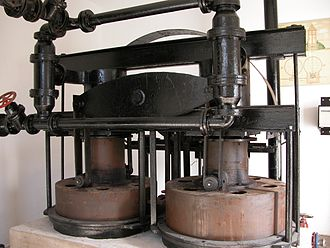
ALTERNATIVE NAME:
Also known as a hydraulic pump
LANGUAGE:
Initially French, then international
TIME: 18th century
LOCATION: France
CATEGORY: Power source
DISCIPLINE: Hydraulics
SHORT DESCRIPTION:
The use of water pressure to provide power.
DESCRIPTION:
Hydraulic pumping is the process of using the kinetic energy of flow to drive running water up to a higher level.
Water naturally flows downhill and is collected in a barrel below the level of the source. From there it goes into a pipe and continues to flow naturally downhill. If the water is contained within the pipe by a one-way valve stopping flow at the end furthest from the barrel, it becomes incompressible (according to physics, the water is solid).
The force of this ‘solid’ length of water can be compared to a battering ram. The force of the ‘ram’ pushes against the valve and opens it to let a small amount of water through into the pump which redirects it to a pressure tank from where it ends up in the area of use. The water has thus been ‘driven’ by the ‘ram’ of ‘solid’ water.
In the second half of the eighteenth century, Joseph <invented by> Montgolfier* developed the hydraulic ram with the help of <developed by> Argand * and their apparatus was widely adopted. In 1807 Joseph Niepce and his elder brother Claude invented “a sort of hydraulic ram” and entered it in a competition held to find replacement apparatus for the supply of water to Versailles from the river Seine. Lazare Carnot was so impressed he wrote to congratulate them on their invention. Montgolfier’s friend Matthew Boulton took out a British patent on his behalf in 1797.
In the nineteenth century, engineers such as <used by> Fairbairn* and <used by> Westinghouse* made great strides in harnessing hydraulic power. Hydraulic rams were used in the construction of <used by> Robert Stephenson’s* revolutionary tubular suspension bridge over the Menai Straits in the 1840’s, and also in the building of the Hudson river tunnel between New York and Jersey City at the end of the nineteenth century (1874-1908).
By the end of the twentieth century, interest in hydraulic rams has revived, due to the needs of sustainable technology in developing countries, and energy conservation in developed ones.
ONELINER: Hydraulic ram, invented by Montgolfier
BIBLIOGRAPHY:
Morrough P O’Brien and Gosline, James E, The Hydraulic Ram, University of California Publications in Engineering, Vol. 3, No. 1, pp. 1-58, University of California Press, Berkeley, California, 1933