Niepce
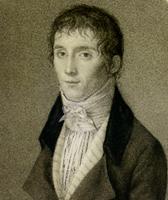
Niepce, Joseph Nicephore
ACHIEVEMENT(S): First photograph
DATE AND PLACE OF BIRTH: March 7, 1765, Chalon-sur-Saone, France
DATE/PLACE OF DEATH/AGE AT DEATH: July 5, 1833, St. Loup de Varenne, France. Aged 68
DISCIPLINE: Photographic inventor
FIELD: Photography
LANGUAGE: French
EDUCATION: Unknown
MAJOR WORK: Heliograph
LIFE AND TIMES:
In 1789, Niepce accepted a job as professor at the Oratorian College in Angers, France. In 1801, he returned to the family estate in Chalon-sur-Saone that his father, a King's Councillor, had abandoned during the French Revolution. His brother, Claude, soon joined him and the two began to collaborate on various research projects.
One of the first inventions Niepce and his brother patented was a combustion engine for boats. Called the "pyreolophore", it used carbon and resin for fuel, and although favorably reported to the Academie des Sciences, was never widely used, being considered impractical. (Claude even traveled to England to promote the invention.) A variety of research projects followed, including an attempt to build a hydraulic ram to extract sugar from beets, and an effort to find plant fibres suitable for textiles.
In 1813, Niepce took up lithography, a fashionable printing method. Soon after, he took up the study of photography. His first photographic image, a view from his workroom, was recorded on paper coated with silver chloride and set with nitric acid, but he was unable to completely fix the image. He next developed the photographic apparatus: chambers, shutters etc.
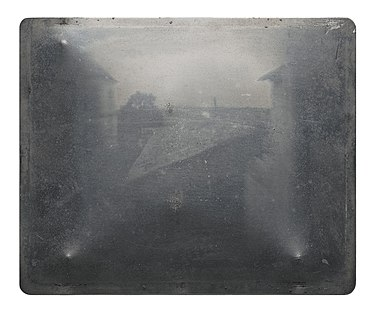
In 1817, hoping to improve his photographic reproduction, he used a glass plate coated with bitumen of Judea. By 1821, he had found a way to produce images on glass and metal, particularly tin. In 1822, he made the first fixed positive image using bitumen of Judea on a pewter plate, naming this a "point de vue". Its exposure time was eight hours.
Niépce called his process heliography, which literally means "sun drawing".[12] In 1822, he used it to create what is believed to have been the world's first permanent photographic image,[13] a contact-exposed copy of an engraving of Pope Pius VII, but it was later destroyed when Niépce attempted to make prints from it.[13] The earliest surviving photographic artifacts by Niépce, made in 1825,[3] are copies of a 17th-century engraving of a man with a horse and of what may be an etching or engraving of a woman with a spinning wheel.
They are simply sheets of plain paper printed with ink in a printing press, like ordinary etchings, engravings, or lithographs, but the plates used to print them were created photographically by Niépce's process rather than by laborious and inexact hand-engraving or drawing on lithographic stones. They are, in essence, the oldest photocopies. One example of the print of the man with a horse and two examples of the print of the woman with the spinning wheel are known to have survived.
French painter Daguerre*, who was to create the Daguerreotype photography method, wrote to Niepce in January, 1826, hoping to establish a working relationship. Nipce had not heard of Daguerre and, although he replied, was cool. After a second letter more than a year later, Niepce sent him a "heliograph" (as he called his early photographs). On a trip to England, Niepce passed through Paris and visited Daguerre.
In London, Niepce showed his invention to the Royal Society, but failed to excite any interest because of his secretiveness about the technique. Daguerre continued to press Niepce for a partnership and in late 1829 Niepce, old and in need of money, agreed. Little is known of their cooperation, except that Daguerre suggested to Niepce that he try silver iodide in the development process. Niepce died four years after their agreement.
ASSESSMENT: Discovered the first technique for the creation of a photographic image
EXTRA CONNECTIONS: Used basic concept of camera obscura*.
His invention was promoted and supported by Arago*
In 1818 Niépce became interested in the ancestor of the bicycle, a Laufmaschine invented by Karl von Drais in 1817. He built himself a model and called it the vélocipède (fast foot) and caused quite a sensation on the local country roads. Niépce improved his machine with an adjustable saddle and it is now exhibited at the Niépce Museum. In a letter to his brother Nicéphore contemplated motorizing his machine.[20]
ONELINER: Joseph Niepce, inventor of photography
BIBLIOGRAPHY:
DSB
PARENTS: Unknown
SIBLINGS: Claude
SPOUSE: Unknown
CHILDREN: Isidore.